📦 Request Quote
📞 Connect with us
Learn how engineering excellence influences drywall screw quality, consistency, manufacturing precision, and procurement confidence.
Explore the manufacturing principles that contribute to consistent drywall screw quality and dependable construction performance.
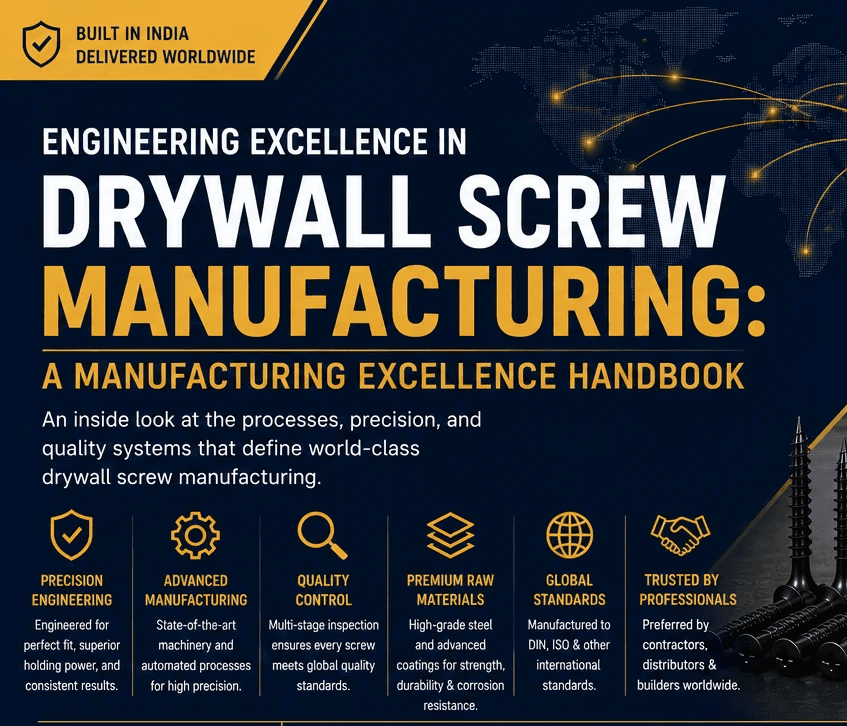
Engineering Excellence in Drywall Screw Manufacturing:
A Manufacturing Excellence Handbook
How manufacturing precision and process consistency determine drywall screw performance — a practical guide for procurement teams, contractors, and distributors.
Quick Answer
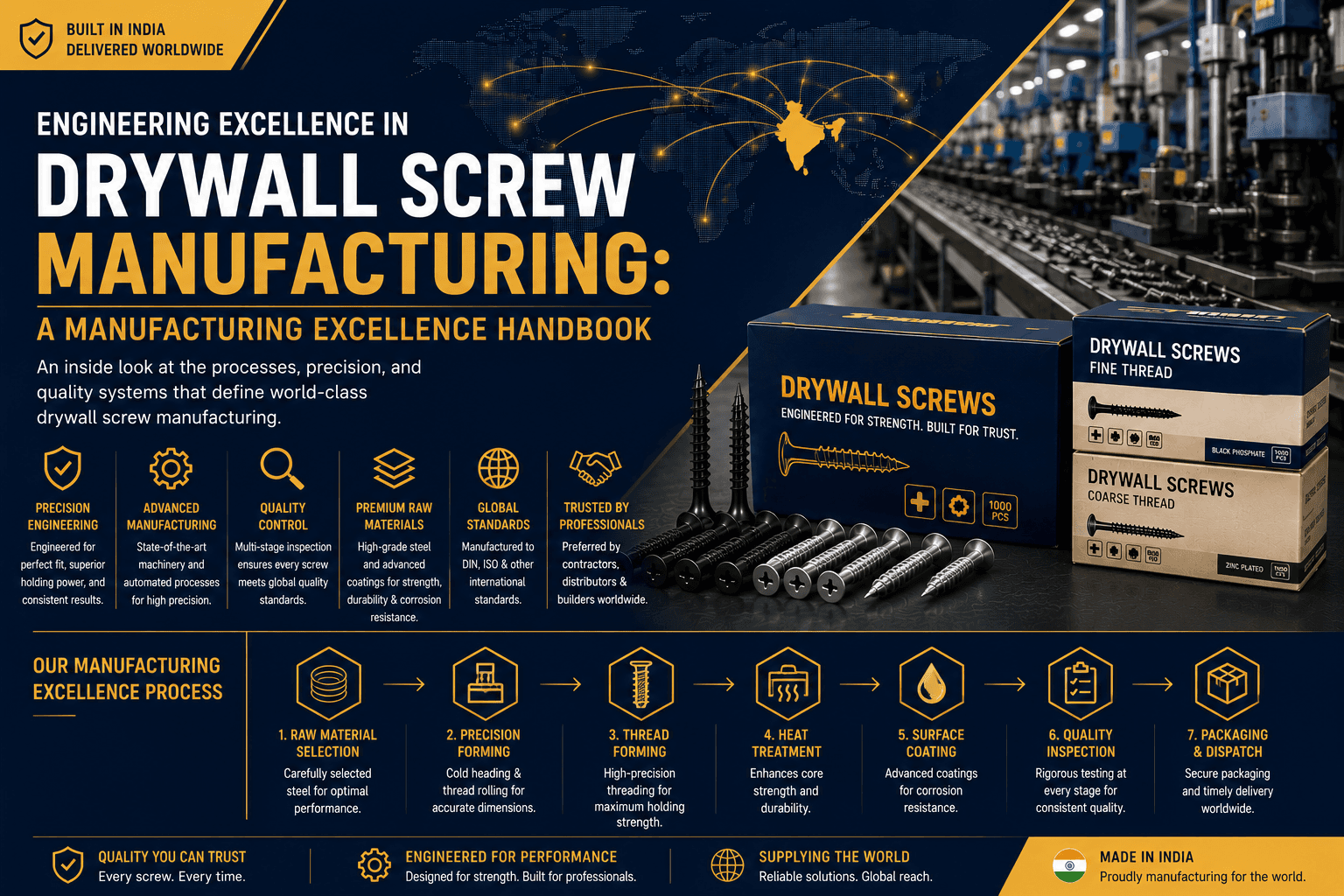
Engineering excellence in drywall screw manufacturing means a controlled, repeatable production process that produces consistent thread geometry, dimensional accuracy, and coating quality across every batch, not just an exceptional-looking sample. Screwbee's drywall screws move through wire drawing, heading, threading, heat treatment, electroplating, and packaging using Taiwan-origin cold heading and precision thread rolling equipment, and pass hardness, torque strength, dimensional accuracy, and surface coating inspection before packaging. That combination of process control and verification is what engineering excellence looks like in practice, not a marketing description.
Why Precision Engineering Improves Drywall Screw Performance
The performance of professional-grade drywall screws begins long before installation. Every stage of drywall screw manufacturing—from raw material selection and cold heading to thread rolling, heat treatment, surface coating, and final inspection—contributes to the reliability of the finished fastener. A trusted drywall screw manufacturer focuses on maintaining tight production tolerances so every screw delivers consistent performance across residential, commercial, and industrial construction projects.
Precision Thread Geometry
Accurate thread pitch and thread depth allow precision-engineered drywall screws to bite cleanly into wood and metal framing while maintaining strong holding power. Uniform thread geometry improves installation speed, reduces stripped threads, and provides consistent fastening performance throughout every production batch.
Consistent Bugle Head Design
A properly engineered bugle head drywall screw seats flush against the drywall surface without damaging the gypsum board. Consistent head dimensions reduce overdriving, simplify finishing work, and help contractors achieve clean, professional installations.
Sharp Point for Faster Installation
A precisely manufactured sharp point enables professional-grade drywall screws to penetrate framing materials quickly with minimal effort. This improves drive speed, reduces installer fatigue, and increases productivity on high-volume construction projects.
Durable Surface Coating
High-quality zinc-plated drywall screws and black phosphate drywall screws provide dependable corrosion resistance while maintaining a uniform finish. Consistent coating application protects the fastener during storage, transportation, and long-term use in interior construction applications.
Reliable Performance Across Every Batch
Construction professionals rely on quality drywall screws that perform consistently from the first screw to the last. Strict quality control, dimensional inspection, torque testing, and manufacturing verification help ensure every batch meets the same high standards. Businesses looking for India's best drywall screw company, a premium drywall screw manufacturer, or a global supplier of drywall screws often prioritize manufacturing consistency because it reduces installation issues, minimizes rework, and delivers long-term value across every project.
Why Small Tolerances Add Up at Scale
A single screw that's a fraction of a millimeter off tolerance is rarely noticeable on its own. The problem shows up at volume. A bulk order of drywall screws can run into the tens of thousands of pieces, and even a small, consistent deviation in thread depth or head diameter, multiplied across that quantity, is what separates a batch that installs cleanly from one that causes intermittent problems across a job site.
This is why dimensional accuracy testing happens at the inspection stage rather than being assumed from the equipment specification alone. Verifying a sample from the batch, not just the design tolerance on paper, is what actually confirms the process held up across the full production run.
How Engineering Excellence Supports Construction Projects
Manufacturing discipline translates differently depending on who is relying on it:
Contractors get screws that drive and seat predictably, reducing time lost to stripped heads or re-driven fasteners on site.
Construction companies get a fastener specification they can standardize across multiple projects without re-testing every shipment.
Distributors get a product they can stock and resell with confidence that each batch matches the last.
Importers get documentation and standards references that support customs clearance and downstream quality assurance.
Procurement teams get a manufacturing process they can evaluate against objective criteria, rather than relying on a supplier's own description of quality.
The common thread across all five is verification. Each group benefits less from a general quality claim and more from being able to check, in some concrete way, that the process behind the product is actually controlled.
Engineering Excellence vs Standard Manufacturing
The differences between engineered and standard manufacturing approaches usually show up in consistency and verification, not in the basic materials used:
Factor | Standard Manufacturing | Engineering Excellence |
Manufacturing Consistency | Output can vary between production runs | Controlled process from wire drawing through packaging, run to run |
Quality Control Approach | Spot checks or none at all | Structured inspection: hardness, torque strength, dimensional accuracy, coating |
Product Uniformity | Visible variation in finish or seating | Consistent thread, point, and head geometry across the batch |
Supply Reliability | Depends on the run; harder to predict | Repeatable process supports predictable bulk order fulfillment |
Business Confidence | Buyers must re-verify quality on each order | Documented process and standards reduce the need for repeat verification |
Manufacturing Evaluation Framework
Buyers assessing manufacturing quality before a bulk order can work through a structured scorecard rather than relying on general reassurances:
Evaluation Area | What to Check | Why It Matters |
Process Documentation | Whether the manufacturer can describe each production stage, from raw material to packaging | Shows the process is controlled and repeatable, not informal |
Equipment Used | Type of heading and thread rolling equipment in use | Precision equipment supports tighter, more consistent tolerances |
Standards Referenced | Whether specifications like DIN 18182-2, ASTM C1002, or ISO 14566 are cited | Gives buyers a verifiable benchmark instead of a general quality claim |
Inspection Stages | What testing happens before packaging (hardness, torque, dimensional, coating) | Confirms defects are caught before shipment, not after installation |
Finish Options | Available coatings and their intended environment (e.g. zinc plated, black phosphate) | Ensures the product fits the project's corrosion and finish requirements |
Sample Consistency | Whether a requested sample matches what arrives in the bulk order | The most direct way to confirm the manufacturing process holds up at scale |
None of these evaluation points require specialized engineering knowledge. They're the same kind of questions a procurement team would ask about any manufactured component before committing to a bulk purchase.
Common Misconceptions
"Engineering excellence only means advanced machines."
Equipment matters, but it's only one part of the picture. A precision machine run without consistent process control and inspection can still produce variable output. Engineering excellence is the combination of equipment, process, and verification, not any one of them alone.
"Every manufacturer follows the same production standards."
Production sequences, inspection stages, and standards referenced vary meaningfully between manufacturers. Two screws that look similar in a listing photo can come from very different levels of process control.
"Price alone indicates manufacturing quality."
Price reflects many factors, including scale, materials, and margin, not manufacturing discipline specifically. A higher price doesn't guarantee tighter tolerances, and a lower price doesn't necessarily mean weaker engineering. Verification, not price, is what actually confirms quality.
Buyer's Evaluation Checklist
Before placing a bulk order, buyers can confirm the following about a manufacturer's process:
Production sequence is documented from raw material to finished, packaged product
Equipment used for heading and thread rolling is specified
Quality inspection includes hardness, torque strength, dimensional accuracy, and coating checks
Finish options (zinc plated, black phosphate) match the project's environment
A sample has been tested and matches the bulk order specification
Packaging protects product condition through shipping and storage
Frequently Asked Questions
What does engineering excellence mean in drywall screw manufacturing?
It refers to a controlled, repeatable production process, from raw material through packaging, that consistently produces screws meeting defined dimensional, mechanical, and coating specifications, rather than quality that varies from batch to batch.
Why is manufacturing consistency important for buyers?
Consistency means a buyer can rely on a bulk shipment performing the same way as the sample they tested, which reduces the risk of installation issues, rework, and unpredictable supply quality on repeat orders.
How can buyers evaluate manufacturing quality before ordering?
Buyers can request documentation of the production process, ask which standards the manufacturer references, confirm what inspection testing is performed before packaging, and test a sample against the bulk specification before committing to volume.
Why do precision processes like thread rolling matter?
Precision thread rolling produces more consistent thread geometry than less controlled methods, which directly affects how cleanly a screw drives and how securely it holds once seated.
Does surface coating affect long-term performance, not just appearance?
Yes. Coatings such as zinc plating and black phosphate are applied for corrosion resistance, which affects how the fastener holds up over the life of the installation, particularly in humid or less controlled environments.
Final Thoughts
Engineering excellence in drywall screw manufacturing isn't a slogan, it's a description of process discipline: a defined production sequence, precision equipment, referenced standards, and inspection stages that catch problems before a shipment leaves the factory. For buyers, the practical takeaway is to evaluate a manufacturer the same way they would evaluate any engineered product, by asking what the process actually involves and how it's verified, rather than taking consistency as a given.
Talk to Our Team
Screwbee manufactures drywall screws in zinc-plated and black phosphate finishes, with fine and coarse thread options built for metal and wood framing. If you're evaluating fastener specifications for a construction project, bulk order, or distribution requirement, we're glad to walk through the technical details with you directly.
Discuss Your Export Requirements
If you are evaluating suppliers for drywall screws, our team can walk you through product specifications, sample requests, bulk order options, and distribution opportunities.