📦 Request Quote
📞 Connect with us
Discover how perfectly engineered drywall screws improve installation quality, holding performance and durability. Learn what builders and contractors should look for.
Discover how engineered drywall screws improve fastening performance, installation efficiency, and durability for builders, contractors, and procurement teams.
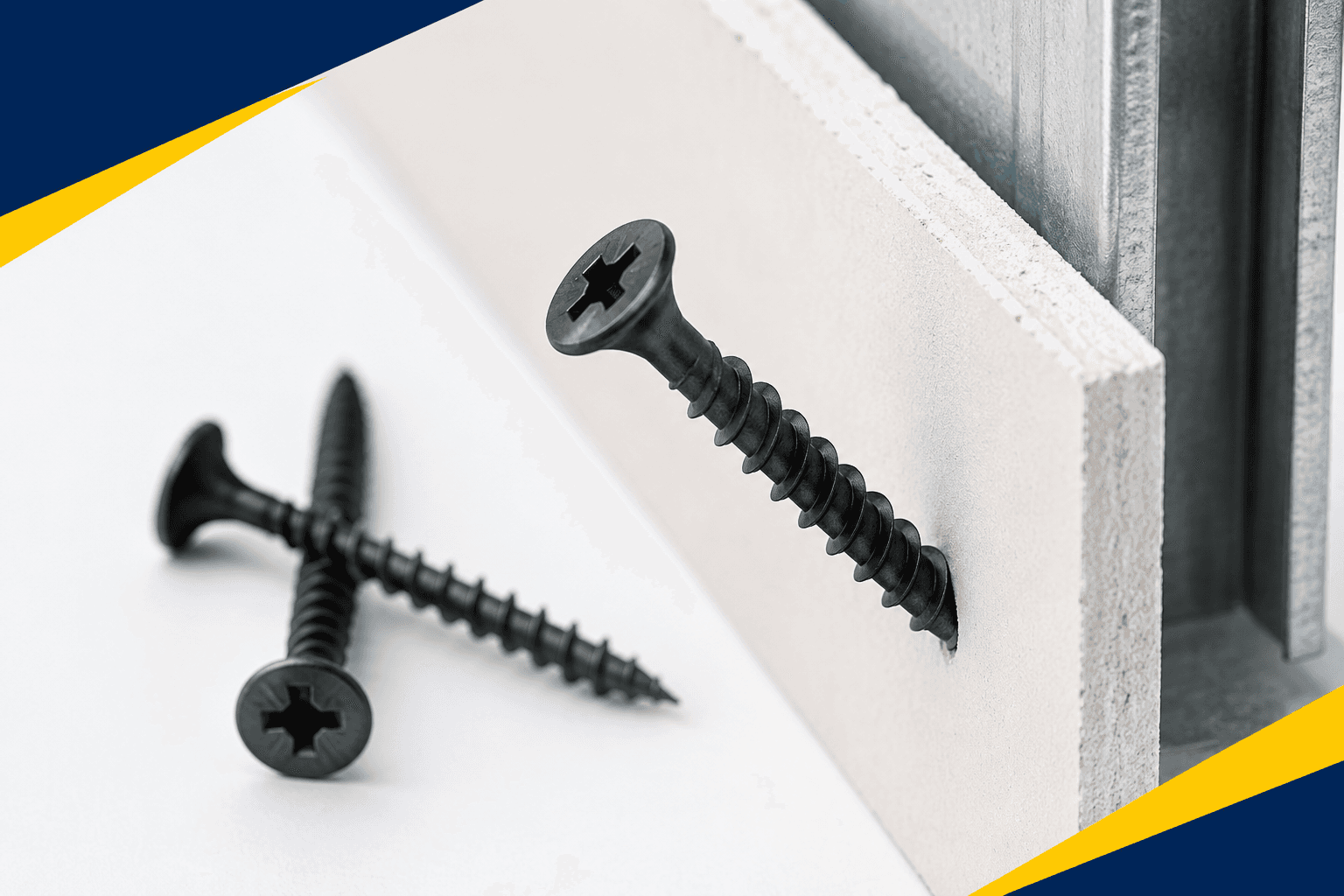
Perfectly Engineered Drywall Screws: Why They Matter for Modern Construction
Every successful drywall installation depends on more than quality panels and skilled workmanship. The fastening system plays a critical role in structural performance and installation quality. When fasteners underperform, the resulting issues such as popped screw heads, surface ridging along seams, or screws gradually working loose under load often appear only after the project has been completed.
Engineered drywall screws address these challenges through precision thread geometry, consistent manufacturing tolerances, and corrosion-resistant coatings designed for predictable, long-term performance. Choosing the right fastening solution, rather than treating screws as a commodity item, helps builders and contractors improve installation efficiency while protecting long-term project quality.
Unlike generic fasteners that can vary from batch to batch, engineered bugle head drywall screws are designed to deliver predictable installation performance across large construction projects.
Key Takeaways
Proper fastening contributes directly to drywall system stability.
Engineered drywall screws provide more reliable and predictable holding strength than generic alternatives.
Quality fasteners improve installation efficiency and reduce rework.
Selecting the correct screw supports the long-term durability of drywall wall and ceiling systems.
Quick Answer: What Are Perfectly Engineered Drywall Screws?
Engineered drywall screws are purpose-designed fasteners developed specifically for securing gypsum or drywall boards to compatible wood or metal framing.
Their performance depends on several factors, including:
Thread geometry
Screw length
Point design
Head design
Material quality
Manufacturing consistency
Surface coating
A well-designed drywall screw should provide reliable engagement with the framing while allowing the head to seat correctly without unnecessarily damaging the drywall facing.
For large construction and fit-out projects, consistency is particularly important because hundreds or thousands of screws may be installed across the same project.
Why Fastener Quality Matters
Drywall screws are a small component carrying a disproportionate amount of structural responsibility. Although inexpensive compared with drywall panels or framing members, screw performance directly influences installation quality, finishing consistency, and long-term durability. Within a finished wall or ceiling assembly, they:
Secure drywall panels to framing systems, whether wood studs or metal track
Support the structural stability of the panel-to-frame connection
Maintain flat, consistent surface alignment needed for finishing and painting
Reduce panel movement, which in turn limits squeaking, cracking, and screw pop over time
Field experience across construction projects consistently shows that poorly manufactured fasteners may not deliver consistent performance which is exactly why fastener quality deserves the same scrutiny as panel quality or framing material during procurement, rather than being treated as an afterthought. Our companion resource looks in more depth at how manufacturing precision at the production stage helps prevent these downstream issues.
Characteristics of Perfectly Engineered Drywall Screws
Four design pillars define a fastener built for consistent, dependable performance on site: thread design, manufacturing consistency, surface protection, and material quality.
Precision Thread Design
Thread geometry has a significant influence on how a drywall screw performs once driven into the substrate. A well-engineered thread profile is designed to provide smoother penetration, secure engagement with wood or metal framing, and reliable holding strength. Proper thread geometry also helps reduce the likelihood of stripping during installation and supports consistent seating without damaging the drywall paper surface.
Consistent Manufacturing Standards
Consistent manufacturing helps maintain uniform thread pitch, screw length, head dimensions, and point formation across production batches. This consistency supports predictable installation performance, allowing installers to work with fasteners that perform more uniformly throughout a project rather than encountering unnecessary variation between screws.
Surface Protection and Coating
Protective surface coatings help improve resistance to corrosion in environments where moisture exposure may occur during or after installation. The suitability of a coating depends on the intended application, making it important to evaluate coating type together with thread design, material quality, and project conditions rather than considering it as an isolated specification.
Material Quality
Material quality influences a drywall screw's strength, resistance to breakage during installation, and long-term fastening reliability. Using consistent base materials helps support dependable mechanical performance, while procurement teams should verify material specifications or supporting documentation when evaluating suppliers.
Benefits for Builders and Contractors
The practical impact of engineered bugle head drywall screws extends well beyond the moment of installation.
Improved Installation Efficiency — Engineered designs support smoother installation workflows, reducing time spent re-driving or replacing screws that strip or seat incorrectly.
Reliable Performance — Consistent thread geometry and manufacturing tolerances help produce repeatable fastening performance across different installers, projects, and production batches.
Professional Finish — Proper fastening helps maintain panel alignment and surface appearance, which affects how cleanly the finishing and painting stages come together.
Long-Term Confidence — Reliable fastening solutions support durability expectations throughout the project lifecycle, reducing the likelihood of callbacks related to fastener failure.
As a general principle borne out across engineered fastening practice, reliable fastening solutions support durability expectations throughout the project lifecycle — a foundation that nearly every other installation decision is ultimately built on.
Standard Screw vs. Perfectly Engineered Drywall Screw
The differences between a generic screw and an engineered drywall screw are easiest to evaluate side by side.
Criteria | Standard Screw | Engineered Drywall Screw |
Thread Geometry | Generic thread profile | Optimized thread geometry for stronger penetration and holding power |
Manufacturing Consistency | Variable production quality | Precision manufacturing for consistent product uniformity |
Surface Protection | Minimal or no coating | Protective coating engineered for corrosion resistance |
Material Quality | Inconsistent material grade | High-quality materials selected for durability |
Installation Behavior | May not deliver consistent performance | Supports smoother, more predictable installation workflows |
Long-Term Reliability | Uncertain durability expectations | Supports long-term durability and project confidence |
Common Applications
Engineered drywall screws are used across a wide range of construction environments, including:
Residential Construction — securing drywall panels throughout new-build and renovation housing projects.
Commercial Interiors — fastening drywall in office fit-outs, retail interiors, and similar commercial spaces.
Ceiling Installations — providing reliable hold for suspended and direct-fixed ceiling systems.
Partition Wall Systems — fastening drywall to metal track in non-load-bearing partition walls.
Interior Fit-Out Projects — supporting fast-paced fit-out schedules where consistent fastener performance reduces rework.
Gypsum board partition systems — fastening gypsum board panels to light-gauge steel or timber framing used in commercial and residential partition walls.
Choosing the Right Drywall Screw: A Buying Guide
When selecting drywall screws for a specific project or for stock, the following six criteria are worth evaluating before placing an order:
Application requirements — confirm whether the screw will be used in wood framing, metal framing, or a mix of both.
Screw length — match screw length to panel thickness and framing depth.
Thread type — verify the thread profile suits the substrate (coarse thread for wood, fine thread for metal).
Material quality — request material grade information rather than assuming consistency.
Surface coating — confirm the coating type is appropriate for the moisture and corrosion conditions of the application.
Manufacturer reliability — favor suppliers who can demonstrate consistent production standards across repeated orders.
Before Purchasing: Quick Checklist
✔ Correct screw size confirmed
✔ Compatible with drywall panel thickness
✔ Suitable coating selected
✔ Quality standards verified
✔ Trusted manufacturer identified
Frequently Asked Questions
What are perfectly engineered drywall screws?
Engineered drywall screws are fasteners designed with optimized thread geometry, consistent manufacturing tolerances, and protective coatings, built specifically to secure drywall panels to wood or metal framing with predictable, long-term performance.
How are engineered drywall screws different from standard screws?
The main differences lie in thread design, manufacturing consistency, coating quality, and base material. Engineered screws are produced to tighter tolerances and evaluated for performance, while standard or generic screws can vary significantly in thread profile, coating, and material grade from batch to batch.
What length of drywall screw should I use?
Screw length should be matched to panel thickness and the depth of the framing member it is being driven into. As a general rule, the screw needs enough length to penetrate the framing securely without protruding through the opposite side or compromising structural members.
Do drywall screws need a corrosion-resistant coating?
Coating becomes especially important in humid environments, coastal regions, bathrooms, and any application where moisture exposure is likely during or after construction. For dry interior applications, coating requirements may be less critical, but it remains good practice to confirm coating specifications with the supplier before ordering.
Can the same drywall screw be used for both wood and metal framing?
Not always. Wood framing generally calls for a coarser thread pitch for better grip, while metal framing typically requires a finer thread designed to bite cleanly into thin-gauge steel track without stripping. Checking the thread specification before bulk ordering helps avoid on-site mismatches.
How can I verify a drywall screw manufacturer’s reliability?
Reliability can be assessed by reviewing material certifications, requesting consistent batch samples, checking thread and coating specifications against stated standards, and evaluating the supplier’s track record with other contractors or distributors.
Are engineered drywall screws suitable for gypsum board?
Yes. Engineered drywall screws are specifically designed for fastening gypsum board to wood or metal framing while providing reliable holding strength and a flush bugle-head finish.
Final Thoughts
Perfectly engineered drywall screws are defined by four key characteristics: well-designed thread geometry, consistent manufacturing standards, protective surface coatings, and reliable material quality. Together, these characteristics influence installation efficiency, fastening reliability, surface finish quality, and long-term performance across residential, commercial, ceiling, partition, and interior fit-out applications. Selecting the right drywall screw requires evaluating application requirements, screw length, thread type, material quality, surface coating, and manufacturer reliability before making a purchasing decision.
Conclusion
The performance of a drywall installation depends on many factors, but the quality of its fastening system is one of the most consistently underestimated.
Perfectly engineered drywall screws provide the consistency, durability, and reliability required for modern construction projects, helping reduce the risk of callbacks, rework, and installation issues associated with inconsistent fastener performance.
By selecting engineered fastening solutions and applying the evaluation criteria outlined above, builders, contractors, and procurement teams can improve installation quality, achieve more predictable project outcomes, and support long-term performance from the very first screw driven.
Explore Related Guides
→ Quality Drywall Screws: Complete Buyer’s Guide
Looking for reliable drywall screws for your next project or bulk requirement?