📦 Request Quote
📞 Connect with us
Learn what coarse thread drywall screws are, their applications, benefits, specifications, and how to choose the right screws for wood framing projects.
A practical guide explaining coarse thread drywall screws, their applications, advantages, specifications, and bulk sourcing considerations for professional construction.

Coarse Thread Drywall Screws:
Complete Guide for Strong and Reliable Wood Framing
Why Thread Type Decides the Outcome
Drywall installation depends on one fastening decision more than any other: matching the screw's thread to the framing material it's going into. For wood studs, timber framing, and plywood backing, that decision points to a single category — coarse thread drywall screws.
Coarse thread screws are purpose-built to grip wood fiber deeply and resist pull-out under the stress of normal building movement. For contractors, distributors, and procurement teams sourcing fasteners at scale, understanding what separates a high-performing coarse thread screw from a mediocre one is the difference between a clean installation and a callback.
To understand how engineered drywall screws improve installation consistency across different construction projects, read our guide.
This guide covers what coarse thread drywall screws are, where they perform best, the specifications that define quality, and what to evaluate when sourcing them — whether for a single job site or a bulk supply order.
What Are Coarse Thread Drywall Screws?
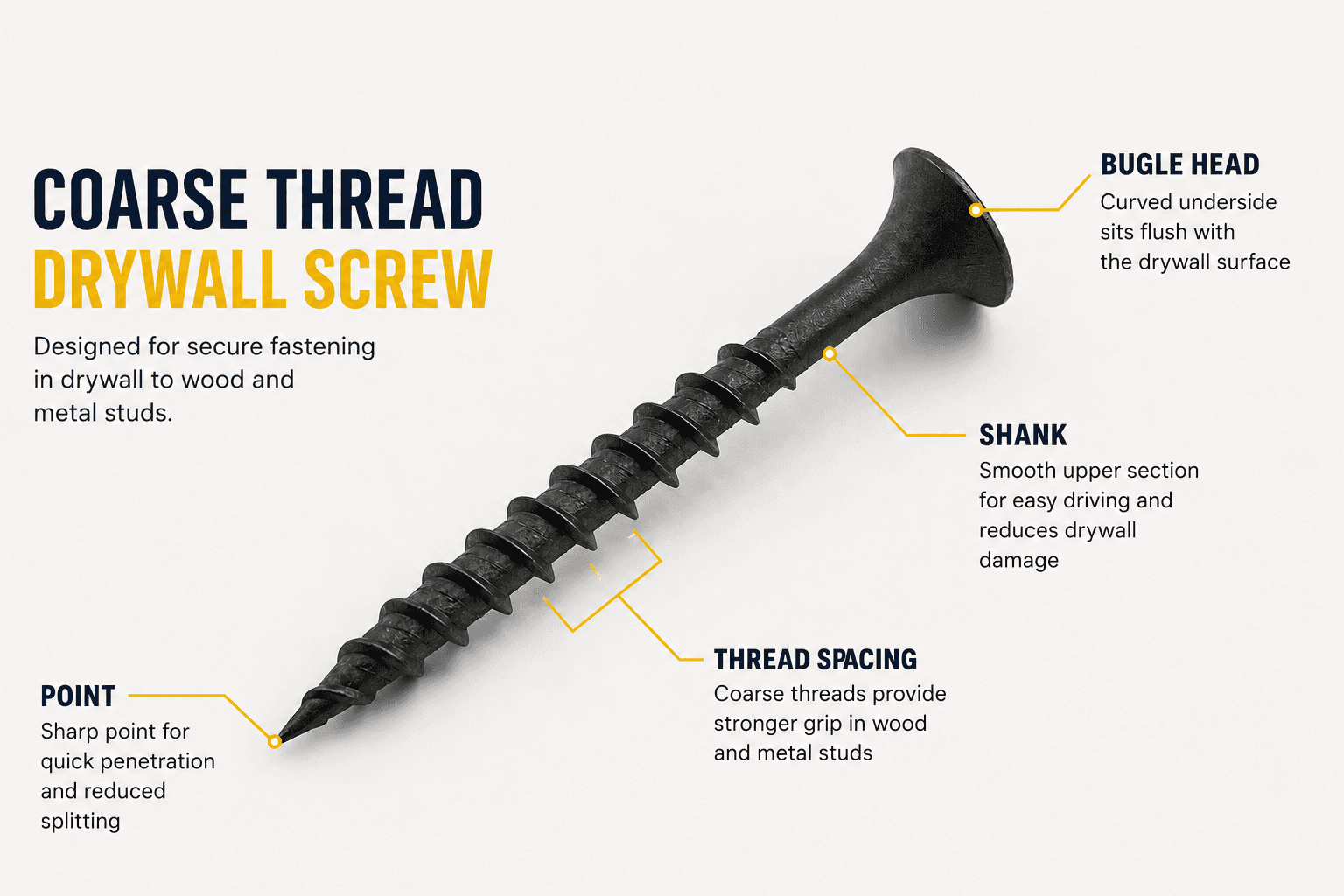
Coarse thread drywall screws are fasteners engineered specifically to attach drywall panels to wooden studs and timber framing. Their defining feature is thread geometry: deep, widely spaced threads that bite into wood fiber far more aggressively than a fine thread design.
Compared to fine thread drywall screws, which are built for metal stud framing, coarse thread screws deliver faster installation and stronger holding power. Read our complete comparison of Fine vs Coarse Thread Drywall Screws.
Key Specifications at a Glance |
Thread design: Deep, widely spaced for maximum wood-fiber engagement |
Point type: Sharp, self-piercing for clean entry without pre-drilling |
Head style: Bugle head for clean countersinking without paper tear |
Material: Hardened carbon steel for torque resistance |
Common finishes: Black phosphate (interior) or zinc-plated (corrosion resistance) |
Typical diameter range: 3.5mm–4.2mm, with lengths from 25mm to 100mm+ |
Why Choose Coarse Thread Drywall Screws
The case for coarse thread screws in wood-frame applications comes down to how the thread interacts with fiber rather than a uniform, predictable substrate like steel. Wood varies in density across grain lines, knots, and moisture content — and coarse threads are designed to compensate for that variability.
Excellent grip in wooden studs— Wider thread spacing means each rotation of the screw engages more wood fiber, producing a mechanical lock that resists loosening.
Fast, efficient installation— The aggressive thread profile reduces the torque needed to drive the screw, which speeds up installation across large wall and ceiling runs.
Strong pull-out resistance— Deep threads anchor more securely against the forces that work screws loose over time — vibration, thermal cycling, and the natural expansion and contraction of wood.
Reduced slippage during driving—A sharp, self-piercing point combined with coarse threading means the screw bites immediately rather than wandering or stripping the entry point.
Consistent performance across softwood species—Coarse threads perform reliably whether the framing is pine, fir, spruce, or engineered lumber — a meaningful advantage on mixed-material job sites.
Where Coarse Thread Screws Are Used
Coarse thread drywall screws are the standard fastener wherever drywall meets wood:
Residential drywall installation
Wood-framed wall partitions
Ceiling installation on wood joists or furring
Timber partition systems
Home renovation and remodeling projects
Interior finishing work
Plywood and OEM panel applications
General wood panel fastening
Any project where the underlying structure is wood rather than metal calls for coarse thread as the default specification.
What Defines a High-Quality Coarse Thread Screw
Not all coarse thread screws perform the same way, even when the thread spec looks identical on paper. The features that separate a reliable product from one prone to stripping or snapping:
Hardened steel construction
Provides the torque resistance needed to drive the screw fully without shearing the head or stripping the drive socket.
Precision-cut threads
Consistent pitch and depth across the full length of the screw ensure predictable holding power batch to batch — inconsistent threading is one of the most common quality failures in low-cost imports.
Sharp, self-piercing point
Allows clean entry into wood without pre-drilling, reducing installation time and minimizing the risk of the screw wandering off-axis.
Bugle head design
Countersinks cleanly into drywall without tearing the paper face, leaving a smooth surface ready for joint compound. See our full breakdown of Bugle Head Screws for more on why this head shape became the industry standard.
Corrosion-appropriate finish
Black phosphate for standard interior use; zinc-plated where the installation environment involves moisture exposure.
High torque resistance
Determines whether the screw can be driven at speed with a power driver without snapping — a critical factor for large-volume installation work.
Coarse Thread vs. Fine Thread: Quick Comparison
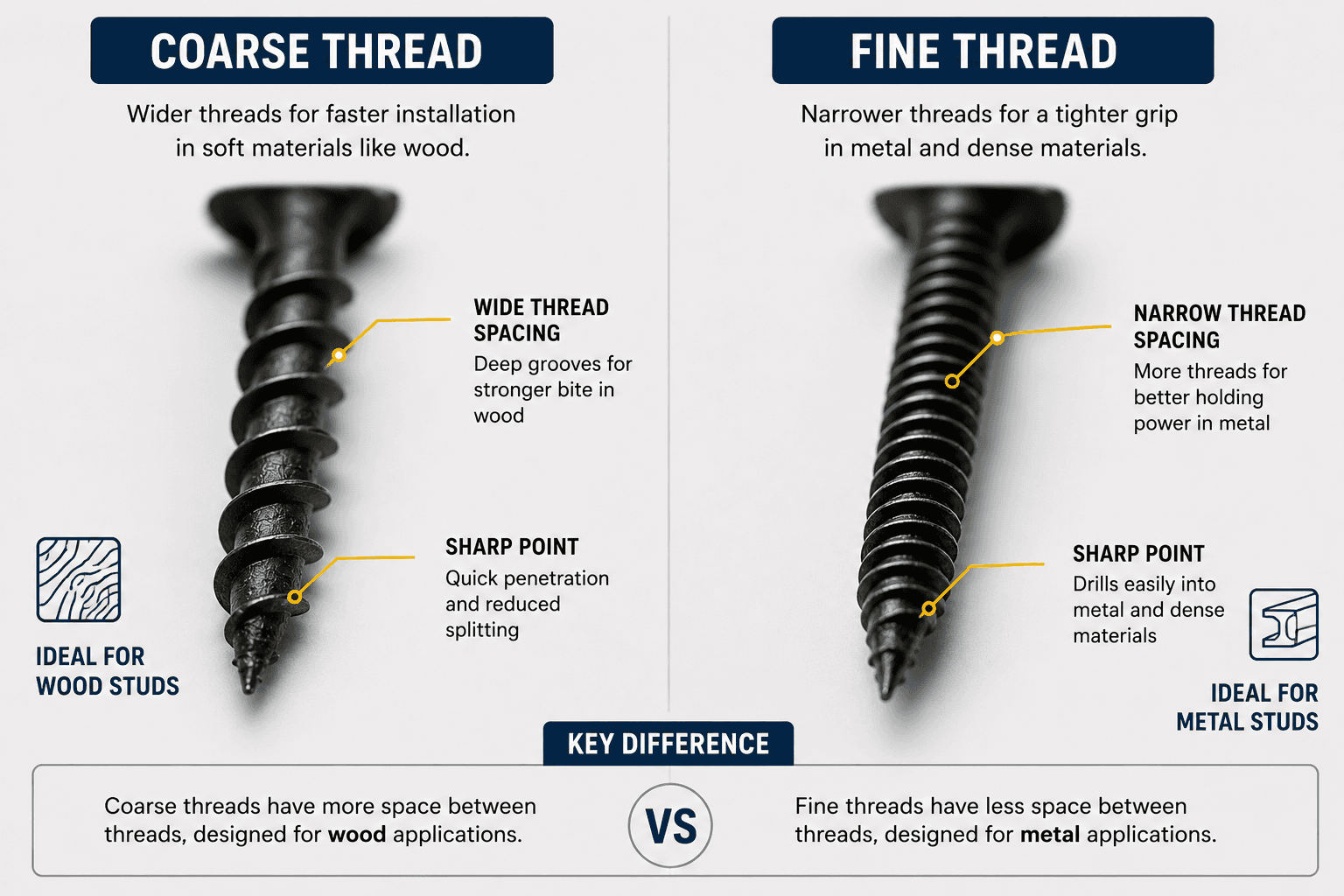
Feature | Coarse Thread | Fine Thread |
Best for | Wooden studs, timber framing | Metal studs, light-gauge steel |
Thread design | Deep, widely spaced threads | Closely spaced threads |
Holding mechanism | Locks into wood fiber | Clean bite into thin metal |
Common use | Residential construction | Commercial steel framing |
Installation speed | Fast in timber | Smooth in metal framing |
Risk if misapplied | Loosens or strips in metal | Weak holding power in wood |
Selecting the correct thread type for the base material is the single most important decision in drywall fastening — and the one most often gotten wrong on mixed-framing job sites. For metal-framed applications specifically, see our companion guide to Fine Thread Drywall Screws.
Sourcing Coarse Thread Screws in Bulk
For contractors, distributors, and hardware suppliers, bulk procurement of drywall screws comes with meaningful advantages over piecemeal purchasing:
Lower cost per unit — Volume pricing reduces per-screw cost significantly compared to retail or small-batch purchasing.
Consistent product quality — Sourcing from a single manufacturer across a project or supply cycle avoids the batch-to-batch variation that comes from mixing suppliers.
Reliable inventory for ongoing work — Bulk stock prevents mid-project shortages, which are a common cause of schedule delays on larger jobs.
Wholesale pricing structures — Most manufacturers offer tiered pricing based on order volume, rewarding distributors and large contractors with better margins.
Faster project execution — Having stock on hand removes procurement lead time as a bottleneck once a project is underway.
Reduced procurement overhead — Fewer, larger orders mean less administrative time spent on repeat purchasing.
Bulk sourcing is particularly relevant for construction contractors managing multiple sites, hardware distributors building retail inventory, and furniture or panel manufacturers with continuous fastening needs.
How to Choose the Right Coarse Thread Screw
Before placing an order — whether for a single job or a bulk supply agreement — evaluate the following:
Screw length
Should provide sufficient penetration into the stud beyond the drywall thickness, typically with at least 5/8" to 3/4" of thread engaged in solid wood.
Wood thickness and density
Denser hardwood framing may call for a slightly longer or more aggressive thread profile than standard softwood studs.
Surface coating.
Black phosphate for dry interior conditions; zinc-plated or other corrosion-resistant finishes for installations exposed to humidity.
Material quality and hardness rating
Confirm the steel grade and heat treatment process — this is what determines resistance to snapping and stripping under torque.
Corrosion resistance requirements
Match the finish to the installation environment rather than defaulting to the cheapest available coating.
Packaging options
Bulk box, loose pallet, or retail-ready packaging depending on whether the buyer is a contractor, distributor, or retailer.
Common Mistakes to Avoid
Most fastening problems on wood-frame drywall jobs trace back to a handful of avoidable errors:
Using coarse thread screws on metal stud framing, where they can strip the hole or fail to seat
Selecting a screw length too short for adequate stud penetration, or too long and risking punch-through
Buying low-quality fasteners that strip drives or snap heads under normal driving torque
Overdriving screws until the head tears through the drywall paper face
Ignoring corrosion protection in moisture-prone installation environments
Mixing fastener sources mid-project, introducing inconsistent thread quality
Each of these is straightforward to avoid with attention to base material, correct length selection, and a quality-focused supplier.
Frequently Asked Questions
What are coarse thread drywall screws used for?
They are used primarily for fastening drywall sheets to wooden studs, timber framing, and plywood backing — any application where the base material is wood rather than metal.
Are coarse thread drywall screws stronger?
In wood, yes. Their wider thread spacing grips wood fiber more effectively than fine thread designs, giving them stronger holding power specifically in timber and softwood framing applications.
Can coarse thread drywall screws be used on metal studs?
No. Coarse threads are not designed to engage thin metal cleanly and can strip the hole or fail to seat properly. Fine thread drywall screws are the correct choice for metal stud and light-gauge steel framing.
Which finish is commonly available?
Black phosphate is the standard finish for indoor drywall installations. Zinc-plated options are available where additional corrosion resistance is needed, such as in higher-humidity environments.
Who buys coarse thread drywall screws in bulk?
Construction contractors, hardware distributors, wholesalers, furniture manufacturers, and building material suppliers are the primary bulk buyers, typically sourcing on volume-tiered pricing for ongoing project or inventory needs.
What should I check before committing to a bulk order?
Verify the manufacturer's quality certifications, request documentation on steel grade and thread tolerances, and confirm lead times and packaging options align with your project or distribution schedule.
📌 Key Takeaways
|
Why Choose Screwbee?
Specifying coarse thread is only half the job — the screws still need to perform consistently once they're on site. Screwbee is built around that consistency:
✅ Why Choose Screwbee
|
Ready to Source Coarse Thread Drywall Screws? Whether it's a single residential job or a recurring bulk order for wood-frame construction, Screwbee supplies coarse thread drywall screws built for consistent grip, fast installation, and fewer callbacks — in stock sizes or volume quantities. |
Conclusion:
Matching the Screw to the Material
Coarse thread drywall screws remain the preferred fastening solution wherever drywall meets wood framing. Their deep thread design, strong pull-out resistance, and fast installation profile make them the standard for residential construction, renovation work, and any project built on timber rather than steel.
For contractors, distributors, and builders sourcing at any volume, the priority is consistency: a manufacturer who delivers the same thread quality, hardness, and finish order after order. That consistency is what turns a correct fastener spec on paper into a reliable installation in the field — fewer callbacks, fewer delays, and a finish that holds up over the life of the building.
Looking to source coarse thread drywall screws for an upcoming wood-frame project or build out bulk inventory? Get in touch to discuss specifications, volumes, and lead times.
Need a Bulk Quote or Technical Assistance?
Contact the Screwbee team today to discuss your project requirements, coating preferences, screw sizes, and bulk order quantities. We're here to help you source the right drywall screws with confidence.
📧 sales@screwbee.in
🌐 www.screwbee.in
Ready to source dependable drywall screws for your next project? Get in touch with our supply team at sales@screwbee.in for bulk pricing and technical guidance.