📦 Request Quote
📞 Connect with us
Understand what makes precision engineered drywall screws different and why manufacturing accuracy matters for construction applications.
Learn why precision engineering improves drywall screw consistency, installation, and product quality.

Precision Engineered Drywall Screws
A Technical Guide to Manufacturing Quality
Understanding what “precision engineered” means for thread accuracy, consistency, and installation performance
Quick Answer
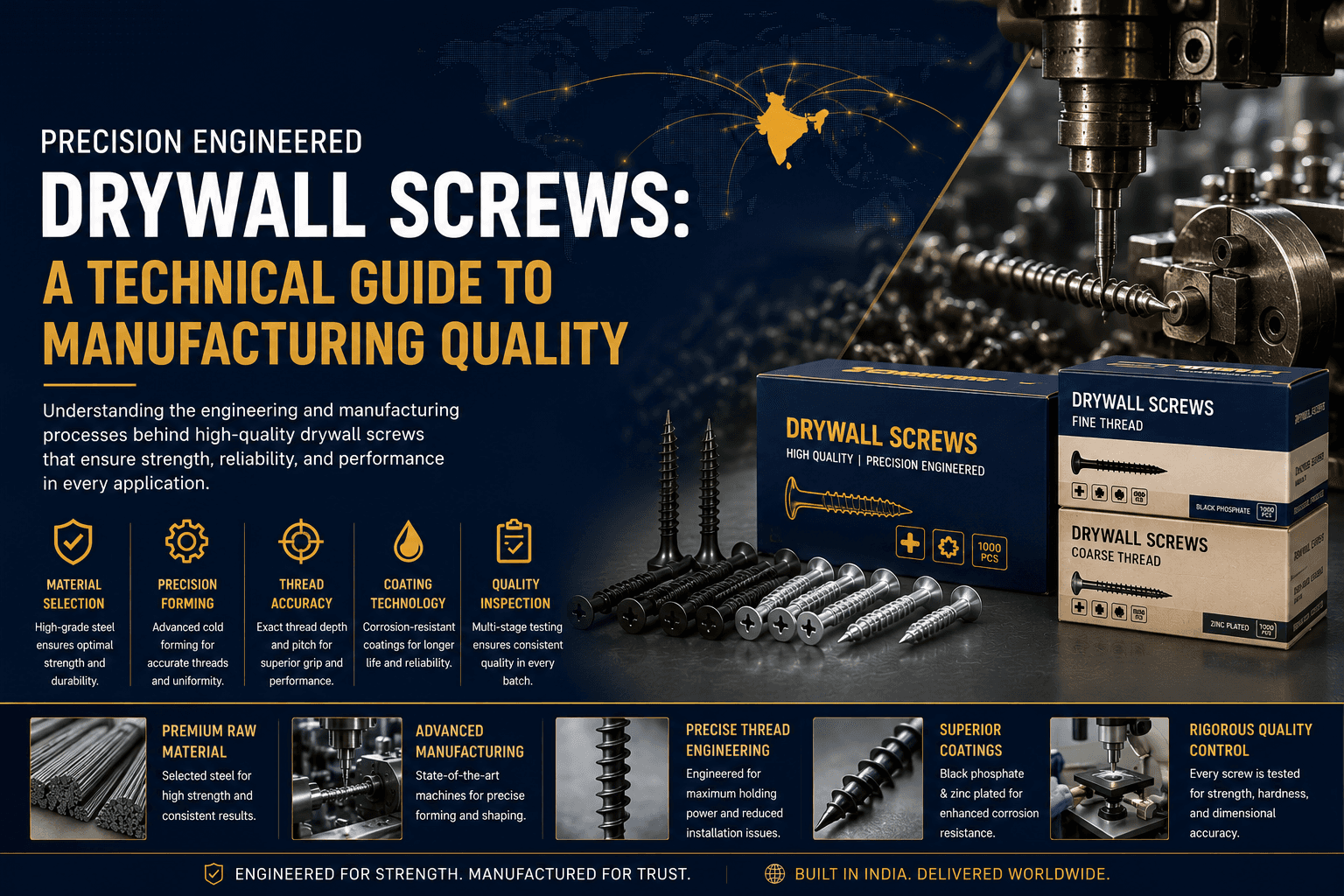
Precision engineered drywall screws are manufactured to tight, repeatable tolerances across thread pitch, point geometry, head shape, and coating thickness. This precision affects how cleanly a screw drives into gypsum board and framing, how consistently a batch performs across a project, and how well the fastener resists stripping or corrosion over time. The key difference from a standard screw isn't a single feature — it's the consistency of every dimension, batch after batch.
Why Precision Matters in Drywall Installation
A drywall screw does a mechanically specific job: it has to penetrate the board without tearing the paper facing, bite into the framing material, and sit flush enough for a clean, paintable finish. Small deviations in manufacturing show up directly in how well that job gets done.
Installation efficiency — A screw with an accurate thread and a sharp, correctly shaped point drives in one pass, without stalling or requiring a second attempt. Inconsistent threading slows installers down and increases the chance of a stripped drive.
Product consistency — On a large project, installers move fast and rely on the screw behaving the same way every time. If thread depth or point sharpness varies across a batch, some screws will underperform even if most are fine — and that inconsistency is hard to catch until it's already in the wall.
Long-term reliability — Precision in manufacturing extends beyond the moment of installation. Consistent coating thickness affects corrosion resistance, and accurate head geometry affects whether the screw sits flush without cracking the board's paper surface — both of which influence how the installation holds up over years, not just on handover day.
Engineering Characteristics of Precision Drywall Screws
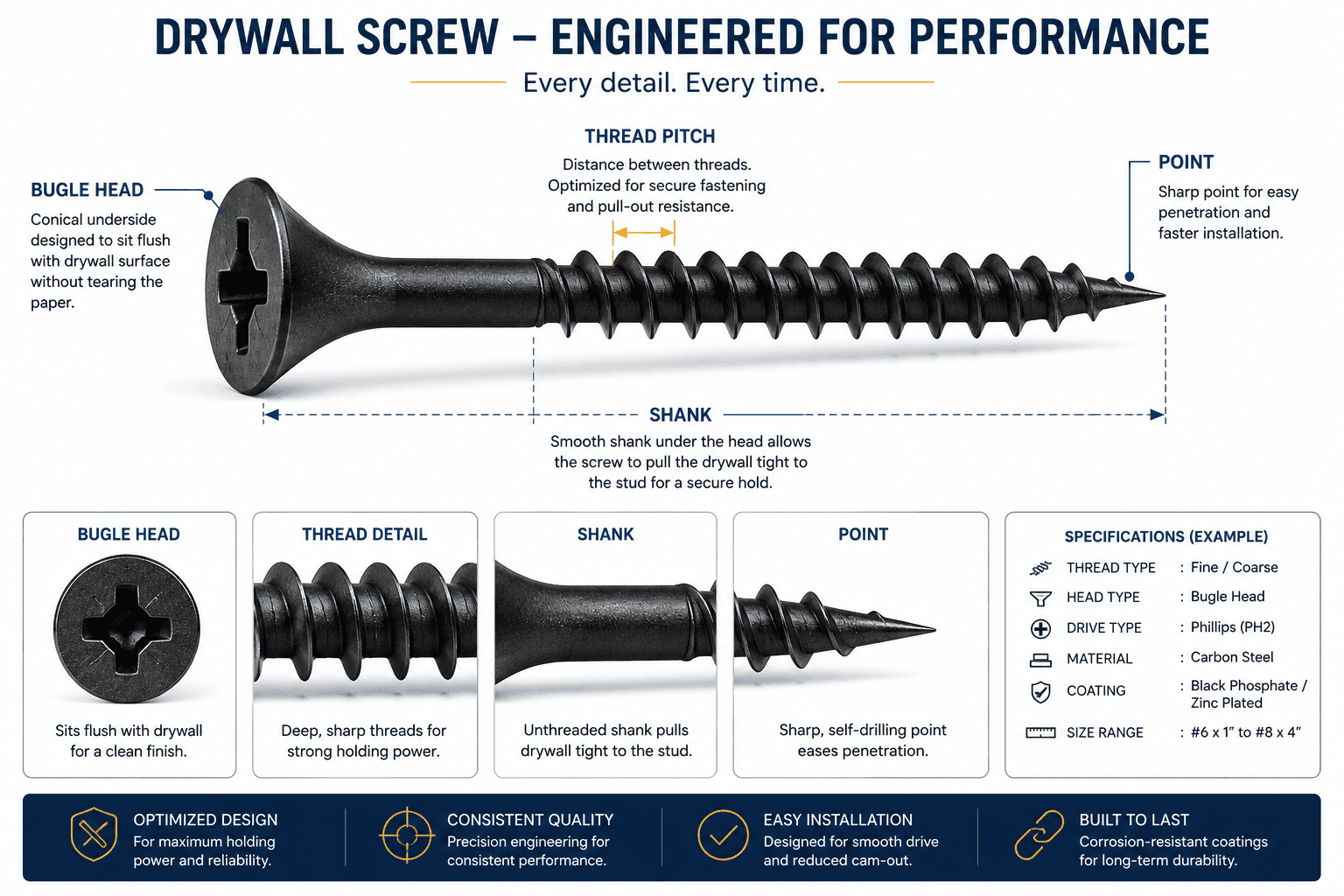
Thread accuracy — Thread pitch and depth need to match the intended application — coarse threads for wood framing, fine threads for metal studs. Precision here means the thread profile is consistent across the full length of the screw and across every unit in a batch, so grip strength doesn't vary from piece to piece.
Point geometry — The sharpness and shape of the point determine how easily a screw penetrates the board and framing material without pre-drilling. A poorly shaped or inconsistently sharpened point increases the force needed to drive the screw and raises the risk of the board cracking around the entry point.
Bugle head consistency — The bugle-shaped head is designed to sink slightly below the drywall surface without tearing the paper facing, leaving a clean, fillable dimple. If head shape varies between screws, some will sit proud of the surface (creating a visible bump) while others may overdrive and tear through the paper.
Surface finish — A consistent surface finish — whether zinc-plated or black phosphate coated — affects both how smoothly the screw drives and how well it resists corrosion. Uneven coating thickness can leave some screws under-protected in humid or exposed conditions.
Manufacturing consistency — This is the umbrella characteristic: precision only matters if it holds across the full batch, not just a sample. A manufacturer's process controls — not just its raw materials — determine whether unit 10,000 performs the same as unit 1.
Dimensional accuracy — Length, shank diameter, and head diameter need to match specification exactly. Even small deviations can affect how a screw interacts with board thickness and framing gauge, particularly on projects where screw spacing and penetration depth are specified precisely.
Precision vs. Standard Drywall Screws
Characteristic | Precision Engineered | Standard |
Thread consistency | Uniform pitch and depth across every unit | Can vary between production runs |
Point geometry | Consistently sharp, correctly shaped | May vary in sharpness and shape |
Head fit | Sits flush without tearing or proud edges | Inconsistent seating depth |
Surface finish | Even coating thickness | Coating thickness can vary |
Batch-to-batch reliability | Repeatable across large orders | More variation across batches |
Best suited for | Large projects, visible finishes, fire-rated or specification-sensitive assemblies | Smaller, less specification-sensitive jobs |
How Manufacturing Precision Improves Installation
Precision translates into practical, on-site advantages rather than just technical specifications on a data sheet:
Fewer stripped drives. Accurate thread geometry reduces the chance of a screw spinning without gripping, which is one of the most common installation frustrations.
Cleaner finishes. Consistent head seating means less rework filling proud screws or patching torn paper facing.
Predictable spacing and load distribution. When every screw performs the same way, installers can rely on standard spacing guidelines without needing to compensate for weak points.
Reduced callbacks. Fewer installation defects at the fastener level mean fewer issues showing up after handover — a benefit that matters more on commercial and multi-unit projects than on a single repair job.
Faster installation on large jobs. Even small reductions in re-driving or adjustment time add up meaningfully across a project using tens of thousands of screws.
Common Misconceptions
“All drywall screws are manufactured the same.”
Thread precision, point geometry, and coating consistency vary meaningfully between manufacturers, even when screws look identical in a product photo or catalog listing. The differences typically only show up during installation or over time, not on a spec sheet.
“Precision only increases cost.”
Precision reduces costs elsewhere — fewer stripped drives, less rework, fewer callbacks. Evaluating cost purely on a per-unit basis misses the labor and rework savings that consistent manufacturing quality provides on larger projects.
“Any screw works for drywall.”
Using a general-purpose screw instead of one engineered specifically for drywall applications can lead to board cracking, poor head seating, or inadequate grip in the framing material. The bugle head, thread profile, and point geometry are specific design choices, not incidental features.
Procurement Checklist
Before purchasing precision engineered drywall screws for a project, evaluate:
✅Thread type matches the framing material — see our fine thread vs. coarse thread guide
✅ A sample batch is available to physically check thread and point consistency
✅Coating type and thickness are appropriate for the installation environment
✅ Head shape and seating depth are confirmed against your board thickness
✅ The manufacturer can explain their process for maintaining consistency across batches
✅Dimensional specifications (length, diameter) are confirmed in writing
✅ Packaging protects the screws from damage or corrosion during transit and storage
Frequently Asked Questions
What makes a drywall screw “precision engineered”?
Consistent thread pitch, point geometry, head shape, and coating thickness across every unit in a batch — not a single standout feature, but reliability across the whole production run.
Does precision affect installation speed?
Yes. Accurate threading and point geometry reduce stripped drives and the need to re-drive screws, which adds up to meaningful time savings across a large project.
Is a precision engineered screw necessary for small jobs?
For a single repair or small residential job, the practical difference may be minor. Precision matters more as project scale, visibility of the finish, or specification requirements increase.
How can I verify precision before placing a bulk order?
Request a sample batch and physically check thread consistency, point sharpness, and coating finish. A manufacturer that welcomes this kind of verification is generally a good sign.
Does thread type affect which precision characteristics matter most?
Yes. Fine thread screws depend heavily on consistent thread engagement with thin metal studs, while coarse thread screws rely more on point geometry and thread depth for grip in wood framing.
Final Thoughts
Precision in drywall screw manufacturing isn't a marketing term — it's a set of measurable characteristics that determine how a screw performs on site and over time. Buyers who take the time to check thread consistency, point geometry, and batch reliability before committing to a bulk order tend to avoid the installation issues and callbacks that come from unevenly manufactured fasteners.
Talk to Our Team
Screwbee manufactures drywall screws in zinc-plated and black phosphate finishes, with fine and coarse thread options built for metal and wood framing. If you're evaluating fastener specifications for a construction project, bulk order, or distribution requirement, we're glad to walk through the technical details with you directly.
Discuss Your Export Requirements
If you are evaluating suppliers for drywall screws, our team can walk you through product specifications, sample requests, bulk order options, and distribution opportunities.