📦 Request Quote
📞 Connect with us
Compare fine and coarse thread drywall screws to choose the right fastener for wood or metal studs. Learn their differences, applications, and installation tips.
Discover the differences between fine and coarse thread drywall screws. Compare thread spacing, applications, holding strength, and choose the right screw for wood or metal framing.fine-vs-coarse-drywall-screws

Fine vs. Coarse Drywall Screws:
How to Choose the Right Thread for Your Project
Drywall installation looks simple on the surface — a board, a frame, and a screw. But the screw you choose has a direct impact on how well that board holds up over time. Get the thread type wrong, and you end up with stripped fasteners, loose panels, or boards that pull away from the frame months after installation. Get it right, and the job goes faster, holds tighter, and needs no rework.
The decision almost always comes down to one question: what is the screw going into — wood or metal? That single factor determines whether you need fine thread or coarse thread drywall screws, and it's the difference this guide is built around.
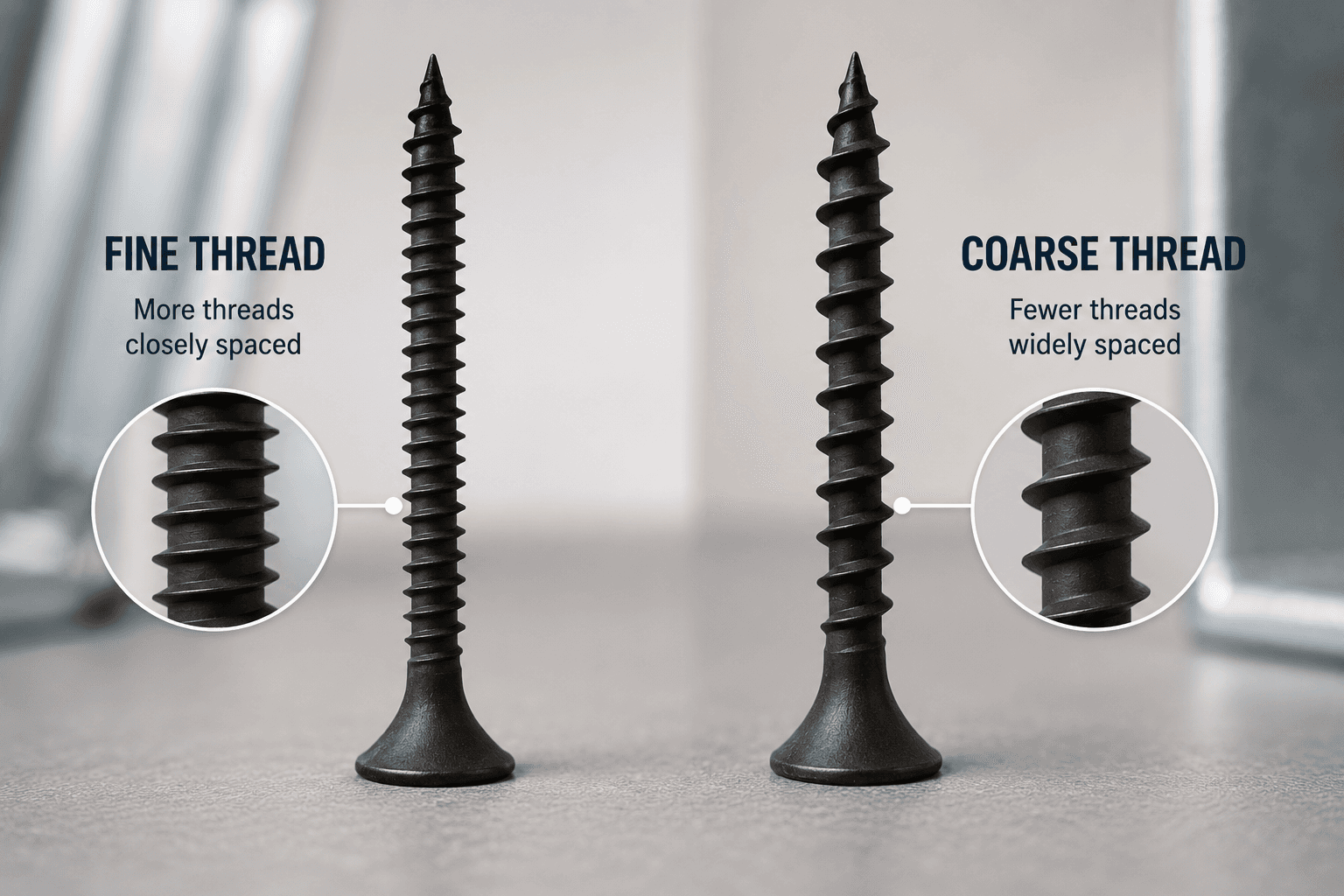
Why Thread Type Matters More Than It Seems
A drywall screw's job is to pull two materials together and hold them there under load, vibration, and time. The thread is what does that work. Thread spacing, depth, and angle all change how a screw interacts with the base material — and wood and metal behave very differently under a fastener.
Wood is fibrous and relatively soft. It needs a screw that can dig in deep and lock into the grain. Metal studs are thin, hard, and unforgiving — they need a screw that bites cleanly without stripping the hole or bending the stud. One thread geometry doesn't serve both jobs well, which is why the fastener industry settled on two distinct designs: fine thread and coarse thread.
Fine Thread Drywall Screws: Built for Metal Framing
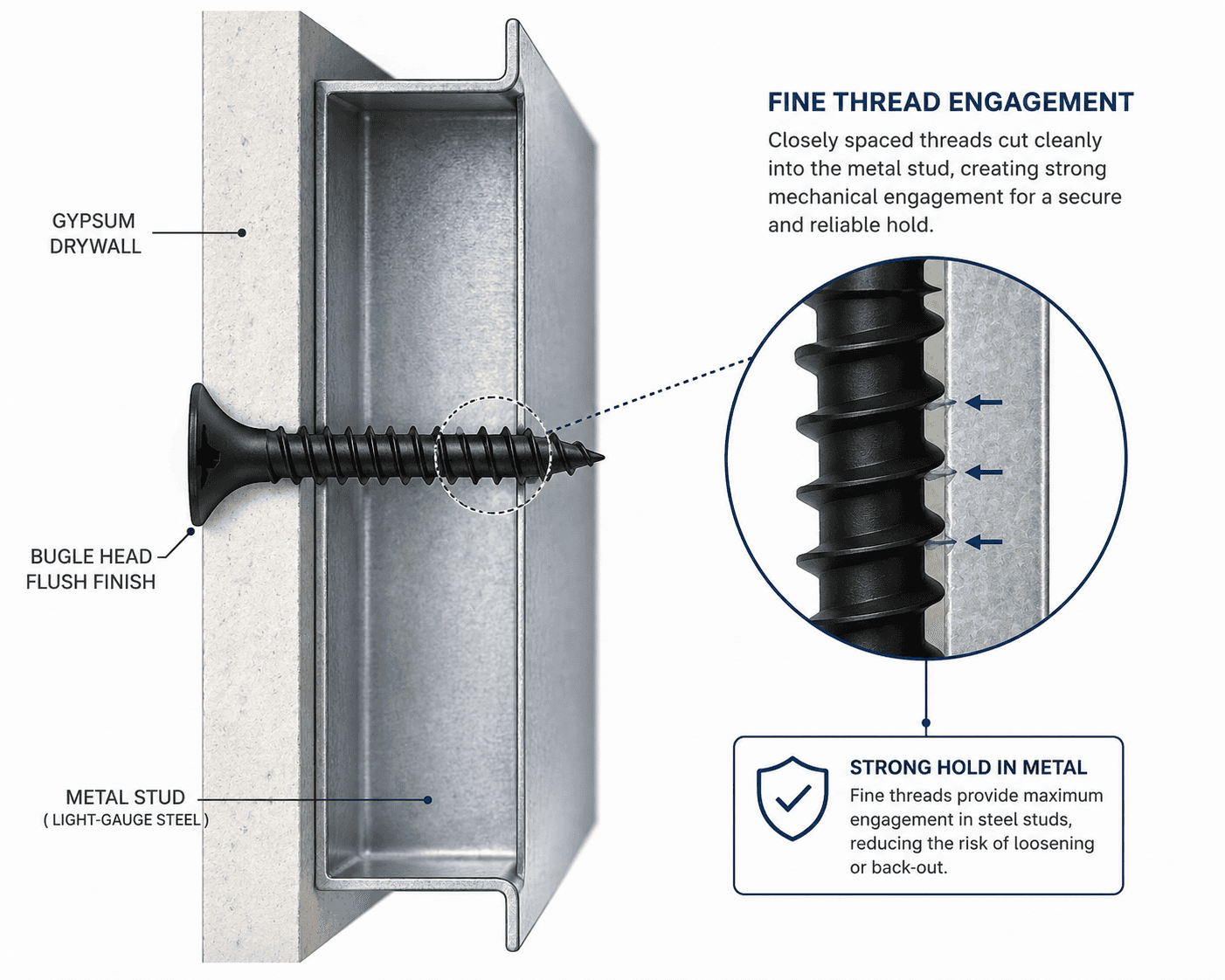
Fine thread screws have threads spaced closely together along the shank. That tighter spacing means more thread contact within a given length of screw, which translates to a steadier, more controlled bite into thin or hard materials. For a deeper look at sizing, finishes, and metal-stud applications, see our complete guide to Fine Thread Drywall Screws.
This makes fine thread screws the standard choice for:
Metal studs and light-gauge steel framing
Commercial partition walls
Suspended and false ceiling systems
Steel-framed interior structures
Because metal studs are thin, an overly aggressive thread can deform the metal or fail to seat properly. Fine threads avoid that — they cut a clean, consistent path through steel without chewing up the stud or weakening the connection point. This is why fine thread screws dominate commercial and light-industrial drywall work, where metal framing is the norm.
Coarse Thread Drywall Screws: Built for Wood Framing
Coarse thread screws have wider gaps between threads and a more aggressive thread profile. That wider spacing lets each thread bite deeper into the wood fiber, which is exactly what's needed for strong, lasting holding power in a softer material. Our dedicated guide to Coarse Thread Drywall Screws covers grain-specific performance and sourcing in more detail.
Coarse thread screws are the standard for:
Wood studs and timber framing
Plywood backing and sheathing
Residential drywall installation
General wood-frame interior construction
Wood doesn't offer the same uniform resistance that metal does — its density varies by grain, knots, and moisture content. A coarse thread compensates for that variability by locking into more fiber per turn, which is what keeps panels from loosening as wood naturally expands and contracts with humidity and temperature changes.
Fine vs. Coarse: Side-by-Side Comparison
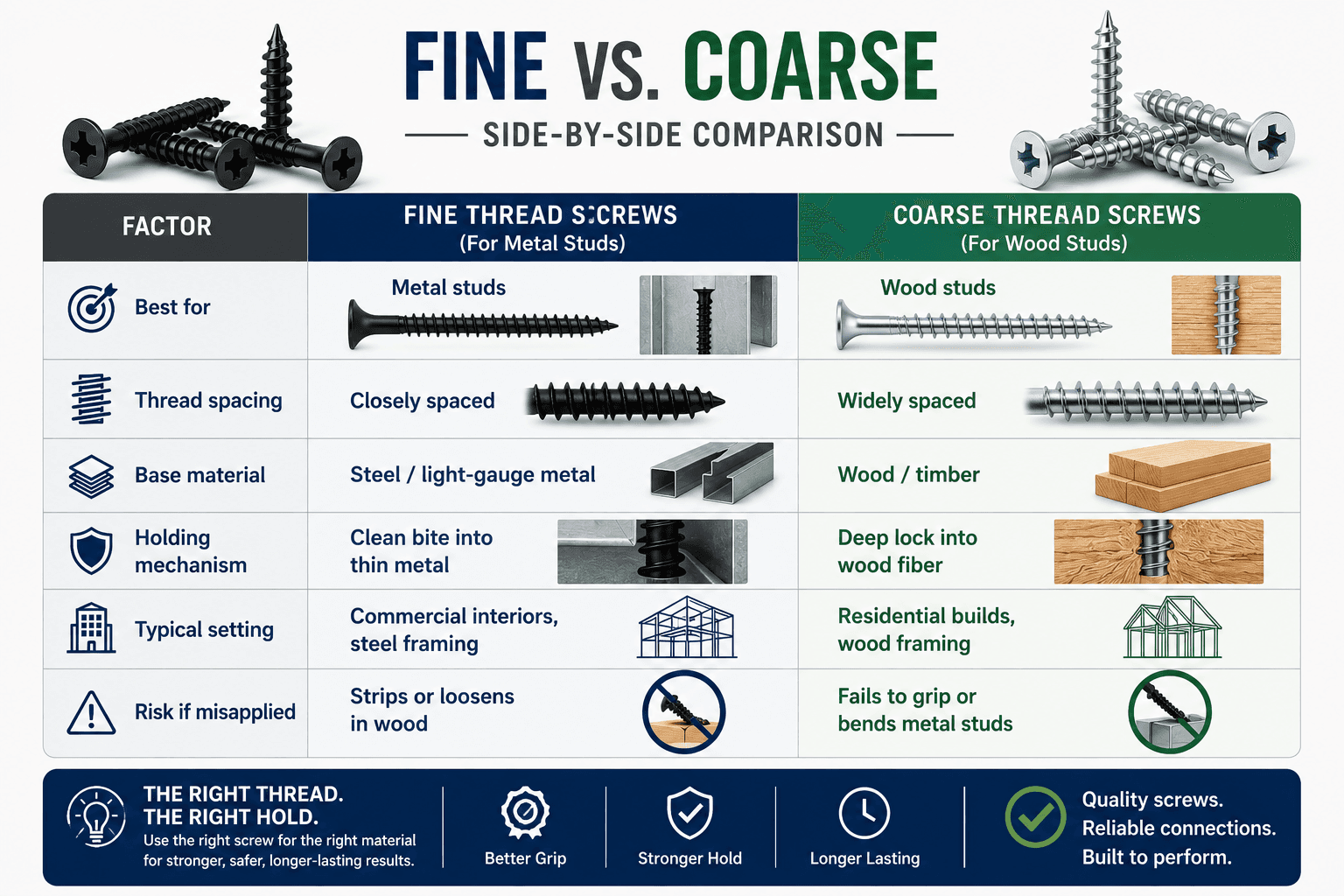
Factor | Fine Thread Screws | Coarse Thread Screws |
Best for | Metal studs | Wood studs |
Thread spacing | Closely spaced | Widely spaced |
Base material | Steel / light-gauge metal | Wood / timber |
Holding mechanism | Clean bite into thin metal | Deep lock into wood fiber |
Typical setting | Commercial interiors, steel framing | Residential builds, wood framing |
Risk if misapplied | Strips or loosens in wood | Fails to grip or bends metal studs |
Can You Swap One for the Other?
Technically, a fine thread screw can be driven into wood, and a coarse thread screw can sometimes be forced into metal. But "can" and "should" are different questions here.
Fine thread in wood: It will often go in, but the tighter thread spacing means less fiber engagement per inch of screw. Holding strength suffers, and the connection is more likely to loosen over time — especially under any vibration or structural movement.
Coarse thread in metal: This is the riskier swap. The aggressive, wide-set threads aren't designed to engage cleanly with thin steel. They can strip the hole on the first pass, fail to seat fully, or distort the stud — any of which compromises the fastening point.
The short version: matching thread type to base material isn't a minor preference, it's the difference between a connection that holds and one that doesn't.
Other Factors to Get Right
Thread type is the first decision, but a few other specs determine whether a screw performs well on the job:
Screw length. The screw needs enough penetration into the framing material to hold securely — typically extending well past the drywall thickness into solid stud — without being so long that it risks punching through wiring, conduit, or the opposite side of light framing.
Surface finish. Black phosphate finishes are standard for interior, dry-area drywall work. For installations in areas exposed to moisture — bathrooms, basements, exterior-adjacent walls — a zinc-plated or other corrosion-resistant finish extends the fastener's service life considerably.
Head type and drive. A bugle head is standard for drywall screws because it countersinks cleanly without tearing the paper face, leaving a smooth surface ready for joint compound.
Installation environment. Standard screws are fine for typical indoor, climate-controlled spaces. Anywhere with sustained humidity or temperature swings calls for corrosion-resistant fasteners regardless of whether the framing is wood or metal.
Common Mistakes Worth Avoiding
A surprising amount of drywall callbacks trace back to fastener selection rather than installation technique. The recurring issues:
Using coarse thread screws on metal stud framing
Using fine thread screws as the primary fastener on wood framing
Selecting a screw length too short for adequate penetration, or too long and risking punch-through
Overdriving screws until the head tears through the drywall paper
Skipping corrosion-resistant finishes in moisture-prone areas
Sourcing low-quality screws that strip or snap mid-installation
Most of these are easy to avoid with basic attention to the framing material and a quality fastener — but they're also the most common reason a drywall job needs rework.
Why Screw Quality Affects the Outcome
Thread type gets the screw into the right material, but quality determines how well it performs once it's there. Inconsistent thread tolerances, weak metal alloys, or poor heat treatment in manufacturing show up as snapped heads, stripped drives, and screws that back out under load.
For contractors and procurement teams sourcing at volume, consistency matters as much as the spec sheet. A batch of screws that performs perfectly in testing but varies pallet to pallet creates exactly the kind of installation delays and callbacks that thread selection is supposed to prevent.
Quick Decision Guide
Framing into metal studs or light-gauge steel? → Fine thread drywall screws
Framing into wood studs or timber? → Coarse thread drywall screws
Mixed framing on the same job? → Stock both; don't rely on one screw type to cover everything
Moisture-prone area? → Add a corrosion-resistant finish regardless of thread type
Frequently Asked Questions
What is the difference between fine and coarse drywall screws?
Fine thread screws have closely spaced threads and are designed for metal stud framing. Coarse thread screws have wider thread spacing and are designed for wood framing.
Are fine thread screws better than coarse thread screws?
Neither is universally better — performance depends entirely on the base material. Fine threads perform better in metal; coarse threads perform better in wood.
Can coarse thread screws be used in wood?
Yes — this is their intended application. The wide thread spacing grips wood fiber effectively and provides strong, lasting holding power.
Can fine thread screws be used in metal studs?
Yes — fine thread screws are purpose-built for metal stud and light-gauge steel framing applications.
What happens if the wrong thread type is used?
In wood, a fine thread screw may not hold as securely and can loosen over time. In metal, a coarse thread screw can strip the hole or fail to seat properly, weakening the connection.
📌 Key Takeaways
|
Why Choose Screwbee?
Choosing the right thread type only pays off if the screws themselves are manufactured to a consistent standard. That's where Screwbee fits in:
✅ Why Choose Screwbee
|
Ready to Source the Right Drywall Screws? Don't let a mismatched fastener undo a well-built wall. Whether your next job is framed in metal, wood, or both, Screwbee supplies the fine thread and coarse thread drywall screws contractors and distributors rely on for consistent, callback-free installations — in stock sizes or bulk volumes. |
Final Takeaway
Choosing between fine and coarse drywall screws isn't about which one performs better in general — it's about matching the thread to the base material. Fine thread screws are built for metal stud framing; coarse thread screws are built for wood framing. Get that match right, along with appropriate length, finish, and fastener quality, and the installation holds the way it's supposed to — clean, secure, and built to last.
If your next project involves mixed framing — or you simply want both thread types on hand from a single reliable source — reach out to discuss stocking fine and coarse thread drywall screws for your job site or warehouse.
Looking for a Reliable Bulk Screw Supplier?
If you're comparing international suppliers or exploring alternatives to Turkish manufacturers, the Screwbee team can help you evaluate the right drywall screw solution for your project. Contact us for product specifications, bulk pricing, export support, and technical guidance.
📧 sales@screwbee.in
🌐 www.screwbee.in
Comparing suppliers for your next bulk order? Reach out to Screwbee's team at sales@screwbee.in to see how an India-based option stacks up on specifications, pricing, and lead time.