📦 Request Quote
📞 Connect with us
Discover what bugle head screws are, why they are used in drywall construction, their advantages, common applications, and how to choose the right type for your project.
Learn how bugle head screws improve drywall installation, protect gypsum board, and deliver clean, professional finishes across construction projects.

What Are Bugle Head Screws Used For
Complete Guide to Applications, Benefits, and Types
Where Every Project Begins
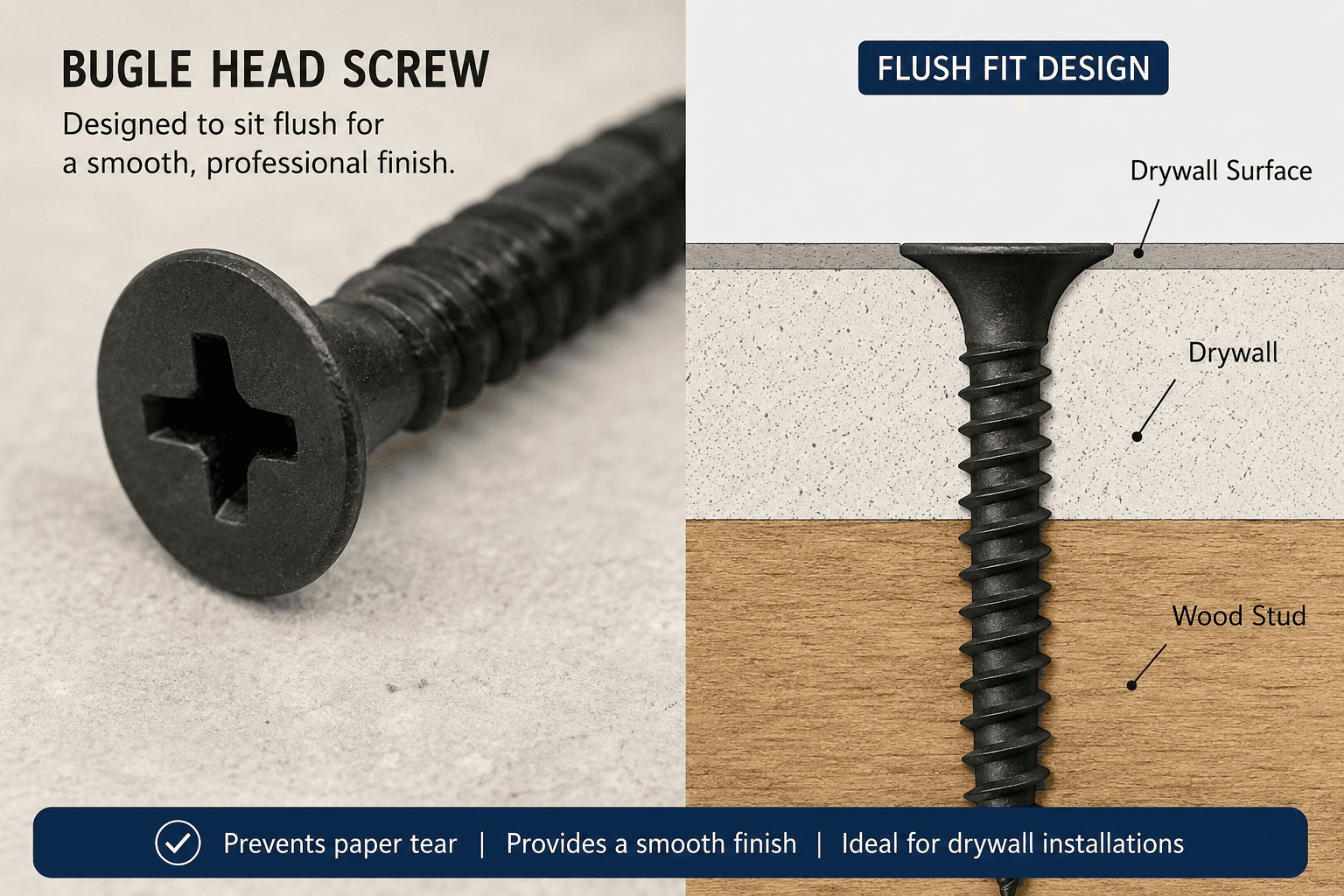
Pick up almost any drywall screw and you'll notice something specific about the head: it isn't flat, and it isn't a sharp cone either. It curves gently from a wide rim down to the shank, like a small trumpet bell. That shape isn't decorative — it's the single design detail that makes drywall installation possible without tearing the board apart in the process.
This is the bugle head, and it shows up on nearly every drywall screw, gypsum board fastener, and construction screw built for board-and-frame assembly. Most installers use bugle head screws daily without ever thinking about why the head is shaped the way it is. But the shape solves a real mechanical problem — distributing driving pressure across a wide, brittle surface instead of concentrating it at a single point — and understanding that problem is what separates a screw that finishes clean from one that cracks the board on the way in.
This guide covers what a bugle head screw actually is, why the design exists, where it's used across construction, how it compares to flat head alternatives, and what to look for when choosing bugle head screws for a specific job.
What Is a Bugle Head Screw?
A bugle head screw has a head that tapers gradually from a wide, rounded top down to a narrower point where it meets the shank — a curved profile rather than the abrupt angle found on a flat or countersunk head. The name comes directly from that resemblance to the bell of a bugle or trumpet, widening smoothly rather than stepping down at a sharp edge.
That gradual curve is the entire point of the design. As the screw is driven, the rounded underside of the head presses against the board's surface progressively rather than all at once, spreading the load across a wider area instead of concentrating it at the rim. On a material as brittle as gypsum board — which is essentially a compressed mineral core wrapped in paper — that distinction determines whether the screw seats cleanly or punches through the paper face.
Bugle heads appear across nearly the entire drywall fastener category:
Gypsum board fasteners
Self-drilling and self-tapping drywall screws
The bugle shape itself stays constant across all of these; what changes between them is the thread design underneath, which is matched to whatever framing material the screw is going into.
Why Are Bugle Head Screws Used?
The case for the bugle head comes down to one core problem: gypsum board and drywall paper tear far more easily than wood or metal compresses. A fastener head designed for lumber — flat, abrupt, with a sharp transition edge — works fine on a forgiving material but tends to chew straight through drywall paper before the screw has even seated properly.
The bugle head addresses that in several connected ways:
It prevents tearing of the drywall paper face. The curved underside contacts the paper gradually, rolling pressure outward instead of cutting into it the way a sharp-edged head would.
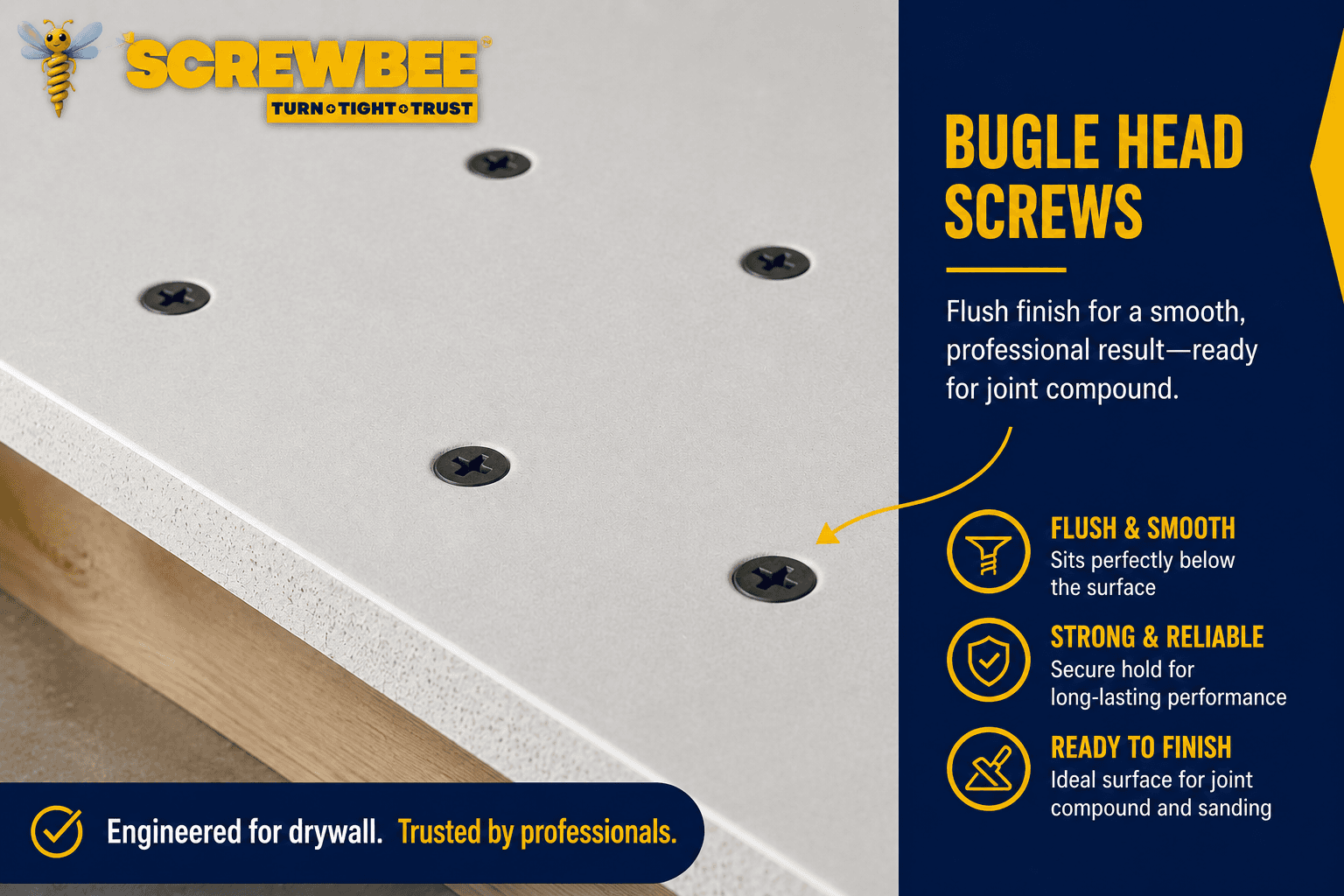
It allows the screw to sit flush with the surface. Once seated, a bugle head finishes just below or level with the board face, leaving a shallow, smooth depression that's easy to fill with joint compound.
It distributes pressure evenly across a wider contact area. Rather than concentrating force at a single rim edge, the curve spreads the load, which matters enormously on a material with as little tensile strength as gypsum core.
It creates a clean, paintable finish. Because the head doesn't tear or crater the surface, the area around each screw needs only a light skim of compound rather than significant patching.
It reduces board damage during installation, especially at speed. Production crews driving hundreds of screws a day rely on the bugle head's forgiving geometry to avoid blow-throughs even when driving torque isn't perfectly consistent screw to screw.
Learn how engineered drywall screws improve installation consistency and long-term construction performance.
Common Applications of Bugle Head Screws
Bugle head screws show up wherever board meets frame, across a wide range of construction contexts.
Drywall Installation
This is the foundational use case. Standard drywall screws with a bugle head are the default fastener for attaching gypsum panels to wall and ceiling framing in essentially every residential and commercial drywall job.
Gypsum Board Fastening
Beyond standard wall and ceiling drywall, the broader category of gypsum board fasteners — used in fire-rated assemblies, acoustic partitions, and multi-layer board systems — relies on the same bugle head geometry to protect the board face across more demanding installation specs.
False Ceilings
Suspended and false ceiling systems, common in commercial fit-outs and modular interiors, depend on bugle head screws to secure board to the ceiling grid or furring channel cleanly, often working against gravity in a way that makes a secure, flush seat even more important.
Wood Framing
On timber studs and joists, coarse thread bugle head screws combine the deep-thread grip needed for wood with the same surface-protecting head geometry, giving installers strong holding power without sacrificing finish quality.
Metal Stud Framing
On light-gauge steel framing, fine thread bugle head screws pair a thread profile built for thin metal with the bugle head's flush-seating behavior — a combination that's become the standard across commercial interior construction.
Interior Construction Generally
Beyond walls and ceilings specifically, bugle head screws turn up across general interior fit-out work — built-in cabinetry backing, soundproofing layers, and any other application where board needs to be fastened cleanly to a frame.
Commercial Projects
Large-scale commercial builds — offices, retail fit-outs, hospitality interiors — depend on bugle head screws at volume, where consistent driving behavior across thousands of fastening points has a direct effect on both labor efficiency and finish quality across the project.
Bugle Head vs. Flat Head Screws
Flat head screws remain common in general woodworking and furniture assembly, but they behave very differently from bugle head screws when used on board materials. The comparison makes clear why the construction industry standardized on bugle heads for drywall specifically.
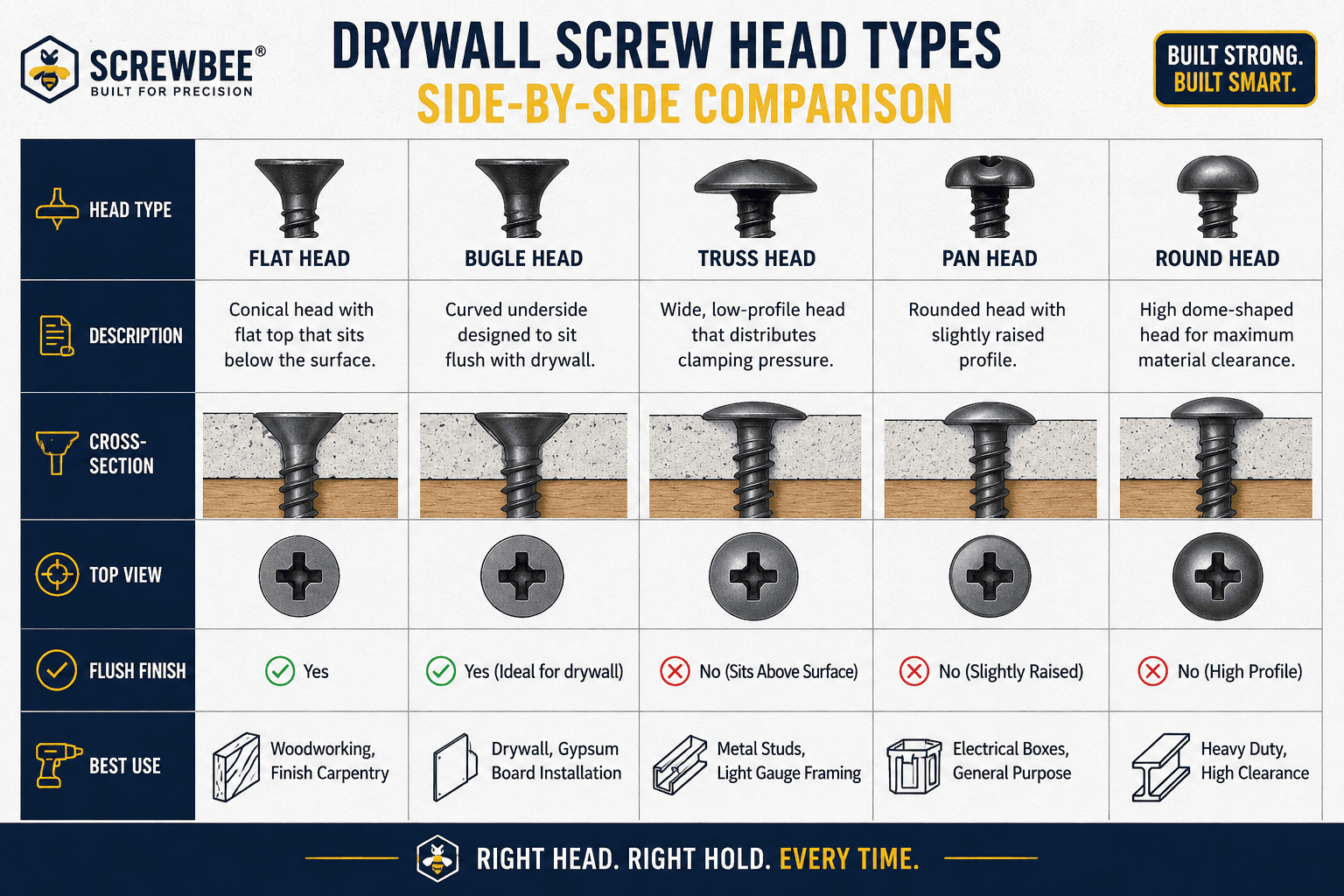
Feature | Bugle Head Screws | Flat Head Screws |
Head shape | Curved, gradual taper | Flat cone with sharp transition edge |
Pressure distribution | Spread evenly across a wide contact area | Concentrated at the rim edge |
Surface finish | Flush, smooth depression | Can create a sharp-edged crater |
Risk of paper tear | Low | Higher, especially at speed |
Countersinking behavior | Gradual, self-leveling | Abrupt, less forgiving of overdriving |
Best application | Drywall, gypsum board, board-to-frame fastening | General woodworking, furniture, non-board fastening |
Installation tolerance | More forgiving of slight torque variation | Less forgiving — easier to overdrive or crater |
For board-and-frame work, bugle head screws are the clear standard. Flat head screws still have a place in furniture assembly and general fastening, where the material being driven into doesn't have the same paper-faced, brittle-core structure that drywall does.
Choosing the Right Bugle Head Screw
The bugle head shape is constant, but the screw underneath it still needs to be matched correctly to the job.
Fine Thread vs. Coarse Thread
This is the most important variable beneath the bugle head itself. Fine thread bugle head screws, with closely spaced threads, are built for metal stud and light-gauge steel framing. Coarse thread bugle head screws, with wider thread spacing, are built for wood stud and timber framing. Using the wrong thread type undermines the holding strength the bugle head is designed to protect — a clean, flush head means little if the screw doesn't grip the framing securely behind it.
Compare both thread profiles in our guide on Fine vs Coarse Thread Drywall Screws.
Screw Length
Length needs to account for both the board thickness and adequate penetration into the framing behind it — typically with enough thread engaged in solid framing to resist pull-out, without running so long that the screw risks punching through wiring, conduit, or thin framing on the far side.
Surface Coating
Black phosphate finishes are the standard choice for interior, dry-condition drywall work. Zinc-plated finishes step up corrosion resistance for installations in higher-humidity environments — bathrooms, basements, or any space where moisture exposure is a realistic concern over the life of the building.
Material Compatibility
Beyond thread type, confirm that the screw's steel grade and hardness are appropriate for the framing density involved. Harder or denser wood species, thicker steel gauges, or fire-rated multi-layer board assemblies may call for a more robust screw than a standard residential spec would require.
Common Mistakes to Avoid
Even with the right head design, a few recurring errors undercut the benefits bugle head screws are built to deliver:
Using the wrong thread type for the framing material — fine thread in wood, or coarse thread in metal, both compromise holding strength regardless of head shape.
Overdriving the screw below the board surface — pushing the bugle head too far in tears the paper face just as badly as using the wrong head shape entirely, defeating the purpose of the design.
Selecting the wrong screw length — too short risks weak holding power; too long risks punching through framing or hitting wiring and conduit.
Poor or inconsistent screw spacing — uneven spacing leaves sections of board under-supported, increasing the risk of sagging or cracking along unsupported spans over time.
Sourcing low-quality fasteners with inconsistent head geometry — not every bugle head is manufactured to the same tolerance, and a poorly formed curve can behave more like a flat head in practice.
Avoiding these is mostly a matter of matching the screw to the material and driving with consistent, controlled torque rather than relying on the head shape alone to compensate for installation shortcuts.
Why Quality Bugle Head Screws Matter
The bugle head only delivers its intended benefits when it's manufactured to consistent tolerances. A head that's slightly too steep behaves more like a flat head under pressure; inconsistent curvature across a batch means some screws seat cleanly while others tear the paper face regardless of installer technique.
High-quality bugle head screws deliver:
Reliable, consistent countersinking behavior across an entire batch
Reduced breakage and stripped drives under normal driving torque
Accurate thread geometry beneath the head, matched to the stated fine or coarse spec
Dependable corrosion resistance appropriate to the stated finish
A cleaner finish that reduces patching and rework time
For contractors and distributors sourcing at volume, this consistency is what determines whether a fastener spec on paper actually translates into the finish quality promised on site.
Learn what defines quality drywall screws and why manufacturing consistency matters across every batch.
Frequently Asked Questions
What are bugle head screws used for?
Bugle head screws are used to fasten drywall and gypsum board to wood or metal framing. Their curved head design lets the screw seat flush with the board surface without tearing the paper face.
Why are drywall screws bugle headed?
The bugle shape distributes driving pressure gradually across a wider area instead of concentrating it at a sharp edge, which prevents the screw from tearing or cratering the drywall's paper surface as it seats.
Are bugle head screws suitable for wood?
Yes. Coarse thread bugle head screws are specifically designed for wood stud and timber framing, combining the bugle head's surface protection with a thread profile built for strong grip in wood fiber.
Can bugle head screws be used with metal studs?
Yes. Fine thread bugle head screws are built for metal stud and light-gauge steel framing, pairing closely spaced threads with the same flush-seating bugle head geometry.
What is the difference between bugle head and flat head screws?
Bugle head screws taper gradually and distribute pressure evenly, making them well suited to brittle, paper-faced board materials. Flat head screws have a sharper transition edge that concentrates pressure at the rim, which works well in wood and general fastening but is more likely to tear drywall paper.
Do all drywall screws have a bugle head?
The vast majority do, across fine thread, coarse thread, and self-drilling variants. It's considered the standard head design for drywall and gypsum board fastening specifically because of how well it protects the board surface during installation.
📌 Key Takeaways
|
Why Choose Screwbee?
A bugle head only delivers on its design promise when it's manufactured to consistent tolerances batch after batch. That consistency is the foundation of what Screwbee supplies:
✅ Why Choose Screwbee
|
Ready to Source Bugle Head Drywall Screws? Whether the job calls for fine thread, coarse thread, or self-drilling bugle head screws, Screwbee supplies drywall fasteners manufactured for consistent, flush seating — in stock sizes or bulk volumes for contractors and distributors. |
Conclusion
The bugle head is one of those design details that's easy to overlook precisely because it works so well — installers rarely think about head geometry because a properly made bugle head screw simply doesn't tear the board, doesn't crater the surface, and finishes flush without drama. That reliability is the entire reason it became the industry standard for drywall and gypsum board fastening rather than a marketing footnote.
Whether the job is wood framing, metal stud partitions, suspended ceilings, or large-scale commercial fit-out work, the combination that matters is the same: the right thread type for the framing material, paired with a bugle head manufactured to consistent, reliable tolerances. Get that combination right, and the fastener does exactly what it's supposed to do — disappear into a clean, professional finish that holds for the life of the building.
If you're comparing fine thread, coarse thread, or other bugle head drywall screws for an upcoming project, browse our full range or reach out for guidance on the right fit for your application.
Need a Bulk Quote or Technical Assistance?
Contact the Screwbee team today to discuss your project requirements, coating preferences, screw sizes, and bulk order quantities. We're here to help you source the right drywall screws with confidence.
📧 sales@screwbee.in
🌐 www.screwbee.in
Ready to source dependable drywall screws for your next project? Get in touch with our supply team at sales@screwbee.in for bulk pricing and technical guidance.