📦 Request Quote
📞 Connect with us
Learn how international buyers evaluate drywall screw exporters from India and what to consider before placing export orders.
A practical export sourcing guide for international buyers seeking dependable drywall screw suppliers from India.

India's Trusted Drywall Screw Exporter
A Procurement Handbook for International Buyers — how importers, distributors, and wholesalers can evaluate and select a dependable Indian drywall screw exporte
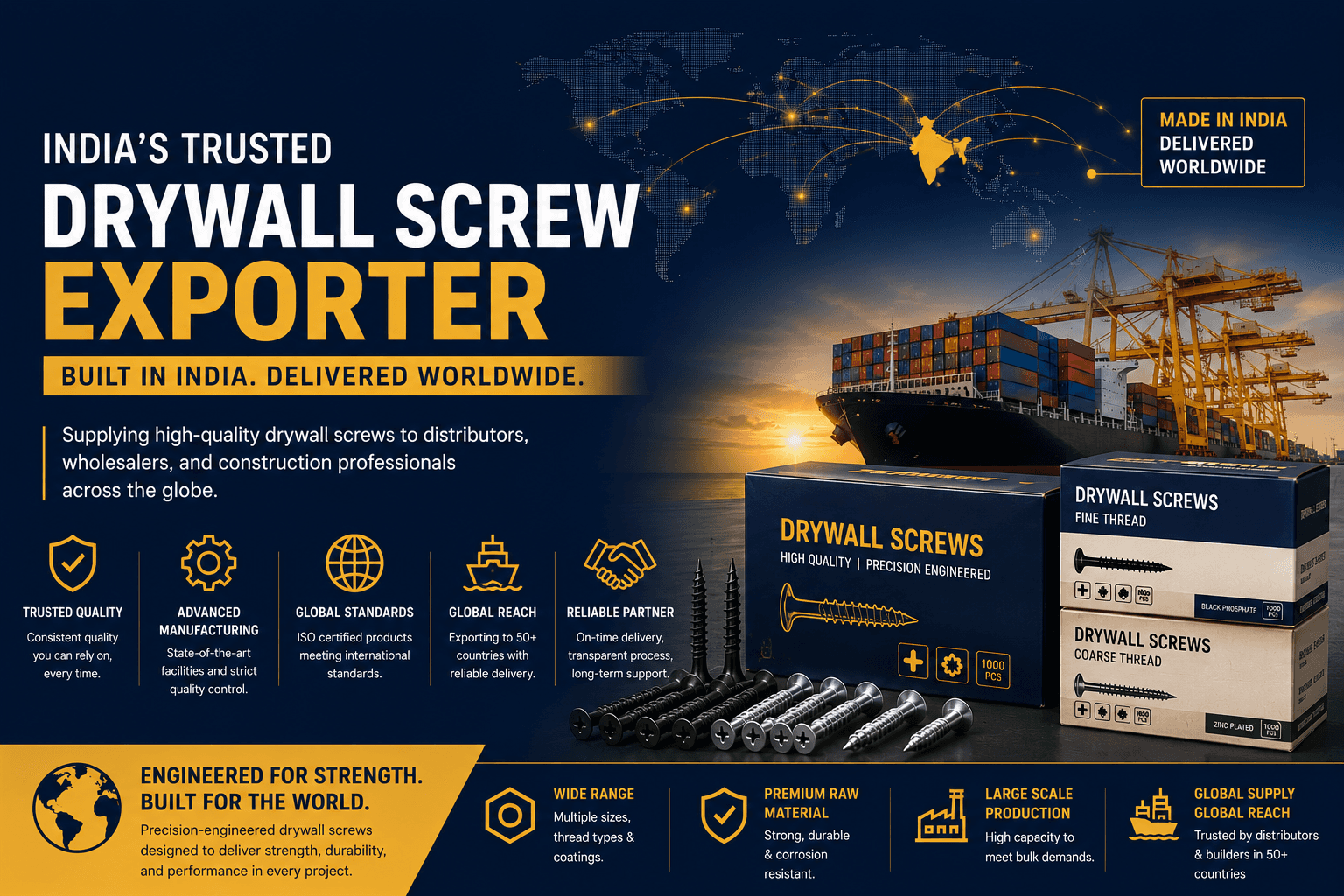
Quick Answer
What makes a trusted drywall screw exporter?
A trusted drywall screw exporter from India is defined by consistent product quality across every batch, compliance with recognized international standards such as DIN, ISO, and ASTM, secure export-grade packaging, complete and accurate shipping documentation, and clear communication throughout the enquiry-to-delivery process. Buyers should also confirm that the manufacturer supports sample approval before bulk production and maintains a documented quality inspection process, including hardness, torque strength, dimensional accuracy, and coating checks.
For buyers researching options, it helps to compare exporters against a Global Supplier of Drywall Screws that can demonstrate all of the above with verifiable documentation rather than general claims.
Why International Buyers Source Drywall Screws from India
India has become a common sourcing destination for construction fasteners, including drywall screws, for several practical reasons that matter to procurement teams evaluating long-term suppliers.
Manufacturing capability aligned with international specifications
Many Indian manufacturers produce drywall screws using imported cold heading and thread rolling equipment, which supports the dimensional accuracy and thread consistency required for gypsum board, metal stud, and wooden frame applications.
Competitive cost structures without compromising specification compliance
Buyers frequently source from India because production costs can be more favorable than in some other manufacturing regions, while still meeting DIN, ISO, and ASTM specifications when the manufacturer maintains proper quality control.
Established export routes to multiple regions
Indian fastener exporters already ship to established markets, including the Middle East, Africa, Europe, Southeast Asia, and North America, which means the logistics, documentation, and customs processes for these routes are generally well understood by experienced exporters.
Flexibility for distributors and contractors
Because drywall systems, false ceiling work, interior fit-outs, and modular construction all use similar screw types, a manufacturer serving these industries domestically is generally positioned to support recurring international orders as well.
What Makes an Export Partner Reliable?
Reliability in export sourcing is rarely about a single factor. Buyers should evaluate exporters across several operational areas.
Product Consistency
Every batch should match the agreed specification for size, thread type, head style, and coating. Inconsistent batches create rework, project delays, and additional inspection costs for the buyer. Ask for documented quality control steps such as hardness testing, torque strength testing, and dimensional accuracy checks.
Supply Reliability
A dependable exporter should be able to commit to realistic production and shipment timelines and communicate proactively if a delay occurs. For recurring or large-volume orders, ask how the exporter plans production during peak demand periods.
Communication
Export transactions involve many technical and logistical details. A partner who responds clearly and promptly to specification questions, sample requests, and shipping queries reduces the risk of misunderstandings that can affect an entire order.
Packaging
Export packaging needs to protect the product from moisture, corrosion, and transit damage across sea, air, or land freight. Ask specifically how cartons, pallets, or containers are prepared and labeled for international shipment.
Documentation
Correct commercial invoices, packing lists, certificates of origin, and any product compliance documents are essential for smooth customs clearance. Missing or inconsistent paperwork is one of the most common causes of shipment delays.
Bulk Order Capability
Confirm that the manufacturer can handle the order volume you require within your timeline, and ask how they manage larger orders without compromising the quality checks used on smaller runs.
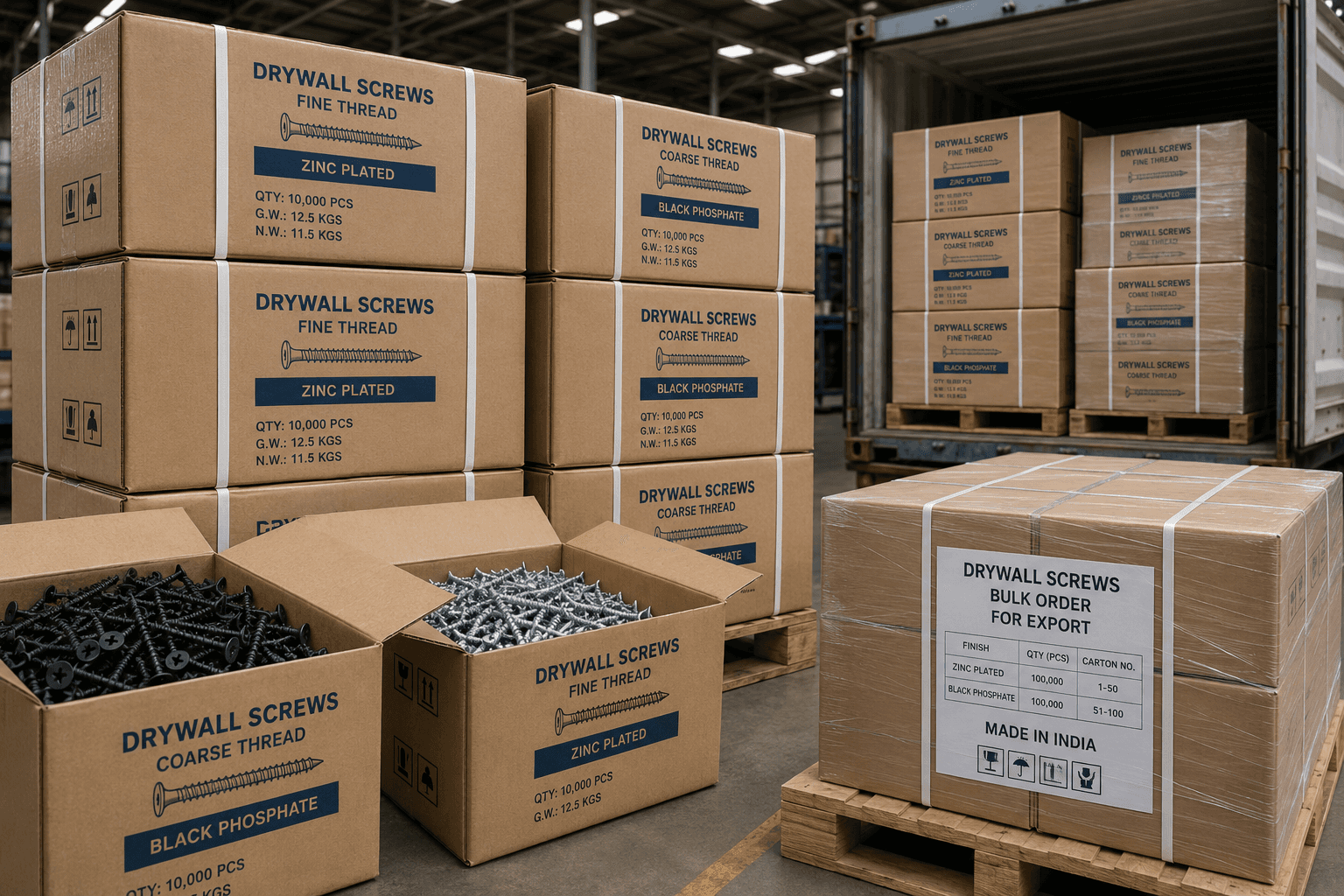
Export Buyer's Decision Framework
Use this framework to score potential exporters before committing to a purchase order.
Evaluation Criteria | What to Verify | Why It Matters |
Product Specification Match | Size, thread type, head style, coating type (e.g., zinc-plated or black phosphate) | Ensures the product performs correctly in your intended application |
Standards Compliance | Compliance with relevant DIN, ISO, or ASTM specifications | Confirms the product meets recognized construction fastener benchmarks |
Sample Availability | Whether samples are provided before bulk production | Allows dimensional and application testing prior to committing to volume |
Quality Inspection Process | Hardness, torque strength, dimensional accuracy, and coating inspection | Reduces the risk of receiving inconsistent or substandard batches |
Packaging Standard | Moisture protection, labeling, and pallet or container preparation | Protects product integrity during international transit |
Documentation Accuracy | Commercial invoice, packing list, and export paperwork | Prevents customs delays and compliance issues |
Communication Responsiveness | Clarity and speed of technical and commercial responses | Reduces the risk of miscommunication on large orders |
Logistics Support | Options for sea, air, or land freight and shipment tracking | Affects delivery timelines and supply chain planning |
Buyers comparing multiple suppliers, including a Reliable Drywall Screw Manufacturer or a Trusted Drywall Screw Manufacturer, can use this table as a scorecard during supplier evaluation calls.
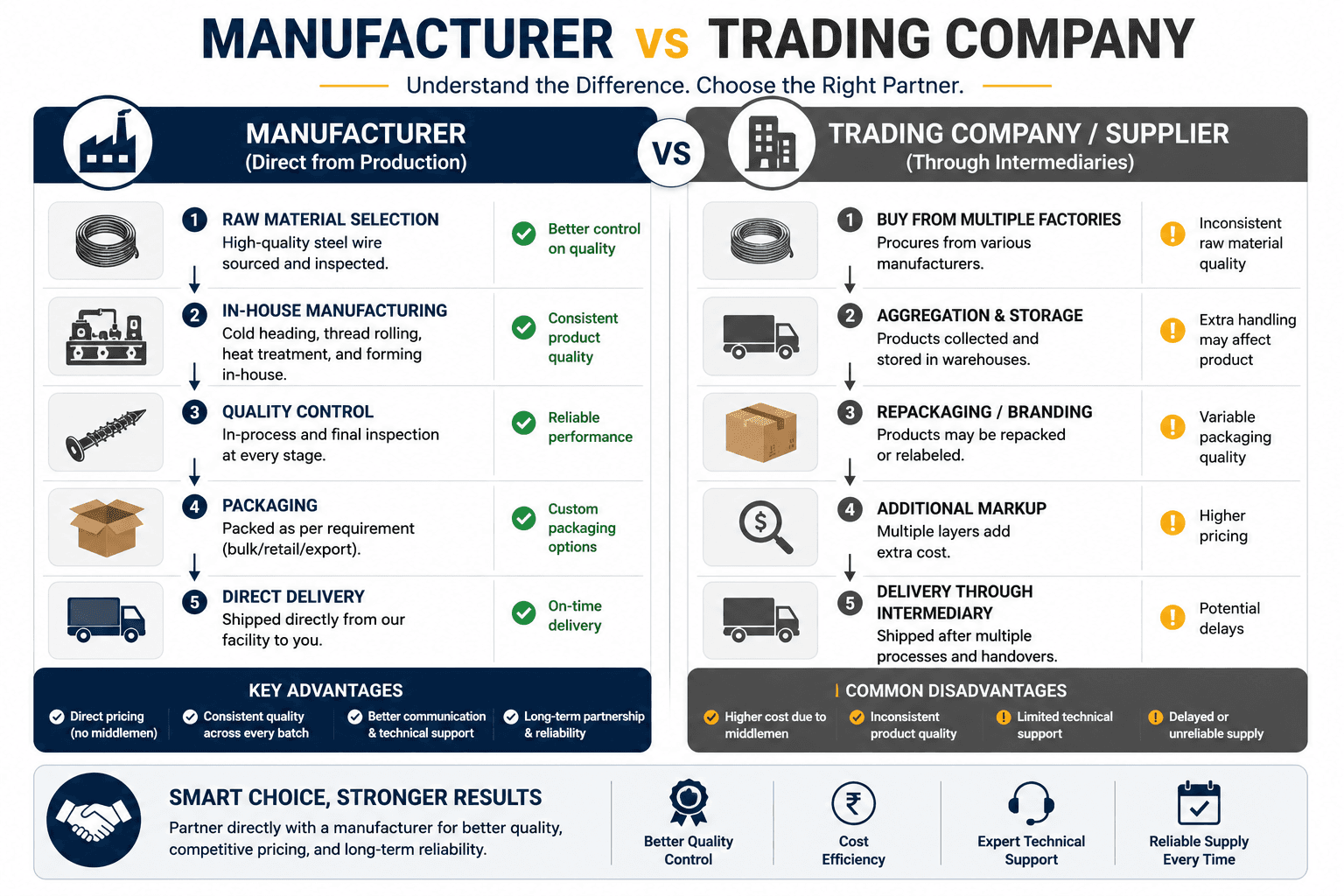
Exporter vs Trading Company
Understanding who you are actually buying from is one of the most overlooked steps in export procurement.
Factor | Direct Exporter (Manufacturer) | Trading Company / Intermediary |
Quality Control | Manages inspection directly at the production stage | Relies on the manufacturer's quality control, with limited direct oversight |
Pricing | Generally more transparent, without added intermediary margins | Includes a margin on top of manufacturer pricing |
Technical Support | Direct access to engineering or production teams for specification questions | Technical answers are often relayed through a third party, which can slow responses |
Customization | Easier to request specification adjustments directly with production | Customization requests depend on the manufacturer's willingness to accommodate the trader |
Order Transparency | Buyer can track production and inspection stages more directly | Buyer has less visibility into actual production conditions |
Best Suited For | Bulk, recurring, or specification-sensitive orders | Smaller, one-off orders where convenience is prioritized over direct oversight |
Neither option is inherently wrong, but buyers should know which type of supplier they are dealing with before negotiating price or timelines, since it directly affects accountability if a quality issue arises.
Common Import Mistakes
Procurement risk in international fastener sourcing often comes down to a small number of recurring mistakes.
Choosing only by price — the lowest quote does not always reflect the true cost once rework, delays, or failed inspections are factored in.
Ignoring exact specifications — approving a general product category without confirming size, thread pitch, coating, and head type can lead to compatibility issues on site.
Not requesting samples — skipping sample approval removes the opportunity to verify dimensional accuracy and application performance before committing to a full production run.
Not confirming packaging in advance — assuming packaging will be adequate, rather than confirming it, increases the risk of moisture damage or corrosion during transit.
Poor communication during the enquiry stage — vague specification requests or delayed responses on either side often lead to mismatched expectations once the order is in production.
Each of these mistakes is preventable with a structured evaluation process, which is why the decision framework and checklist in this guide are worth using before finalizing any order.
International Buyer's Checklist
Use this checklist before placing an export order for drywall screws.
Confirm exact product specification: size, thread type, head style, coating (zinc-plated or black phosphate)
✅ Request and review compliance information against relevant DIN, ISO, or ASTM specifications
✅ Request samples for dimensional and application testing
✅ Confirm quality inspection steps used during production
✅ Review packaging method for your specific freight type (sea, air, or land)
✅ Confirm production and delivery timeline in writing
✅ Request a detailed quotation covering product, packaging, and logistics costs
✅ Verify export documentation the supplier will provide
✅ Clarify communication points of contact for the order lifecycle
✅ Confirm shipment tracking and delivery support after dispatch
Frequently Asked Questions
Does India export drywall screws to markets outside Asia?
Yes. Indian drywall screw exporters commonly ship to buyers across the Middle East, Africa, Europe, Southeast Asia, and North America, using sea, air, or land freight depending on the destination and order size.
What standards should drywall screws meet for international projects?
Buyers typically look for compliance with recognized construction fastener specifications such as DIN, ISO, and ASTM standards, which help confirm dimensional accuracy, material quality, and application suitability.
Should I always request a sample before a bulk order?
Yes. Sample approval allows dimensional verification and application testing before committing to full production, which reduces the risk of receiving an unsuitable product at scale.
What is the difference between a manufacturer and a trading company for export purposes?
A manufacturer controls production and quality inspection directly, while a trading company sources from manufacturers and adds a margin. Buyers with specification-sensitive or recurring orders generally benefit from working directly with a manufacturer.
What documentation should I expect for a drywall screw export order?
At minimum, expect a commercial invoice, packing list, and any relevant compliance documentation. Requirements can vary by destination country, so confirm this with the exporter during the quotation stage.
How is corrosion resistance typically evaluated for drywall screws?
Corrosion resistance is commonly assessed through salt spray testing, which measures how long a coating withstands corrosive exposure before visible degradation occurs.
Final Thoughts
Sourcing drywall screws internationally is less about finding the lowest price and more about finding a supplier whose specifications, quality process, packaging, and documentation match what your project or distribution business actually requires. Buyers who evaluate exporters using a structured framework, request samples, and confirm documentation in advance are in a stronger position to avoid the delays and quality issues that often come from rushed procurement decisions.
Whether you are sourcing Export Quality Drywall Screws for a single project or establishing a recurring supply relationship for Wholesale Drywall Screws, the fundamentals in this guide apply: verify specifications, confirm quality control, and communicate clearly at every stage.
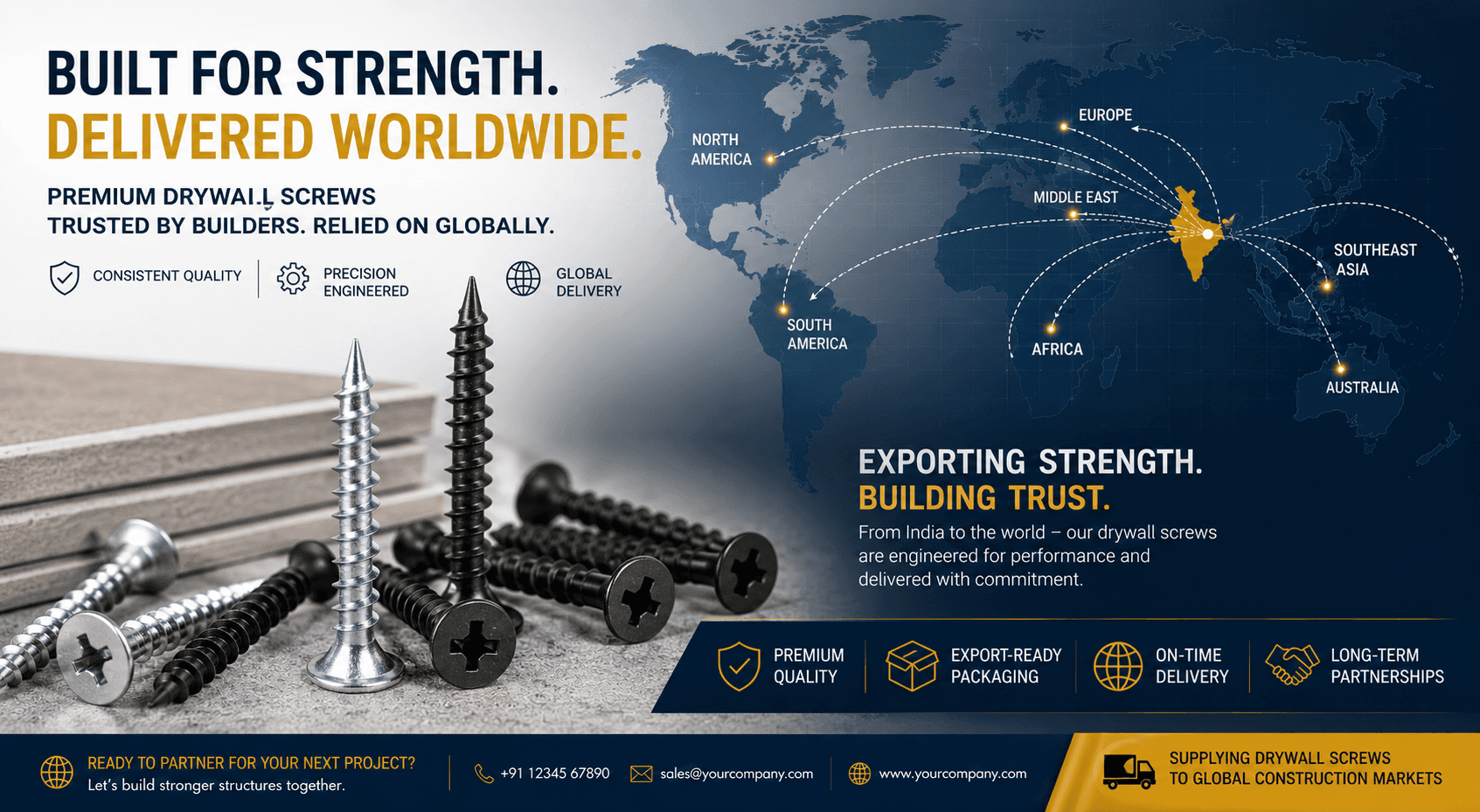
Discuss Your Export Requirements
If you are evaluating suppliers for drywall screws, our team can walk you through product specifications, sample requests, bulk order options, and distribution opportunities.