📦 Request Quote
📞 Connect with us
Learn why Chipboard Screws spin without tightening in MDF and how screw size, pilot holes, alignment and torque affect holding power.
Learn why Chipboard Screws can spin without tightening in MDF and how correct size, pilot holes and torque can prevent the problem.
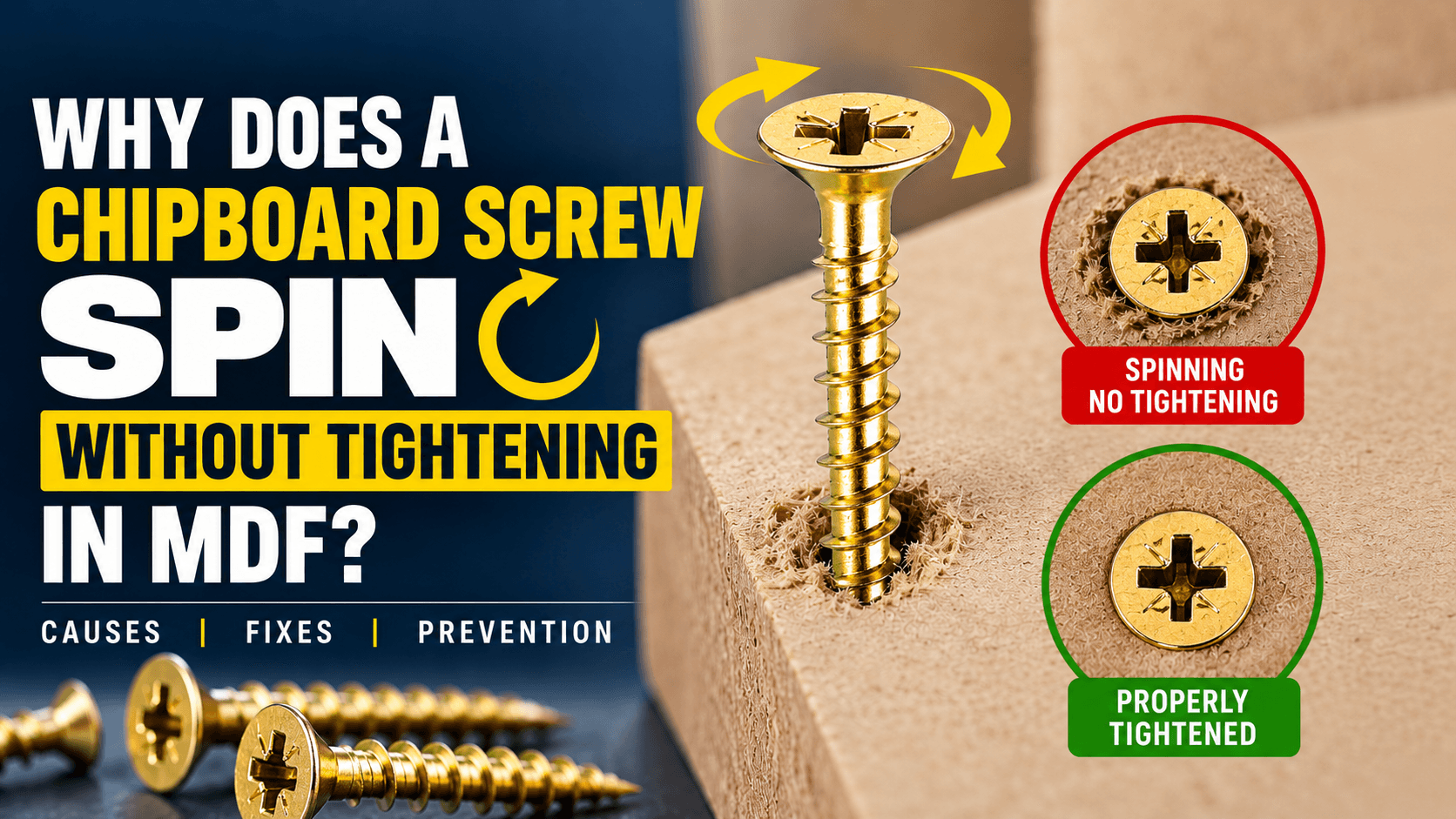
Why Does a Chipboard Screw Spin Without Tightening in MDF?
A chipboard screw can sometimes keep turning without tightening properly in MDF.
The screw may look like it is going in, but the joint does not become secure.
In simple terms:
The screw spins, but the material is no longer gripping the thread correctly.
This can happen because of:
Over-tightening
An oversized pilot hole
Damaged MDF fibres
Reusing the same screw hole
Wrong screw diameter
Poor thread engagement
Low-density or weakened material
For compatible MDF, particle board, furniture and joinery applications, Chipboard Screws are designed with a deep coarse thread and sharp point to engage wood-based materials.
1. The Screw Was Over-Tightened
One of the most common causes is excessive tightening.
As the screw reaches its final position, continuing to apply torque can damage the MDF around the thread.
Once the fibres are crushed or torn, the screw may lose its grip.
Then the screw begins to spin.
The better approach is:
drive steadily → seat the head correctly → stop when secure
More torque does not always create a stronger joint.
2. The Pilot Hole Is Too Large
A pilot hole can help reduce splitting and improve alignment.
But if the pilot hole is too large, the screw threads may not have enough material to grip.
This can cause:
The pilot hole should guide the screw without removing too much material.
3. The Same Hole Has Been Reused Too Many Times
Removing and reinstalling a screw in the same MDF hole can weaken the material.
Each installation can disturb the fibres around the thread path.
After repeated use, the hole may become enlarged.
The screw may then rotate without tightening.
If possible, avoid repeatedly using the same damaged hole.
4. The Screw Diameter Is Too Small
A screw that is too thin may not create enough thread engagement for the joint.
This is especially important in:
Thick furniture panels
Structural cabinet joints
Repeated-use connections
Larger fixing points
The screw diameter should match the material and joint requirement.
Screwbee Chipboard Screws are available across multiple diameter options, so buyers should select the size according to the board thickness and application.
5. The Screw Diameter Is Too Large
Too large can also be a problem.
A screw that is too thick can damage the surrounding MDF during installation.
The material may crack, crush or lose strength around the hole.
That can reduce holding power and eventually lead to spinning.
So the goal is not:
“Use the biggest screw possible.”
The goal is:
Use the correct screw diameter for the material and joint.
6. The MDF Around the Hole Is Damaged
MDF is made from compressed wood fibres.
If the area around the hole becomes damaged, the screw thread may no longer have enough material to engage.
Possible causes include:
When the substrate is weakened, even the correct screw may not hold properly.
7. The Screw Is Too Short
A short screw may not reach enough material to create useful engagement.
At first, it may appear to tighten.
But the connection can remain weak.
The correct length should allow the screw to pass through the first component and engage adequately with the second.
8. The Screw Is Too Long
A screw that is unnecessarily long can create other problems.
It may:
Pass through the opposite side
Damage the finished surface
Interfere with another component
Apply stress in the wrong area
Correct length is part of a secure joint.
9. The Screw Is Driven at an Angle
If the screw enters at an angle, the thread may not engage evenly.
This can damage the hole and reduce holding power.
For better results:
Keep the driver straight
Start the screw carefully
Avoid forcing the screw sideways
Use controlled speed
Straight installation helps protect the material around the hole.
Example Scenario: MDF Cabinet Joint
Imagine a cabinet panel being assembled.
The installer drives the screw quickly and continues tightening after the head is already seated.
The screw suddenly begins spinning.
What likely happened?
The excessive torque damaged the MDF fibres around the thread.
The screw is still inside the board, but the material can no longer grip it properly.
The real issue is:
Over-tightening → damaged fibres → reduced thread engagement → spinning screw
How Can You Prevent a Chipboard Screw from Spinning?
Use this checklist:
Select the correct screw diameter
Choose the correct length
Use a suitable pilot hole if required
Keep the screw straight
Use controlled speed
Avoid excessive torque
Stop once the head is seated
Do not repeatedly reuse damaged holes
Inspect the MDF around the fixing point
These steps can reduce many common holding problems.
Why Does the Deep Coarse Thread Matter?
Chipboard Screws use a deep coarse thread to engage compatible wood-based materials.
This thread geometry helps create grip in:
But thread design alone cannot compensate for damaged material or poor installation.
The screw still needs:
correct size + correct hole + correct torque + good material
What Should You Do If the Screw Is Already Spinning?
Stop driving it.
Continuing to rotate the screw usually damages the hole further.
Then inspect:
Screw size
Hole condition
Board damage
Pilot-hole size
Material thickness
Depending on the application, the fixing point may need to be relocated or repaired before installing another screw.
Chipboard Screws for Furniture and Joinery
Chipboard Screws are commonly used in:
For these applications, the screw should be selected according to the actual joint, not only by appearance.
Chipboard Screws for UAE Buyers
Furniture manufacturers, joinery workshops, fit-out companies and building-material buyers may search for:
For bulk buying, check:
material → diameter → length → thread → head → quantity → application
That helps reduce installation problems and incorrect orders.
Frequently Asked Questions
Why does a Chipboard Screw spin in MDF?
Common causes include over-tightening, damaged MDF fibres, an oversized pilot hole, wrong screw size or repeated use of the same hole.
Can over-tightening damage MDF?
Yes. Excessive torque can crush or tear the MDF fibres around the screw thread.
Does screw diameter matter in MDF?
Yes. A screw that is too small may not grip enough, while one that is too large can damage the material.
Should I keep tightening if the screw starts spinning?
No. Stop immediately and inspect the hole and material.
Are Chipboard Screws suitable for MDF?
Yes, when the screw size, installation method and material condition are suitable.
Final Answer
A Chipboard Screw that spins without tightening usually means the material around the thread has lost proper grip.
Remember this sequence:
Correct screw size → suitable pilot hole → straight installation → controlled torque → stop when seated
That helps protect the MDF and create a stronger, more reliable furniture or joinery joint.