📦 Request Quote
📞 Connect with us
Learn why MDF splits when screwing and how correct screw size, pilot holes, edge distance and installation technique can help prevent cracks and damage.
Learn why MDF splits when screws are installed and how the right Chipboard Screw size, pilot hole and installation method can help prevent damage.

Why Does MDF Split When Screwing? Causes and How to Prevent It
MDF can split or crack when a screw is installed incorrectly.
The most common reasons are:
Screw too close to the edge
Screw diameter too large
No pilot hole when one is needed
Over-tightening
Wrong screw type
Poor screw alignment
The good news is that most MDF splitting problems can be reduced by choosing the right screw and installing it correctly.
Why Is MDF More Likely to Split?
MDF is not the same as solid wood.
It is made from compressed wood fibres, so the material can behave differently when a screw is driven into it.
If too much pressure is created around the screw, the board may:
Crack
Bulge
Split at the edge
Lose holding strength
Break around the fixing point
That is why screw size, thread design and installation method matter.
1. The Screw Is Too Close to the Edge
This is one of the most common causes.
When a screw is installed very close to the edge of MDF, there may not be enough material around the screw to resist the pressure.
That can cause:
Edge cracking
Board splitting
Weak fixing
Damaged corners
How to prevent it
Leave enough distance between the screw and the edge of the board.
The exact distance depends on:
Board thickness
Screw diameter
Joint design
Project requirement
Avoid forcing a screw into a very narrow edge without checking the material first.
2. The Screw Diameter Is Too Large
A thicker screw creates more pressure inside the board.
If the screw is too large for the MDF thickness, it can push the fibres apart and create a split.
A larger screw is not always a stronger solution.
The correct screw should match:
MDF thickness
Joint type
Required holding strength
Available edge distance
Screwbee Chipboard Screws are available in an observed diameter range from approximately 3.0 mm to 6.0 mm and lengths from 12 mm to 100 mm.
3. A Pilot Hole May Be Needed
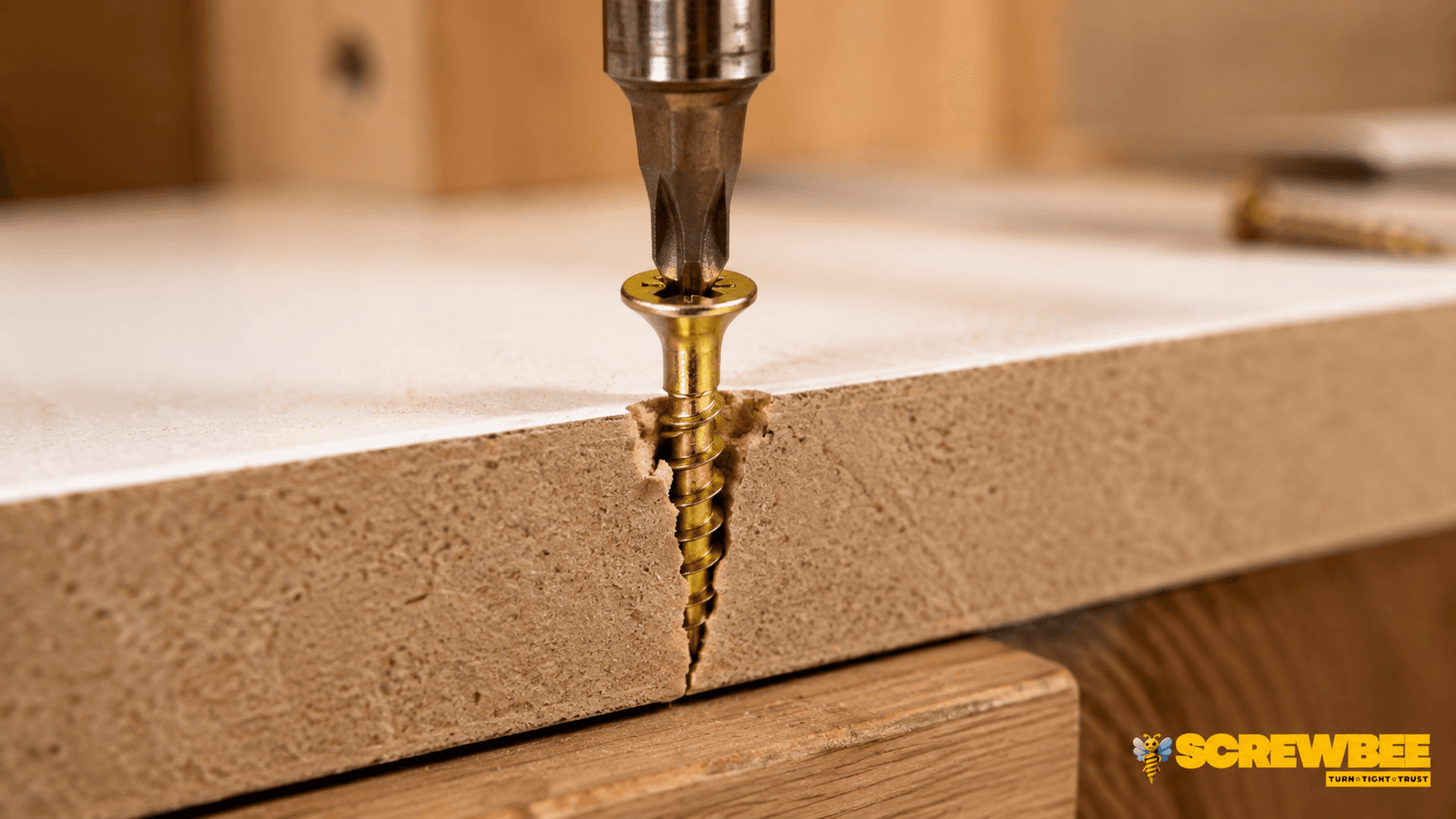
A common question is:
Do chipboard screws need a pilot hole in MDF?
The answer is: sometimes.
A sharp-point screw may start directly in some compatible applications, but a pilot hole can help when:
The screw diameter is larger
The fixing is close to an edge
The MDF is thin
The joint needs better accuracy
The board is prone to splitting
Screwbee’s product page notes that pilot-hole needs depend on the diameter and substrate.
In simple terms:
If the board is thin or the screw is large, a pilot hole is often a safer choice.
4. The Screw Is Over-Tightened
Over-tightening can damage MDF even when the screw itself is suitable.
If too much torque is applied:
The screw head may sink too deep
The MDF surface can crush
The fibres around the screw can weaken
The board may crack
How to prevent it
Use controlled tightening.
Stop when the screw is secure and the head is seated correctly.
Do not continue driving just because the tool still has power.
5. The Wrong Screw Type Is Used
Not every screw is designed for MDF or particleboard.
Using a screw with the wrong thread or head can make installation harder.
Screwbee Chipboard Screws are designed for compatible wood-based boards and use:
Deep coarse thread
Flat countersunk head
Sharp point
Mild carbon steel
Multiple drive options, including Pozi / Phillips / Torx / slotted
The coarse thread helps engage wood-based materials, while the countersunk profile supports a clean finish when installed correctly.
6. The Screw Is Not Straight
A screw installed at an angle can place uneven pressure on MDF.
This may cause:
Side cracking
Misaligned joints
Weak fastening
Surface damage
For a cleaner result:
Mark the fixing point
Keep the screw straight
Use the correct bit
Start slowly
Increase speed only after the screw is aligned
7. The Screw Is Too Long
A screw that is too long can create unnecessary stress or pass through the other side of the panel.
Before selecting length, check:
First panel thickness
Second panel thickness
Required grip depth
Whether the screw tip must remain hidden
Screwbee Chipboard Screws are available across a broad observed length range of approximately 12 mm to 100 mm.
The longest screw is not automatically the best screw.
8. The Countersunk Head Is Driven Too Deep
Chipboard Screws use a flat countersunk head.
This design helps the head sit flush or slightly below the board surface.
But if the screw is driven too deep, the head can crush the MDF around the fixing point.
That may create:
Surface damage
Weak fixing
Broken edges
Poor furniture finish
The goal is a clean flush finish, not a deeply buried screw head.
Why Are Chipboard Screws Suitable for MDF?
Chipboard Screws are designed for wood-based boards.
Screwbee’s Chipboard Screws use a deep single-start coarse thread and flat countersunk profile, designed for secure engagement in compatible particleboard and wood-based panels.
The product range is positioned for applications including:
That makes them a practical option when the size and installation method match the board.
How to Prevent MDF from Splitting When Screwing
Follow this simple checklist:
1. Check MDF thickness
Do not use an oversized screw for a thin panel.
2. Leave enough edge distance
Avoid installing too close to the edge.
3. Use a pilot hole when needed
Especially for larger screws, thin MDF or edge fixing.
4. Choose the correct screw diameter
Bigger is not always better.
5. Choose the correct screw length
Do not use unnecessary length.
6. Keep the screw straight
Misalignment can create uneven pressure.
7. Tighten carefully
Avoid excessive torque.
8. Stop at a clean countersunk finish
Do not crush the board surface.
Common MDF Screw Mistakes
Avoid these mistakes:
Using a thick screw in thin MDF
Fixing too close to the edge
Skipping a pilot hole when needed
Using the wrong screw type
Over-tightening
Driving the head too deep
Using a screw that is too long
Installing the screw at an angle
Choosing only by price
Chipboard Screws for UAE Furniture and Joinery Projects
Buyers searching for:
should check more than just screw size.
Compare:
Diameter
Length
Thread type
Head profile
Drive type
Board thickness
Edge distance
Quantity requirement
For furniture, cabinetry and joinery projects, the correct screw helps reduce splitting and improve the finished result.
Frequently Asked Questions
Why does MDF split when I screw into it?
Common causes include using a screw that is too large, fixing too close to the edge, over-tightening or skipping a pilot hole when one is needed.
Do chipboard screws work in MDF?
Yes. Chipboard Screws are commonly used in compatible MDF and other wood-based boards when the correct size and installation method are selected.
Should I drill a pilot hole in MDF?
A pilot hole can be useful when the MDF is thin, the screw diameter is larger or the fixing is close to the board edge.
What head type is used on Screwbee Chipboard Screws?
Screwbee lists a flat countersunk head for its Chipboard Screw range.
What thread type is used?
The product range uses a deep coarse thread designed for compatible wood-based boards.
What sizes are available?
The observed range covers approximately 3.0 mm to 6.0 mm diameter and 12 mm to 100 mm length.
Final Answer
So, why does MDF split when screwing?
Usually because too much pressure is created in the board.
The main causes are:
Wrong screw size → too close to edge → no pilot hole when needed → over-tightening → wrong screw type → poor alignment
The easiest prevention method is:
Choose the correct Chipboard Screw → keep enough edge distance → use a pilot hole when needed → tighten carefully
That simple process can help reduce MDF splitting and create a cleaner, stronger furniture or joinery connection.