📦 Request Quote
📞 Connect with us
Avoid common chipboard screw mistakes in MDF and particle board, including wrong size, edge splitting, over-tightening and poor countersunk seating.
Learn seven common Chipboard Screw mistakes that can cause splitting, loose joints and poor finishes in MDF and particle board.

7 Mistakes to Avoid When Using Chipboard Screws in MDF and Particle Board
Chipboard Screws are widely used in furniture, cabinetry, MDF, particle board and other compatible wood-based boards.
But even the right screw can give poor results if it is selected or installed incorrectly.
A common situation is simple:
The screw goes in, the joint looks fine, but later you notice a split edge, loose fixing, damaged surface or poor finish.
The problem may not be the screw itself.
It may be one of these common chipboard screw mistakes.
Screwbee Chipboard Screws currently feature a flat countersunk head, deep coarse thread and mild carbon steel construction, with an observed size range of approximately 3.0–6.0 mm diameter and 12–100 mm length. The range includes multiple drive options depending on specification.
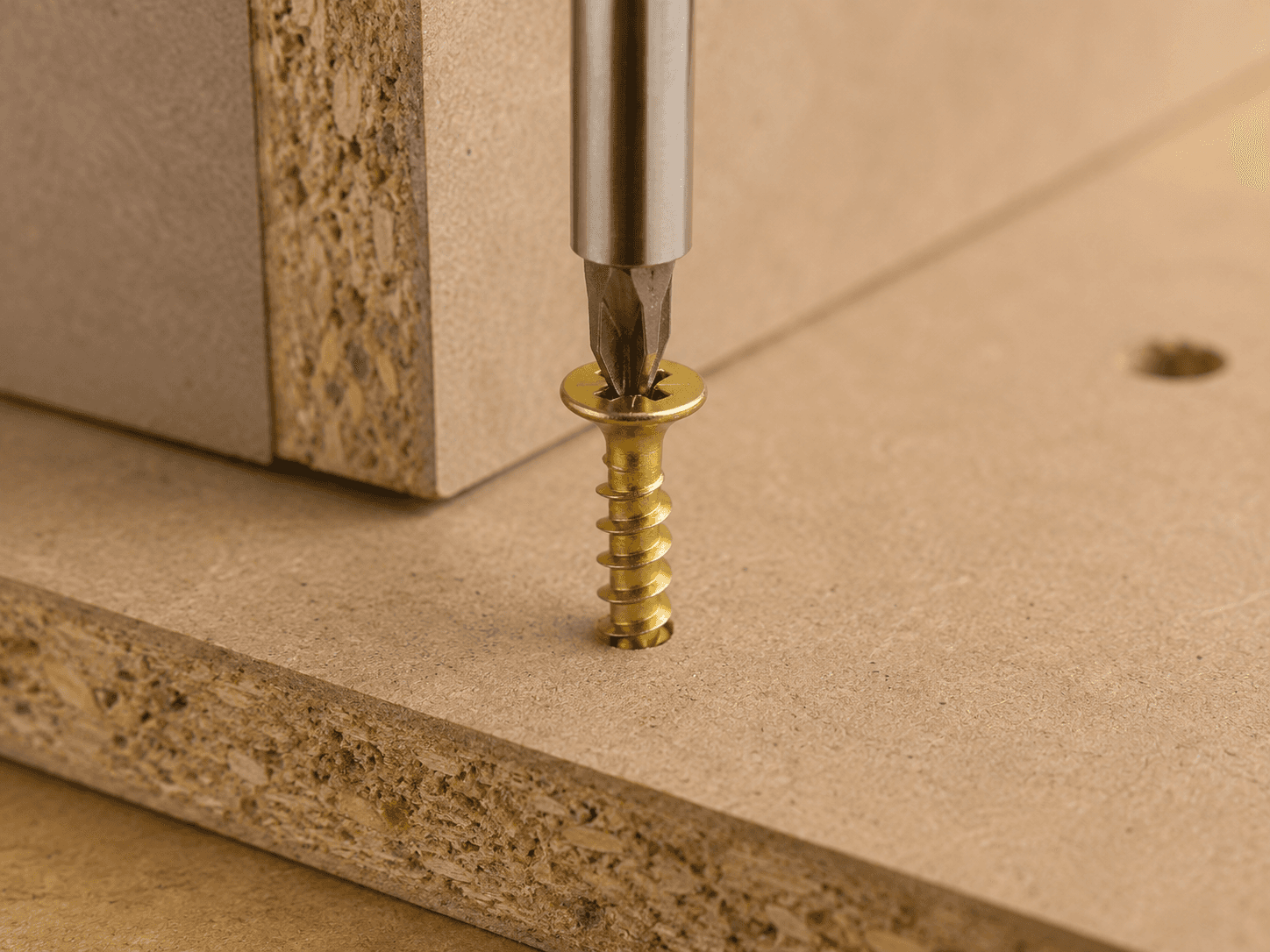
Mistake 1: Choosing the Wrong Screw Length
One of the easiest mistakes is choosing a screw only by appearance.
A screw that is too short may not provide enough engagement in the second board.
A screw that is too long may:
Come through the opposite surface
Damage a finished panel
Interfere with another component
Be unnecessary for the joint
A better approach is to check:
board thickness → joint design → required engagement → screw length
Longer does not automatically mean stronger.
Mistake 2: Using Too Large a Diameter
A thicker screw may look stronger, but that does not mean it is automatically better for MDF or particle board.
Using a screw that is too large for the material can increase stress around the fixing point.
This becomes especially important:
Near board edges
In thinner panels
In lower-density board
Where several screws are positioned close together
Screwbee's observed Chipboard Screw range covers approximately 3.0 mm to 6.0 mm diameter, so the correct diameter should be selected according to the material and application.
Mistake 3: Driving Too Close to the Edge
MDF and particle board can be more sensitive near their edges.
If a screw is placed too close to an edge, the material may split, chip or weaken.
Before driving:
Check the edge distance
Keep the screw aligned
Avoid damaged board areas
Consider a pilot hole where appropriate
This is particularly important for cabinet panels and furniture joints.
Mistake 4: Ignoring the Need for a Pilot Hole
Chipboard Screws have a sharp point and deep coarse thread, but some MDF and board applications can still benefit from a pilot hole.
A pilot hole may help:
Guide the screw
Reduce splitting risk
Improve alignment
Reduce installation stress
Whether one is needed depends on factors such as:
Board density
Screw diameter
Edge distance
Material thickness
Joint design
Do not assume every board behaves exactly the same.
Mistake 5: Over-Tightening the Screw
This is another common furniture assembly mistake.
Once the screw head reaches the surface, excessive tightening may damage the material around the threads.
You may see:
Crushed board fibres
Loose thread engagement
Damaged countersunk area
Screw spinning without tightening
A screw should be securely seated, not forced beyond what the material can handle.
Mistake 6: Driving the Countersunk Head Too Deep
Screwbee Chipboard Screws use a flat countersunk head.
The purpose is to allow a neat, flush finish in compatible wood-based boards.
But if the screw is driven too deep, the head can crush or damage the board surface.
The goal is:
Clean seating — not excessive burial
A properly seated countersunk head can help provide a smoother furniture or joinery finish.
Mistake 7: Using One Screw Specification for Every Board
MDF, particle board, plywood and other wood-based materials are not identical.
They can differ in:
Density
Thickness
Internal structure
Edge strength
Holding behaviour
So a screw that works well in one panel may not automatically be the best choice for another.
Before ordering, check the actual material and joint requirement.
Why Does the Deep Coarse Thread Matter?
Screwbee Chipboard Screws use a deep coarse thread designed for engagement in compatible wood-based boards.
This thread geometry can help provide grip in materials such as:
Chipboard
Particle board
MDF
Compatible plywood
Furniture panels
But thread design alone cannot compensate for poor installation.
Correct screw size, alignment and tightening still matter.
Example Scenario: MDF Cabinet Side Panel
Imagine a cabinet side panel being assembled.
The installer uses:
A large-diameter screw
Very little edge distance
No pilot hole
High driver torque
The screw goes in quickly.
But a small crack appears near the edge.
The issue is not necessarily poor screw quality.
The better diagnosis is:
Material + edge distance + screw diameter + pilot hole + torque
This is why installation choices matter as much as the screw itself.
Quick Chipboard Screw Checklist
Before installation, check:
What board material are you using?
What is the board thickness?
What screw length is required?
Is the diameter suitable?
How close is the screw to the edge?
Would a pilot hole help?
Is the screw being driven straight?
Is the countersunk head seating correctly?
Are you avoiding excessive torque?
This simple check can prevent many common problems.
Chipboard Screws for Furniture and Joinery
Chipboard Screws are commonly used in applications such as:
Furniture assembly
Cabinet construction
MDF fixing
Particle-board fixing
Joinery
Wood-based panel assembly
Screwbee's current product range uses a flat countersunk head, deep coarse thread and zinc finish across many listed size combinations.
Chipboard Screws for UAE Buyers
Furniture manufacturers, joinery workshops, fit-out companies and hardware buyers may search for:
For bulk buying, avoid choosing only by price.
Check:
material → size → thread → head → drive → finish → quantity
That gives buyers a much clearer specification before ordering.
Frequently Asked Questions
What are the most common chipboard screw mistakes?
Common mistakes include choosing the wrong length or diameter, installing too close to the edge, ignoring pilot-hole needs, over-tightening and driving the countersunk head too deep.
Can Chipboard Screws be used in MDF?
They can be used in compatible MDF applications when the screw size, board thickness and installation method are suitable.
Why does MDF split when screwing?
Possible causes include excessive screw diameter, installation near the edge, lack of a suitable pilot hole, poor alignment or excessive tightening.
What head type do Screwbee Chipboard Screws use?
The current product range uses a flat countersunk head.
What thread do Chipboard Screws use?
Screwbee lists a deep coarse thread for its Chipboard Screw range.
What sizes are available?
The observed range currently covers approximately 3.0–6.0 mm diameter and 12–100 mm length. Exact combinations should be confirmed before ordering.
Final Answer
Most chipboard screw problems are not caused by one factor alone.
The safer approach is to check:
Board material → screw diameter → screw length → edge distance → pilot hole → alignment → tightening
Choosing and installing the screw according to the complete joint helps reduce splitting, loose fixing and surface damage.