📦 Request Quote
📞 Connect with us
Find clear answers to 50 coarse thread drywall screw questions covering wooden studs, screw size, length, spacing, driving depth, ceilings, finishes and bulk buying.
Practical answers to 50 common questions about selecting and installing coarse-thread drywall screws in wooden-stud systems.
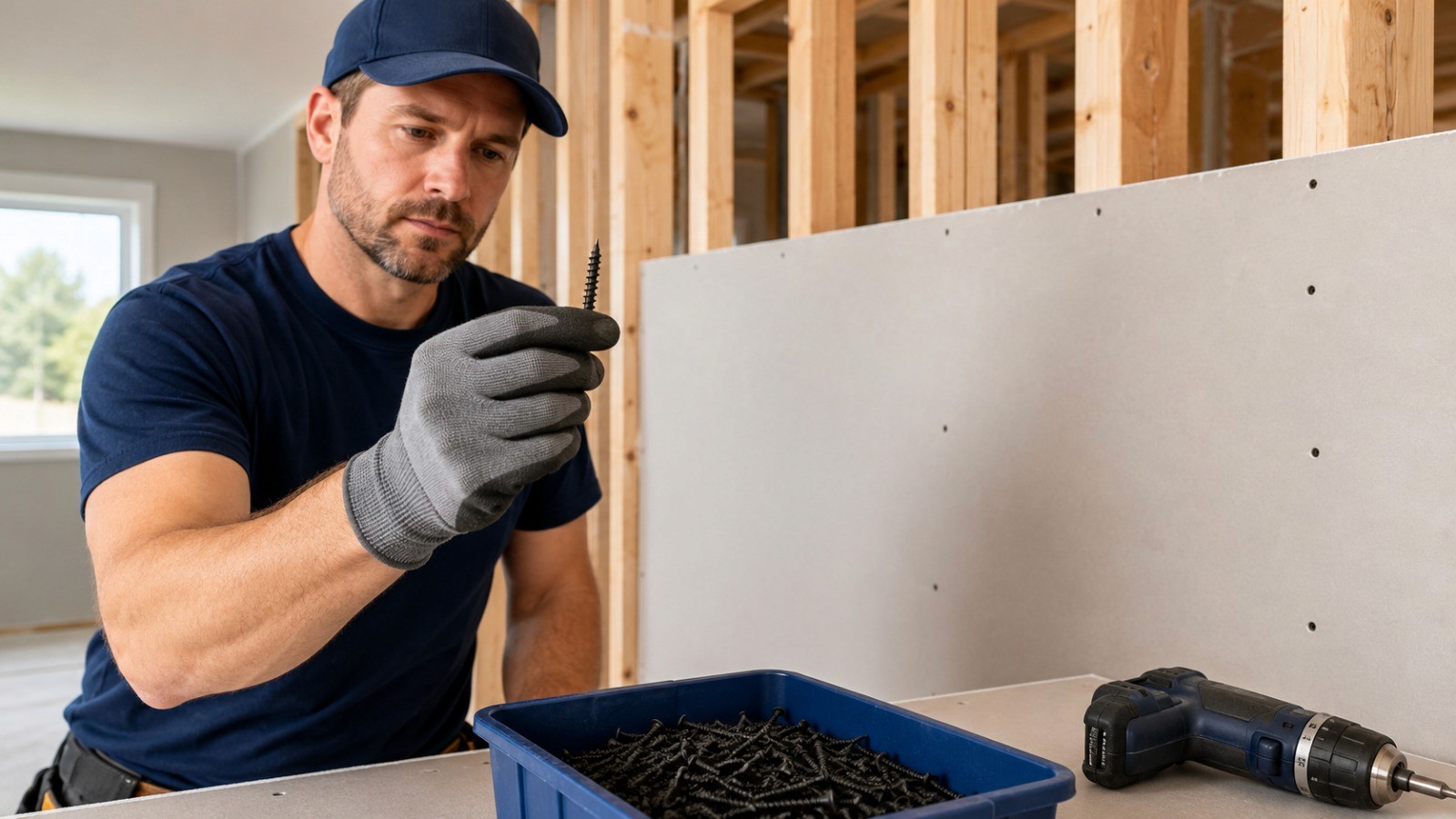
50 Questions and Answers About Coarse-Thread Drywall Screws
Before starting a wooden-stud drywall project, a contractor contacts the supplier with several practical questions.
Which coarse-thread screw size should be selected? Can one screw length be used for single-layer and double-layer boards? Are coarse drywall screws suitable for timber-framed ceilings? How deeply should the screw enter the wood stud? What causes drywall screw pops after finishing?
These decisions directly affect installation quality. An unsuitable fastener can result in spinning screws, loose boards, torn paper facing, split timber, visible screw heads and unnecessary rework.
This guide answers 50 common coarse thread drywall screw questions about sizes, wooden-stud applications, screw length, timber penetration, spacing, driving depth, finishes, storage and purchasing.
Quick Answer
Coarse-thread drywall screws are commonly used to secure gypsum board to suitable wooden studs because their deep, widely spaced threads engage wood fibres effectively.
Before installation, confirm:
• Board thickness
• Number of board layers
• Timber type and condition
• Required framing engagement
• Wall or ceiling application
• Correct screw length
• Approved fixing centres
• Screw-head driving depth
• Finish requirement
• Project specification
For a broader product overview, read the complete drywall screw guide.
Basic Coarse-Thread Drywall Screw Questions
1. What is a coarse-thread drywall screw?
A coarse-thread drywall screw is a gypsum-board fastener with deep, widely spaced threads intended to engage suitable timber framing.
Typical features include:
• Sharp point
• Coarse thread pattern
• Bugle-shaped head
• Phillips drive
• Hardened steel construction
• Black or zinc-based finish
2. Why is it called a coarse-thread screw?
The name refers to the wider spacing between the threads.
Compared with fine-thread screws, coarse-thread screws normally have fewer threads over the same length, but the threads are deeper and designed to grip wood fibres.
3. What is the main application of coarse drywall screws?
Their primary drywall application is fixing gypsum board to suitable:
• Wooden studs
• Timber battens
• Timber-framed partitions
• Wood-framed wall linings
• Approved timber ceiling systems
For additional applications, review the drywall screw applications guide.
4. Are coarse drywall screws the same as wood screws?
No.
Although both can enter timber, they are designed for different purposes. Drywall screws commonly use a bugle head that seats into gypsum board, while wood screws may use different head, shank and thread designs.
5. Are coarse-thread drywall screws suitable for gypsum board?
Yes, when the gypsum board is being fixed to compatible wooden framing and the screw matches the board thickness, number of layers and approved installation system.
6. Do coarse drywall screws normally have a bugle head?
Yes. A bugle head gradually enters the board surface and creates a shallow recess for joint compound.
Read more about this design in the bugle-head screws guide.
7. Are all black drywall screws coarse-thread screws?
No.
Colour or finish does not identify the thread type. Black screws may be available with either coarse or fine threads.
8. Are coarse-thread drywall screws stronger than fine-thread screws?
They should not be compared only as stronger or weaker.
Each thread type is intended for a different framing material:
• Coarse thread: suitable wooden framing
• Fine thread: suitable light-gauge metal framing
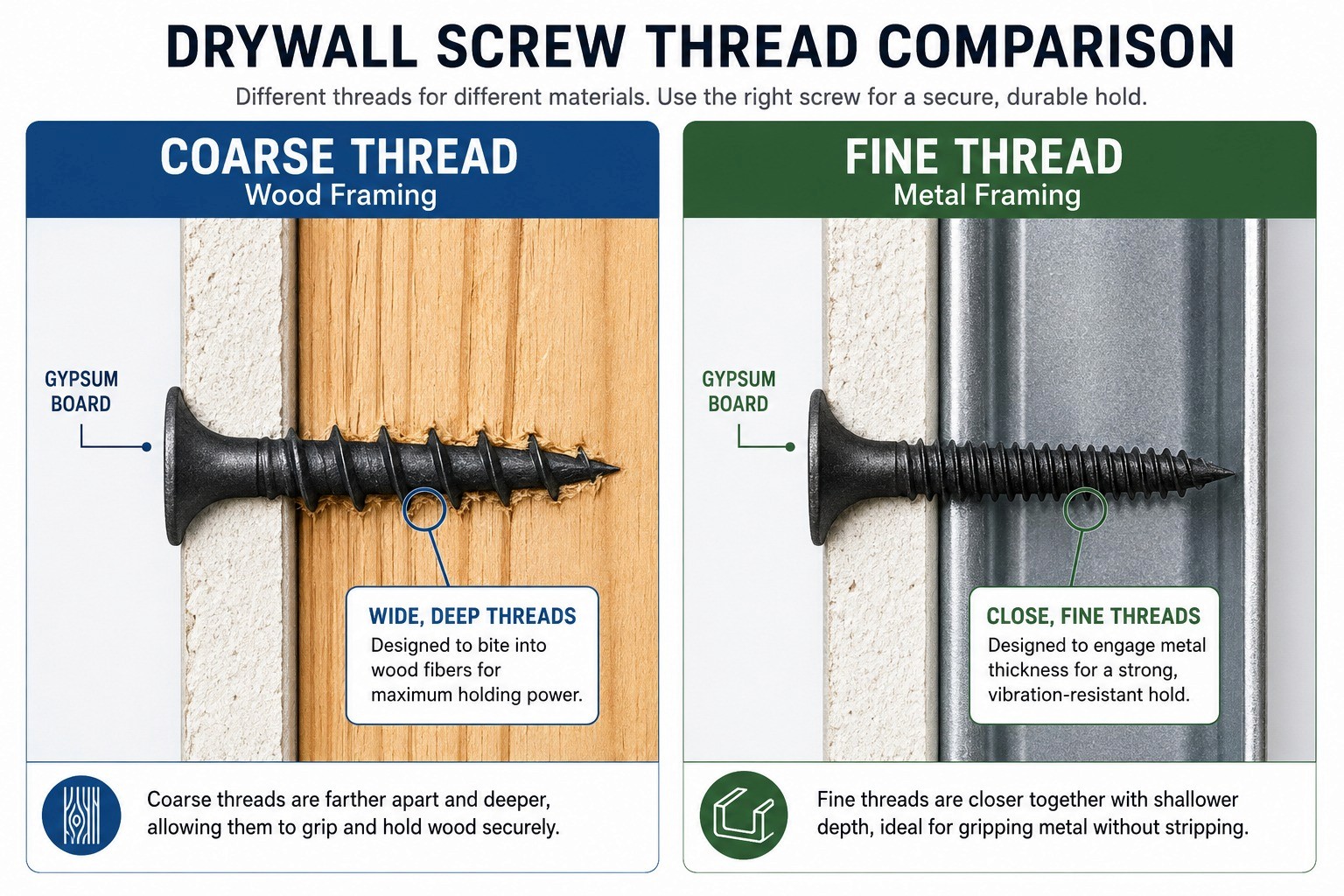
See the complete fine-thread vs coarse-thread drywall screw comparison.
Practical Example 1: Confirm the Framing First
A contractor orders black zinc drywall screws after checking only the colour and length. At the site, the framing is metal rather than timber.
The problem is not the black finish. The thread pattern does not match the framing material.
The correct process is:
1. Confirm wood or metal framing.
2. Select the suitable thread type.
3. Measure the board build-up.
4. Choose the required length.
5. Check the approved installation system.
Drywall Screws for Wooden Studs
9. Why are coarse-thread drywall screws suitable for wooden studs?
Their wide, deep threads cut into and engage wood fibres. This helps pull the gypsum board firmly against the timber framing.
10. Can coarse-thread drywall screws be used with softwood studs?
They are commonly used with suitable softwood framing.
Before installation, inspect the timber for:
• Splits
• Bowing
• Excessive moisture
• Damaged edges
• Loose framing
• Old stripped fixing holes
11. Can coarse-thread screws be used with hardwood framing?
Suitability depends on the timber density, screw design and approved installation method.
For dense hardwood:
• Reduce excessive driving speed.
• Keep screws away from timber edges.
• Check for splitting.
• Do not force a screw that is not entering correctly.
• Follow any approved pilot-hole requirements.
12. Can a coarse drywall screw split a wooden stud?
Yes, especially when the screw is driven:
• Too close to the timber edge
• Into already cracked framing
• At excessive speed
• Into unusually dense wood
• Beside several other fixings in a small area
13. How can wood splitting be reduced?
To reduce splitting:
• Position the screw away from timber edges.
• Inspect the framing before boarding.
• Avoid excessive driver pressure.
• Keep the screw centred on the stud.
• Do not reuse damaged holes.
• Follow the approved installation method.
14. Can coarse-thread drywall screws be used with timber battens?
They may be suitable when the batten provides enough sound timber for the required framing engagement.
The batten dimensions and installation system should be checked before screw selection.
15. Can coarse drywall screws be used in engineered timber?
Do not assume compatibility.
Confirm the approved fastener, penetration and preparation requirements for the specific engineered timber product.
16. What happens when a drywall screw misses the wooden stud?
A screw beside the framing does not create a reliable board-to-stud connection.
It may:
• Spin without tightening
• Remain loose
• Damage the paper
• Appear secure temporarily
• Cause movement during finishing
Practical Example 2: A Spinning Screw
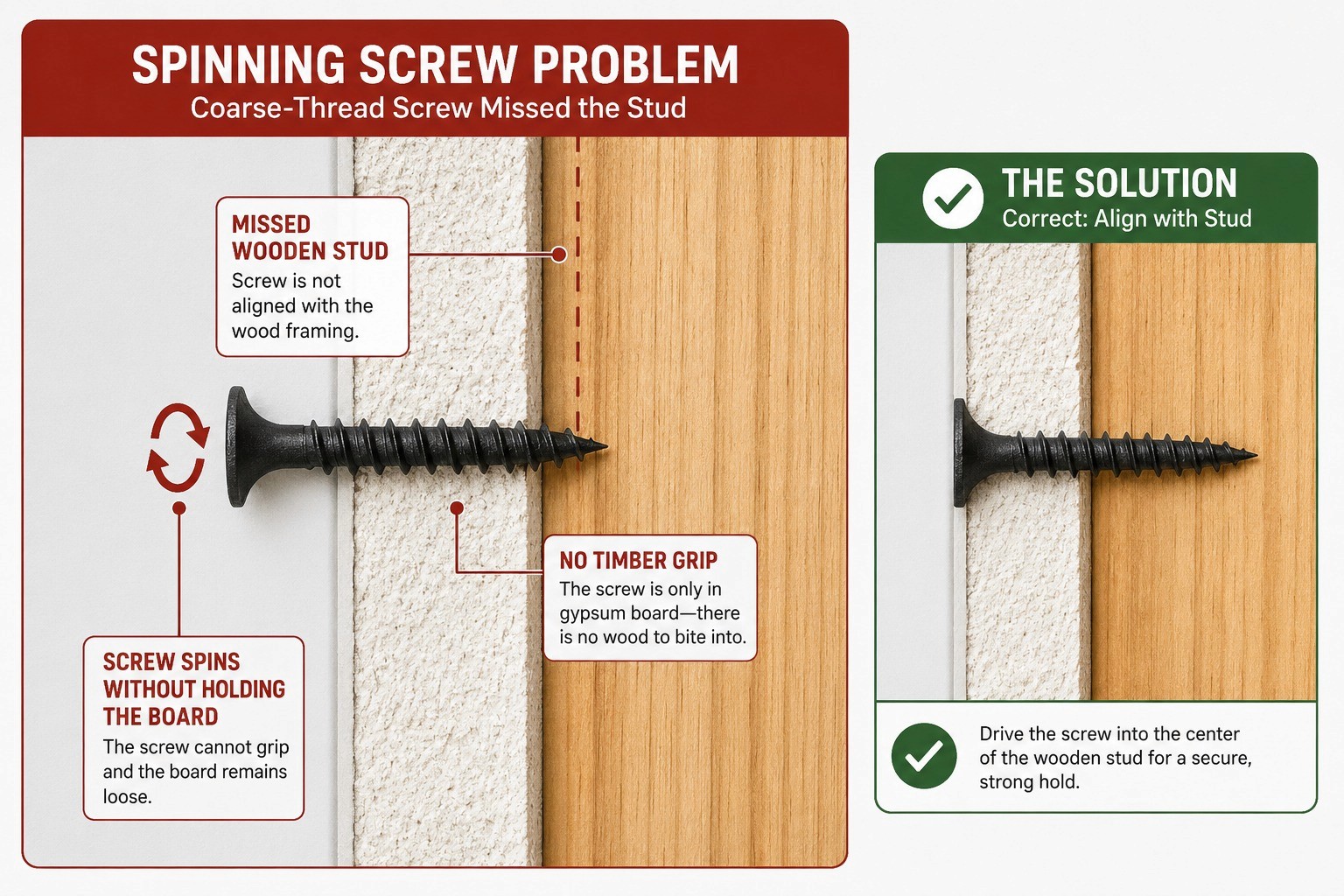
An installer drives a coarse-thread screw, but it keeps spinning without pulling the board tight.
Possible causes include:
• The screw missed the stud.
• The screw is too short.
• The timber is damaged.
• The screw entered an old stripped hole.
• The board is not held against the framing.
Remove the screw, identify the cause and install a suitable replacement in an approved nearby position.
Coarse-Thread Screw Size and Length Questions
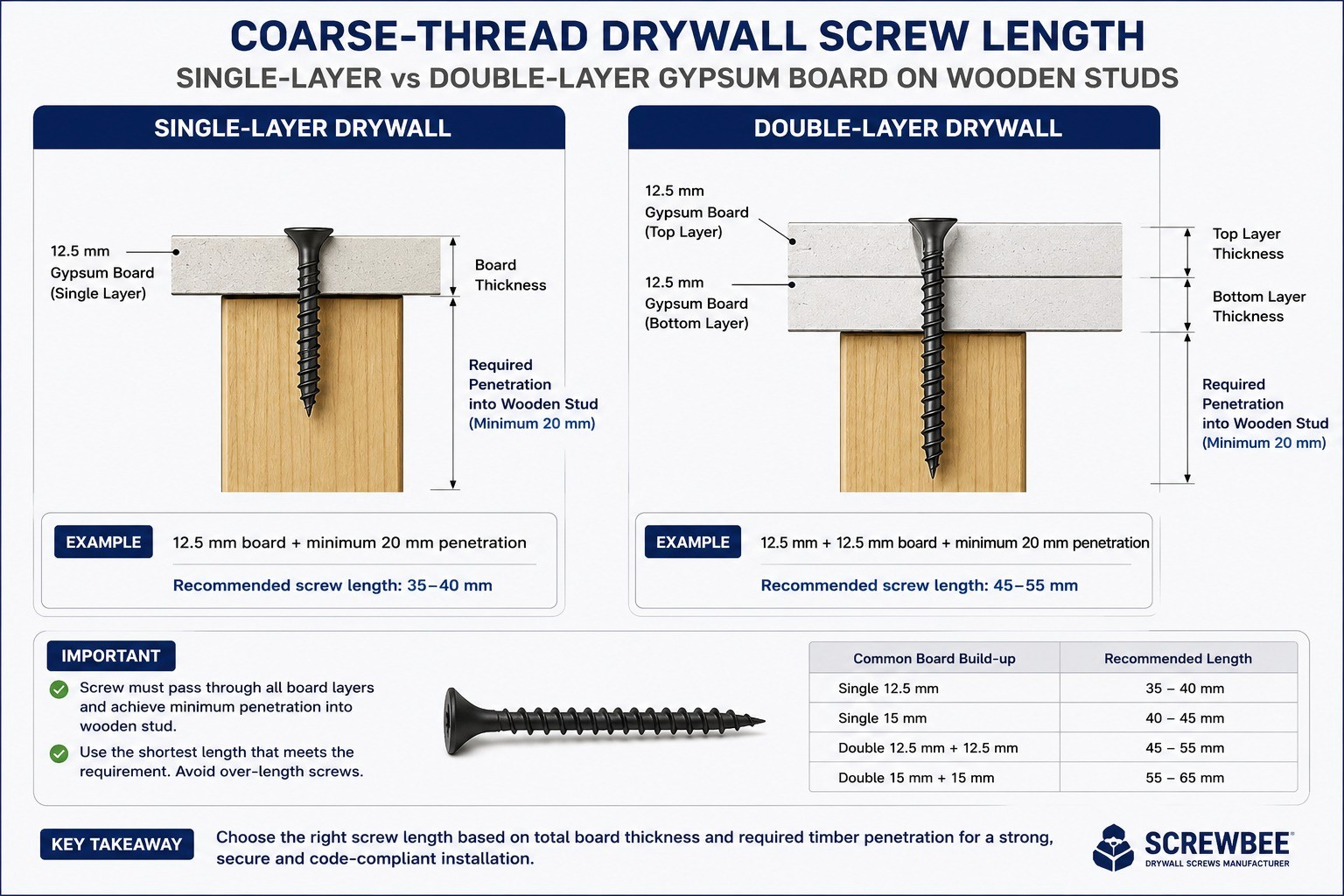
17. How should coarse drywall screw length be selected for wooden studs?
Add the total board build-up to the framing engagement required by the approved system.
The complete calculation should consider:
• Board thickness
• Number of layers
• Intermediate materials
• Required timber penetration
• Wall or ceiling use
18. Does board thickness alone determine screw length?
No.
The installer should also check:
• Number of board layers
• Timber framing arrangement
• Resilient channels
• Approved framing engagement
• Concealed electrical or plumbing services
19. Can one coarse-thread screw size be used for every project?
No.
Different projects may use:
• Different board thicknesses
• Single or multiple board layers
• Walls and ceilings
• Timber studs and battens
• Specialist acoustic or fire-rated systems
20. What happens if a coarse drywall screw is too short?
A short screw may not engage enough sound timber.
Possible results include:
• Spinning screws
• Loose board edges
• Weak fixing points
• Movement during finishing
• Visible screw heads later
21. What happens if a coarse-thread screw is too long?
An unnecessarily long screw can:
• Be harder to control
• Increase driving time
• Increase fastener cost
• Raise the risk of contacting concealed services
• Fail to match the approved system
22. How is screw length chosen for a single-layer gypsum board?
The screw must pass through the full board thickness and enter the wooden stud according to the approved framing-engagement requirement.
23. How is screw length chosen for a double-layer board?
The outer-layer screw must pass through both boards before reaching the timber framing.
Calculate:
• First-layer thickness
• Second-layer thickness
• Any intermediate component
• Required timber penetration
24. Can the same screw be used for the first and second board layers?
Not automatically.
A screw suitable for the first layer may be too short for the outer layer.
25. Does a longer screw always provide better holding?
No.
The correct selection is a suitable screw that passes through the complete board build-up and provides the required timber engagement without excessive additional length.
Practical Example 3: Incorrect Double-Layer Screw Length
A contractor uses the same screw for both layers of a double-layer partition.
The first layer is secure, but the outer layer moves because its screw barely reaches the wooden stud.
The correct approach is to calculate the combined board thickness before choosing the outer-layer fastener.
Single-Layer and Double-Layer Board Questions
26. Are coarse drywall screws suitable for single-layer walls?
Yes, when the screw length, board thickness, timber framing and fixing pattern match the approved wall system.
27. Are coarse-thread drywall screws suitable for double-layer walls?
Yes, but the screw used for the outer layer must account for the total thickness of both boards.
28. Should each board layer be fastened separately?
This depends on the approved installation system.
Some assemblies specify separate fixing patterns and screw lengths for each layer.
29. Should joints be staggered in double-layer drywall systems?
Many multi-layer systems use staggered joints, but the exact arrangement should come from the approved system documentation.
30. Can one fixing pattern be used for both layers?
Not automatically.
The first and outer layers may have different fixing-centre requirements.
31. What should buyers confirm for multi-layer drywall projects?
Confirm:
• Thickness of each layer
• Required screw length for each layer
• Joint arrangement
• Fixing centres
• Framing-engagement requirements
• Required screw quantity
32. Why do outer-layer screws sometimes spin?
Possible causes include:
• Insufficient screw length
• Missed framing
• Damaged timber
• Angled driving
• Reuse of a stripped fixing path
Wall and Ceiling Installation Questions
33. Can coarse-thread drywall screws be used for wooden-stud walls?
Yes, when the screws are compatible with the board and approved timber-framed wall system.
34. Can coarse-thread screws be used for timber-framed ceilings?
They may be suitable for approved ceiling systems using timber joists or battens.
The screw length and spacing should be checked separately from wall requirements.
35. Can drywall screw spacing for wooden-stud walls be used on ceilings?
Not automatically.
Ceiling fixing centres may differ because boards are installed overhead and remain subject to gravity.
36. Why may ceilings require closer screw spacing?
Closer approved fixing centres may help keep ceiling boards firmly supported between joists or battens.
The exact spacing must come from the selected ceiling system.
37. Can one screw length be used for walls and ceilings?
Not automatically.
Walls and ceilings may use different:
• Board thicknesses
• Framing arrangements
• Fixing patterns
• Required screw lengths
38. Should ceiling boards be supported while screws are installed?
Yes.The board should be held firmly against the framing before driving the screws.
Practical Example 4: Wall Spacing Used on a Ceiling
An installer copies a wall fixing pattern onto a timber-framed ceiling.
Later, the board shows movement between fixing points.
The mistake was assuming one spacing rule applies everywhere. The approved ceiling fixing pattern should have been confirmed before installation.
Drywall Screw Driving Depth Questions
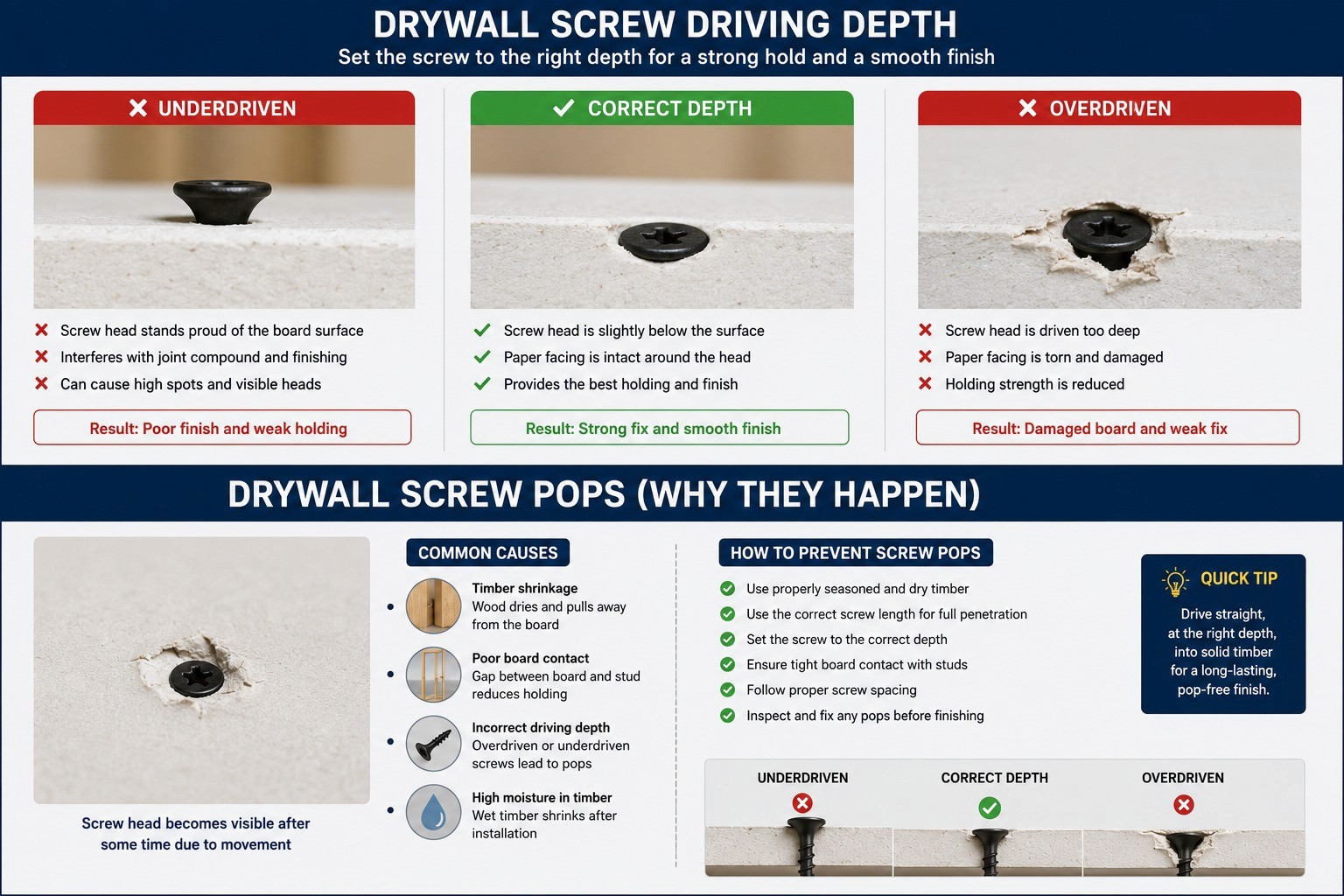
39. What is the correct drywall screw driving depth?
The bugle head should sit slightly below the board surface without tearing the paper facing.
40. What is an underdriven drywall screw?
An underdriven screw remains above the surface.
It may:
• Interfere with joint compound
• Create a visible high point
• Prevent proper finishing
• Indicate poor board contact
41. What is an overdriven drywall screw?
An overdriven screw is driven too deeply into the board, tearing the paper and entering the softer gypsum core.
42. Why is torn drywall paper a problem?
The paper facing supports the screw head.
When the paper is badly torn:
• The fixing point may weaken.
• The screw may no longer hold the board correctly.
• Another fixing may be required nearby.
• Additional finishing work may be needed.
Screw Pops and Timber Movement Questions
43. What causes drywall screw pops in timber framing?
Possible causes include:
• Timber shrinkage
• High timber moisture
• Twisted or bowed framing
• Poor board contact
• Insufficient screw engagement
• Overdriving
• Missed studs
• Finishing over defective fixings
44. Can timber moisture cause screw pops?
Yes.
Timber installed with high moisture content may shrink as it dries. This movement can change the relationship between the board, framing, screw and joint compound.
45. Can a longer screw prevent every screw pop?
No.
Screw pops may result from framing movement, board contact, damaged paper, incorrect spacing or poor finishing—not only screw length.
46. How can drywall screw pops be prevented?
The risk can be reduced by:
• Using properly conditioned timber
• Aligning the framing before boarding
• Choosing the correct screw length
• Holding the board firmly against the studs
• Avoiding overdriving
• Following approved fixing centres
• Inspecting all fixings before finishing
Practical Example 5: Screw Heads Appear After Finishing
Several screw heads become visible a few weeks after installation.
The board is initially blamed, but inspection shows that the timber was wet during installation and several screws had torn the paper facing.
The repair should address the framing and fixing defects rather than only covering the visible heads.
Finish, Storage and Purchasing Questions
47. Should black or zinc coarse-thread drywall screws be selected?
Select the finish according to:
• Project specification
• Intended environment
• Storage conditions
• Corrosion-resistance expectations
• Approved application
Finish alone does not determine suitability.
48. How should coarse-thread drywall screws be stored?
Store the screws:
• In a dry, covered area
• Inside closed packaging
• Away from water and excessive humidity
• Off wet floors
• Separated by size and finish
49. What should buyers confirm before ordering coarse-thread drywall screws?
Confirm:
• Board thickness
• Number of board layers
• Wooden-stud or batten arrangement
• Required screw lengths
• Diameter
• Head and drive type
• Finish
• Packaging quantity
• Delivery schedule
Buyers planning larger quantities can review the bulk drywall screw buying guide.
50. Is it better to order one size or a mixed-size quantity?
A mixed-size order may be more suitable when the project includes:
• Single-layer walls
• Double-layer walls
• Timber-framed ceilings
• Different gypsum-board thicknesses
The final size mix should be based on actual installation requirements.
Final Buyer Checklist
Before ordering coarse-thread drywall screws, confirm:
• Framing material is wood
• Timber type and condition are known
• Board thickness is confirmed
• Number of board layers is confirmed
• Required timber penetration is known
• Correct screw lengths are selected
• Wall and ceiling requirements are separated
• Finish is approved
• Packaging quantity is suitable
• Storage conditions are dry
• Approved fixing centres are available
• Product samples are checked where necessary
Available screw options can be reviewed on the Screwbee products page.
Conclusion
These 50 coarse thread drywall screw questions address the practical doubts contractors, installers, dealers and buyers face when fixing gypsum board to wooden framing.
The most important steps are:
• Confirm the framing material.
• Choose suitable drywall screws for wooden studs.
• Measure the complete board build-up.
• Select the correct coarse-thread screw size.
• Confirm the required drywall screw length for timber framing.
• Drive the screw perpendicular to the board.
• Set the correct drywall screw driving depth.
• Keep the paper facing intact.
• Follow approved drywall screw spacing for wooden studs and ceilings.
• Inspect all fixings before finishing.
Correct coarse drywall screw installation can help reduce split timber, spinning screws, loose boards, paper damage, screw pops and unnecessary rework.
For sizes, finishes, packaging, product availability or bulk enquiries, contact Screwbee.
Source Drywall Screws from Screwbee
Looking for reliable drywall screws for wholesale, distribution or project procurement? Screwbee offers zinc and black zinc drywall screws in multiple sizes with dependable bulk-supply support.
📞 Ready to Work with a Trusted Drywall Screw Manufacturer?
Whether you're sourcing drywall screws for wholesale distribution, commercial construction, or long-term procurement, Screwbee is ready to support your business with premium manufacturing, consistent quality, and dependable supply.
🟨 Request Bulk Quote
📘 Download Product Catalogue
📞 Contact Our Sales Team
Related Products
Zinc Drywall Screws — Explore available sizes and thread options.
Black Zinc Drywall Screws — Discover Screwbee’s dark zinc-finished product range.
Drywall/Gypsum Screws — Learn about available specifications for gypsum-board fixing.