
A practical guide to choosing the right drywall screw size, length, thread, and point for gypsum board partitions, ceilings, and framing applications.
Drywall Screw Size Guide for Gypsum Board Partitions in India
📦 Request Quote
📞 Connect with us
Drywall Screw Size Guide for Gypsum Board Partitions in India
Choosing a drywall screw by appearance alone is one of the easiest ways to create installation delays. A screw can look sharp, have a black finish, and still be the wrong choice for the board thickness, framing material, or wall assembly. For contractors, builders, wholesalers, and project procurement teams, a drywall screw size guide is therefore not a minor reference. It is a practical control point for gypsum board quality, labour productivity, and material wastage.
In Indian interiors, gypsum board partitions are used in offices, hospitals, retail sites, hotels, residences, schools, and industrial facilities. These jobs often combine several board thicknesses, light-gauge metal studs, ceiling channels, insulation, and multiple layers of board. The right drywall screw must pass through the board, engage the framing adequately, and seat below the surface without tearing the paper face.
Start with the board and the substrate
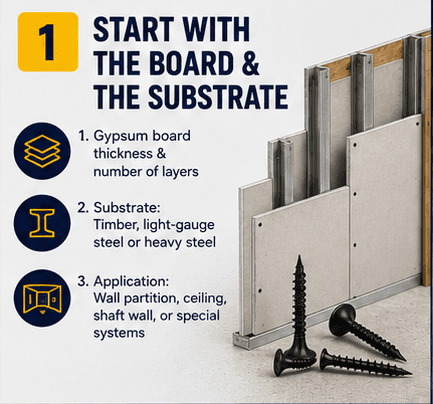
The first question is not “Which screw is cheapest?” It is “What exactly is being fastened?” Record three things before placing a bulk order:
1. Gypsum board thickness and number of layers.
2. Substrate: timber, light-gauge steel, or a heavier steel member.
3. Application: wall partition, ceiling, shaft wall, or a special fire- or acoustic-rated system.
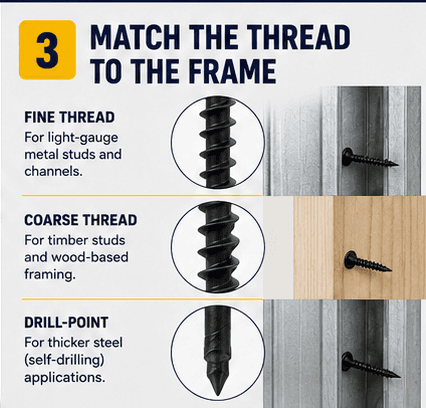
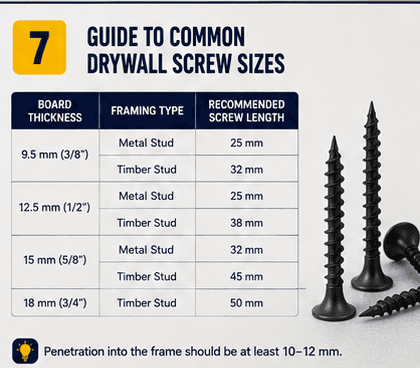
For a single standard board fixed to light-gauge metal framing, a fine-thread drywall screw is commonly selected. The fine thread is designed to bite into thin metal without excessively damaging the stud. Timber framing typically calls for a coarse-thread drywall screw because its deeper, more widely spaced thread obtains purchase in wood fibres. Heavy-gauge steel may require a drill-point or self-drilling fastener instead of a standard sharp-point drywall screw.
How to choose screw length
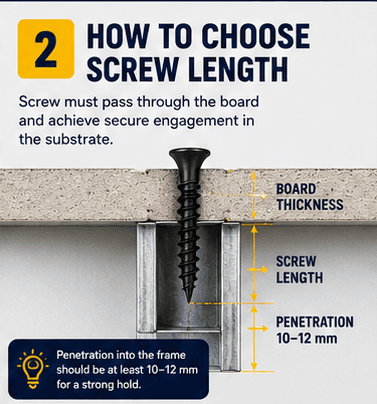
A useful purchasing rule is that the screw must be long enough to pass through the board and achieve secure engagement in the substrate. It should not be selected only by the visible head size or by a “one size for all” site habit.
Single-layer gypsum board
For common single-layer boards, contractors often use a screw length that extends beyond the board and gives meaningful bite into the stud or timber. The exact requirement should follow the board-system specification, framing gauge, and project drawings. A buying team should list board thickness separately for each work area instead of assuming every gypsum sheet is identical.
Double-layer and fire-rated assemblies
Multi-layer partitions need a different approach. The second layer may need a longer screw that passes through both boards and still reaches the framing. If the screw is too short, the outer board can feel secure initially but may not provide dependable holding under service movement. If it is too long, it can create unnecessary protrusion, interfere with services, or raise cost without improving performance.
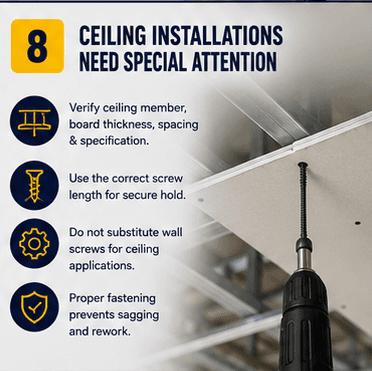
Ceiling installations
Ceilings deserve special attention because overhead work magnifies the consequences of poor fastening. Verify the ceiling member, board thickness, spacing, and specification before ordering. Avoid substituting wall-partition screws simply because the cartons are already on site.
Match the thread to the frame
Thread type has a direct impact on driving performance and holding quality.
Fine-thread drywall screws
Fine-thread drywall screws are generally used for gypsum board fixed to light metal studs and channels. Their closer thread pattern supports controlled engagement in thin steel framing. For commercial partitions and office fit-outs using cold-formed metal framing, this is the category procurement teams should verify first.
Coarse-thread drywall screws
Coarse-thread drywall screws are commonly associated with timber studs and wood-based backing. Their deeper threads grip timber effectively and can reduce the risk of weak holding caused by using a metal-stud screw in wood.
Drill-point screws
Where framing steel is thicker than the system intended for a sharp-point drywall screw, a drill-point screw may be required. The drill point helps penetrate the steel before the thread engages. It is important not to treat “self-drilling” as a universal upgrade: the correct fastener depends on the metal thickness and approved wall-system detail.
The head matters as much as the length
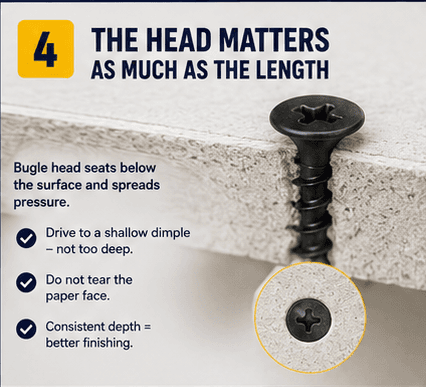
Most drywall fasteners use a bugle head. Its curved shape helps the head seat slightly below the gypsum surface while spreading pressure around the paper face. Proper seating makes joint finishing easier. An over-driven screw that breaks the paper is not a successful fixing, even if the head looks flush.
For site teams, the target is a shallow dimple: the head should sit just below the board surface, without tearing the paper and without standing proud. Screw-gun depth settings, a stable bit, and consistent operator technique all influence this result.
A practical procurement checklist
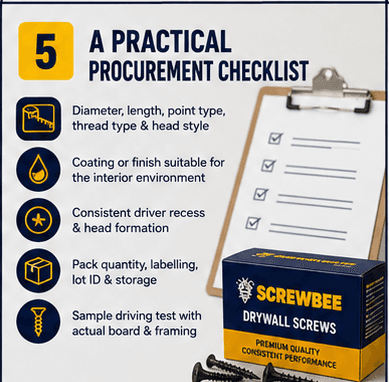
Before ordering gypsum board screws in bulk, ask the supplier for a clear specification sheet or sample approval. Check:
- Nominal diameter, length, point type, thread type, and head style.
- Coating or finish suitable for the intended interior environment.
- Consistent driver recess and head formation.
- Pack quantity, carton labelling, lot identification, and storage conditions.
- A sample driving test with the actual board and framing used on site.
Bulk procurement should also allow for separate SKUs. A project with partitions and ceilings may need different screw sizes. Combining them into one generic “drywall screw” purchase order can create sorting errors and on-site substitutions.
Common size-selection mistakes
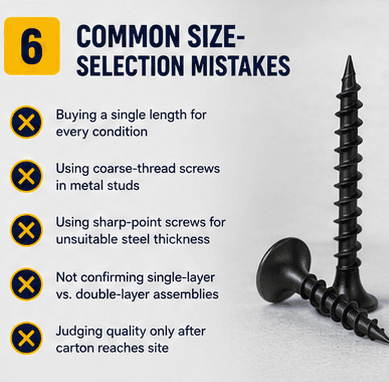
The most common mistake is buying a single length for every wall and ceiling condition. Other frequent errors include using coarse-thread screws in metal studs, using sharp-point screws for unsuitable steel thicknesses, and selecting fasteners without confirming whether the assembly is single- or double-layer.
Another mistake is judging quality only after a carton reaches site. A small pilot test before a large order can reveal stripping, inconsistent driving, head breakage, or poor engagement. This is particularly useful for contractors managing fast-paced interior packages across multiple locations.
The Screwbee approach to buying drywall screws
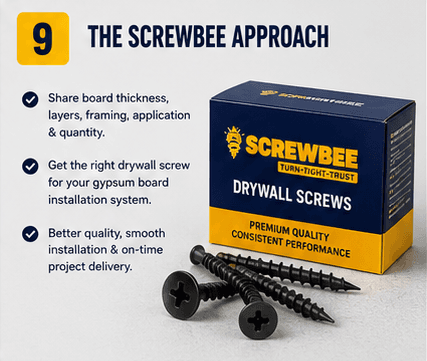
For a Screwbee enquiry, share the board thickness, number of layers, framing type, steel gauge where relevant, application, and required quantity. This gives the procurement conversation a technical base rather than a price-only comparison. Screwbee can then help a buyer identify the correct drywall screw category for the gypsum board installation system being planned.
The right drywall screw size is a small decision with a large effect on finishing quality and project flow
📦 Explore Our Product Range
📞 Talk to Our Sales Team

Precision Fasteners for Stronger Connections. We manufacture high quality industrial screws designed for durability, strength, and global standards.
Contact
+91 94875 28279
sales@screwbee.in
352/5, 352/6, Kaatuvilai, Kattimancode, Kurundankod, Kanniyakumari, TamilNadu-629801
© 2026 Screwbee Fasteners. All rights reserved.