📦 Request Quote
📞 Connect with us
Learn why furniture screw joints can loosen and how screw length, diameter, thread engagement, alignment and tightening affect the connection.
A practical guide to why furniture screw joints loosen and how the right screw length, diameter and installation can improve the connection.

A Furniture Joint Looked Strong but Failed — Was the Screw Choice Wrong?
Imagine a cabinet or furniture joint that looks perfectly fine after assembly.
The panels are aligned. The screw is tight. The surface looks clean.
But after repeated use, the joint slowly starts to loosen.
The first reaction may be:
“Was the screw too small?”
Maybe — but screw failure in furniture is not always caused by size alone.
The real issue can come from a combination of:
Wrong screw length
Incorrect diameter
Poor thread engagement
Weak material around the fixing point
Over-tightening
Misalignment
Unsuitable screw design for the application
For furniture, cabinetry and woodwork, Flat Head Allen Screws can be a useful option when the screw specification matches the joint and material.
Screwbee's current Flat Head Allen Screw range uses an internal hex drive, low-profile flat/countersunk head, full thread, black zinc finish and deep coarse thread geometry, with diameters approximately M3.5–M4.8 and selected lengths from 16–60 mm.
Why Can a Furniture Joint Fail Even When the Screw Feels Tight?
A screw feeling tight during assembly does not automatically mean the joint is ideal.
The screw needs to create enough engagement in the material while keeping the connected parts properly seated.
A furniture joint may become loose if:
Too little thread enters the second component
The screw is too large for the material
The screw hole becomes damaged
The screw is driven at an angle
Excessive torque damages the material
The joint experiences repeated movement
So screw selection should consider the entire joint, not only the screw itself.
Problem 1: The Screw Is Too Short
A screw that is too short may enter the second panel only slightly.
At first, the joint may look secure.
But the thread may not have enough material to grip.
With repeated movement, the connection may loosen.
A better approach is to choose enough length for proper engagement without unnecessarily extending through the material.
The correct length depends on:
Material thickness
Joint design
Number of connected components
Required engagement
Application requirement
Problem 2: The Screw Is Too Long
Longer does not always mean stronger.
A screw that is unnecessarily long can:
Pass through the opposite side
Damage the finished surface
Interfere with another component
Make assembly harder
Create an unsuitable joint
This is especially important in cabinets and furniture where panel thickness can be limited.
Choose the length for the actual joint.
Problem 3: The Diameter Does Not Match the Material
Diameter means how thick the screw is.
If the screw is too small, it may not provide enough engagement for the application.
If it is too large, it may place unnecessary stress on wood-based material.
Screwbee's Flat Head Allen Screw range currently covers approximately M3.5 to M4.8 diameter.
But there is no rule that says:
“Always choose the biggest diameter.”
The better rule is:
Choose a diameter that matches the material, joint and project requirement.
Problem 4: The Screw Is Over-Tightened
This is a common assembly mistake.
Once the screw is seated, applying excessive torque can damage the material around the thread.
The result may look tight initially.
But the damaged material may provide weaker holding later.
The internal hex drive on a Flat Head Allen Screw provides controlled tool engagement, but the installer still needs to apply suitable torque.
More force is not always better.
Problem 5: The Screw Is Driven at an Angle
Furniture joints usually need good alignment.
If the screw enters at an angle:
The panels may pull unevenly
The head may not seat cleanly
Thread engagement can become inconsistent
The finished joint may look poor
The pointed tip on Screwbee's Flat Head Allen Screw helps with positioning, while the internal hex socket supports controlled driving.
Still, correct alignment during installation is essential.
Why Does Full Thread Matter?
Screwbee Flat Head Allen Screws are listed with a full-thread design.
Full thread means the threaded section extends along most or all of the usable screw body.
For compatible furniture and wood applications, this can provide thread engagement across the connected material.
The actual performance still depends on:
Material density
Screw size
Pilot-hole requirements
Joint design
Installation torque
So thread design should be considered together with the application.
What Does the Deep Coarse Thread Do?
The product page describes deep coarse threads designed for strong engagement and holding power.
In wood and suitable wood-based materials, deeper thread geometry can help the screw engage with the material.
This is useful in applications such as:
Furniture assembly
Cabinetry
Joinery
Wood-to-wood fixing
General woodworking
But the material still needs to be compatible with the screw specification.
Why Is the Internal Hex Drive Useful?
An internal hex drive means the tool fits into a hexagonal socket inside the screw head.
This can help provide:
Positive tool engagement
Controlled installation
Better access in some assembly situations
Clean finished appearance
For furniture assembly, controlled driving is useful because over-tightening can damage the material.
Why Does the Low-Profile Head Matter?
Furniture often needs a clean finished appearance.
A large projecting screw head can interfere with:
Adjacent components
Hinges
Shelves
Decorative surfaces
General appearance
The Flat Head Allen Screw has a low-profile head designed to create a neat, compact finish.
That makes head design important not only for fastening, but also for the final appearance of the furniture.
Example Scenario: Cabinet Side Panel Connection
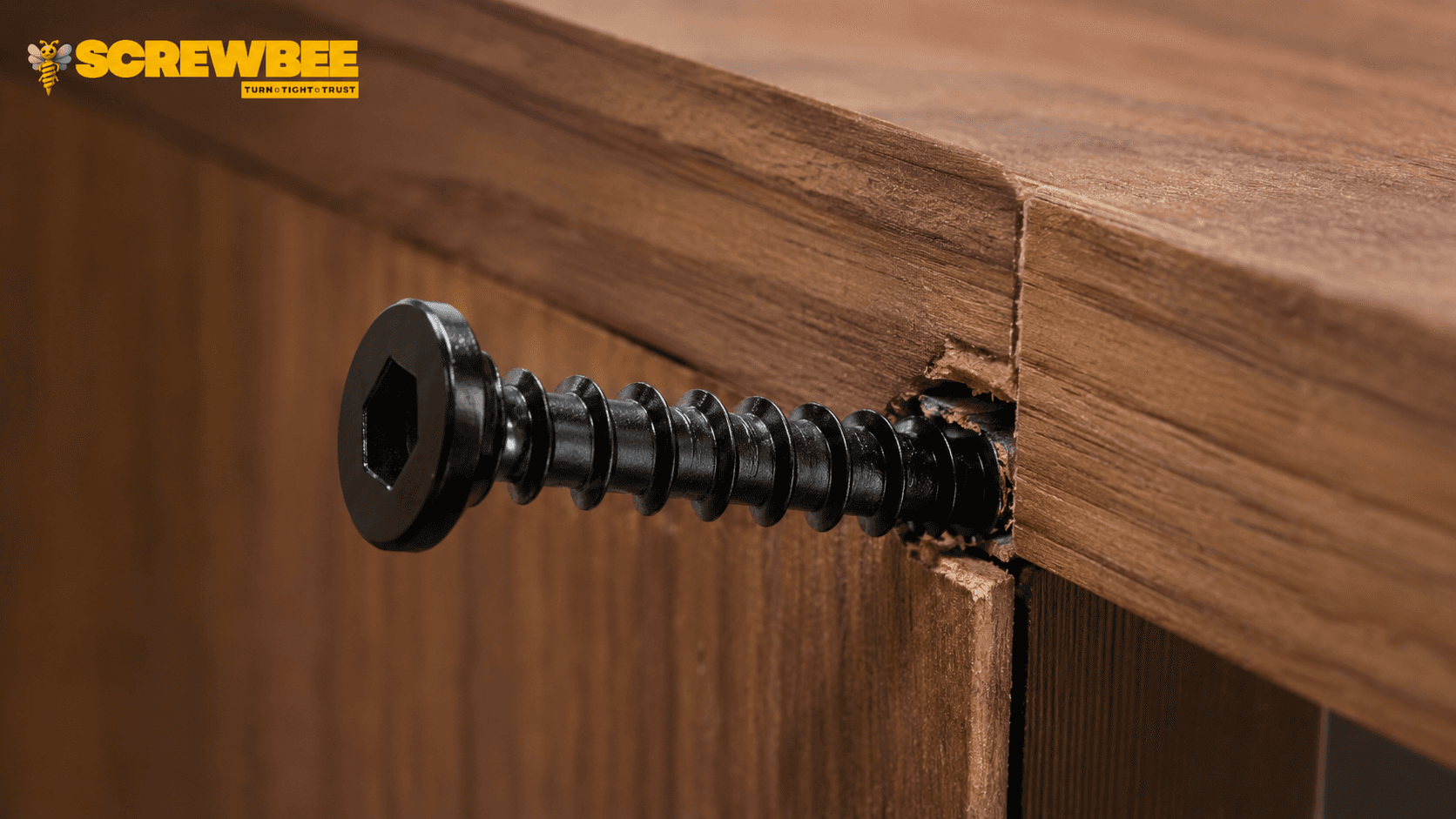
Imagine a cabinet side panel being fixed to an internal support.
The installer chooses a screw without checking the panel thickness.
The screw tightens successfully, so the joint appears strong.
After repeated opening, closing and movement, the connection becomes loose.
What should be checked?
Instead of blaming only the screw, inspect:
Material thickness → screw length → diameter → thread engagement → alignment → installation torque
This gives a much clearer picture of why the joint may have failed.
How Should Buyers Choose Flat Head Allen Screws for Furniture?
Before ordering, check:
Material type
Is it solid timber, plywood or another compatible wood-based material?Panel thickness
Know how much material is available for thread engagement.Required screw length
Avoid both insufficient and excessive length.Diameter
Match the screw thickness to the joint and material.Head requirement
Decide whether a neat low-profile finish is important.Drive requirement
Confirm that internal hex installation suits the assembly process.Quantity and specification
For bulk projects, confirm exact size combinations before ordering.
Where Are Flat Head Allen Screws Commonly Used?
According to the current Screwbee product information, applications include:
Wood-to-wood fixing
Cabinet assembly
Fixture installation
General woodwork
Furniture
Joinery
This makes the product especially relevant where both controlled fastening and a neat finished appearance matter.
Flat Head Allen Screws for UAE Furniture and Joinery Buyers
Furniture manufacturers, joinery workshops, interior fit-out companies and hardware buyers may search for:
For bulk purchasing, buyers should focus on the actual specification rather than choosing only by appearance.
Check:
application → material → diameter → length → thread → head → drive → quantity
That helps reduce incorrect orders and installation problems.
Frequently Asked Questions
Why does a furniture screw joint become loose?
Possible causes include insufficient thread engagement, wrong screw length or diameter, damaged material, poor alignment or over-tightening.
Are Flat Head Allen Screws suitable for furniture?
Screwbee lists its Flat Head Allen Screws for compatible furniture, cabinetry, joinery and general woodwork applications.
What drive do Flat Head Allen Screws use?
They use an internal hex drive, allowing controlled tool engagement.
Are Flat Head Allen Screws fully threaded?
The current Screwbee range is listed with full thread.
What sizes are available?
The current range covers approximately M3.5–M4.8 diameter and selected lengths from 16–60 mm.
Is a larger furniture screw always stronger?
No. The correct screw needs to suit the material thickness, joint design and required engagement. Larger is not automatically better.
Final Answer
If a furniture joint becomes loose, don't immediately assume the screw itself is defective.
Check the complete connection:
Material → screw length → diameter → thread engagement → alignment → tightening
For compatible furniture, cabinetry and woodwork applications, the right Flat Head Allen Screw can provide controlled fastening and a clean low-profile finish when correctly selected and installed.