📦 Request Quote
📞 Connect with us
Learn what screw to use for gypsum board and how to choose the right thread, length, diameter and head type for wood or metal framing.
Learn how to choose a gypsum board screw based on framing material, thread, length, diameter and installation requirements.

What Screw Should You Use for Gypsum Board? A Simple Selection Guide
You are ready to install a gypsum board partition. The boards and framing are in place, but one important question remains:
What screw should you use for gypsum board?
The simple answer is: use a drywall screw designed for gypsum-board fixing, and choose its thread, length and diameter according to the board and the material behind it.
For compatible interior drywall applications, Zinc Drywall Screws are one option for fixing gypsum board to suitable framing.
The important part is not choosing a screw only by its colour, size or price. The screw needs to match the complete installation system.
What Screw Is Used for Gypsum Board?
Gypsum board is relatively soft compared with solid timber or metal.
Because of this, the fastener needs to:
Pass through the gypsum board cleanly
Grip the supporting framing
Seat neatly at the board surface
Avoid unnecessary damage to the face paper
Provide reliable holding for the application
Screwbee Zinc Drywall Screws are designed with a Phillips bugle head and are available with fine and coarse thread options for compatible drywall applications.
Start With the Material Behind the Board
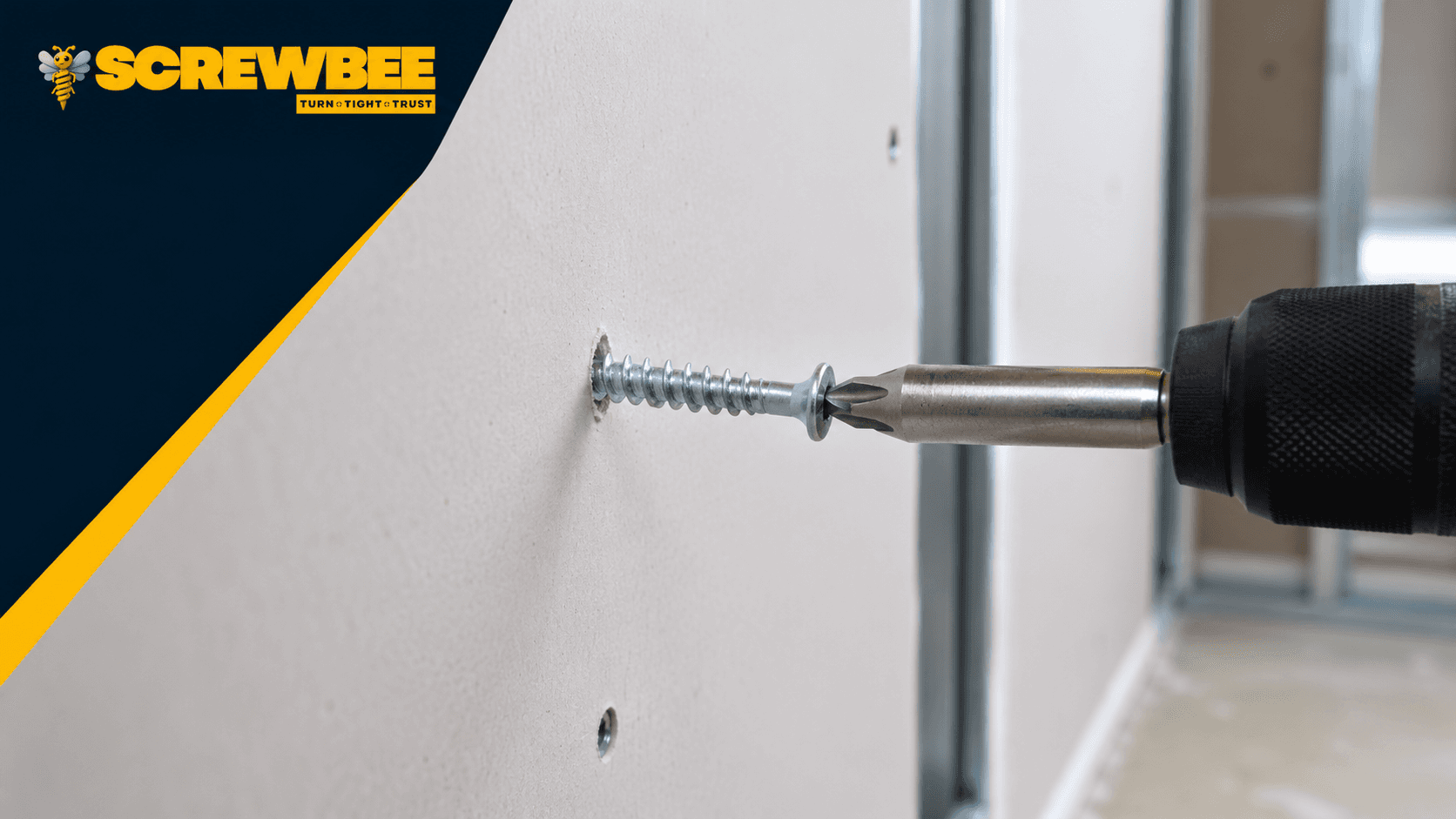
Before choosing the screw, ask:
What is the gypsum board being fixed to?
Usually, the supporting structure will be either:
Wood framing
Compatible light-gauge metal framing
This matters because the thread needs to interact correctly with the material behind the gypsum board.
Gypsum Board on Wood Framing
For compatible timber framing, a coarse-thread drywall screw is commonly considered.
The wider thread spacing helps the screw engage with the wood.
Gypsum Board on Light-Gauge Metal Framing
For compatible light-gauge metal framing, fine-thread drywall screws are commonly used.
The closer thread pattern can suit thin metal framing applications.
If you want a detailed explanation of the difference, read Screwbee's Fine Thread vs Coarse Thread Drywall Screws guide.
This avoids repeating the full fine-vs-coarse explanation here and keeps this article focused on choosing a screw for gypsum board.
Check the Gypsum Board Thickness
Next, identify the thickness of the board.
The screw needs enough length to:
pass through the board → reach the framing → provide suitable engagement.
This is why simply choosing the longest screw available is not the right approach.
Consider:
Gypsum board thickness
Single or multiple board layers
Supporting framing
Required penetration
Project specifications
A thicker assembly may require a different screw length than a thinner one.
How Do You Choose the Screw Length?
Screwbee's Zinc Drywall Screw range includes selected lengths from approximately 16 mm to 60 mm.
Instead of memorising one universal size, use this basic principle:
Board thickness + required framing engagement = suitable screw length
A screw that is too short may not provide enough engagement.
An unnecessarily long screw does not automatically create a stronger fixing.
The correct length depends on the application.
What About Drywall Screw Diameter?
Diameter means the thickness of the screw body.
Screwbee's Zinc Drywall Screw range is approximately M3.5 to M4.8.
Again, bigger does not automatically mean better.
The diameter should suit:
Gypsum-board system
Framing material
Required fixing
Project specification
This article intentionally doesn't go deeply into every drywall screw size because screw sizing is a separate search intent and deserves its own detailed guide.
Why Do Gypsum Board Screws Use a Bugle Head?
A bugle head has a curved profile that helps the screw seat neatly into the gypsum-board surface.
When properly installed, the screw head should create a small recess that can later be covered during finishing.
The basic goal is:
Not too high → Not too deep → Correctly seated
Driving the screw excessively deep can damage the board's face paper.
Leaving the screw too high can make finishing difficult.
So even after choosing the correct screw, installation depth still matters.
Why Is the Phillips Drive Important?
Screwbee Zinc Drywall Screws use a Phillips drive.
The driver bit fits into the screw head and transfers the turning force required during installation.
For cleaner installation:
Use the correct driver bit
Keep the driver aligned
Apply controlled pressure
Avoid excessive driving
Stop once the screw is correctly seated
Using the right screw with poor installation technique can still create problems.
Simple Gypsum Board Screw Selection Checklist
Before ordering or installing drywall screws, check these six things:
1. What board are you fixing?
Confirm that the application involves gypsum board or plasterboard.
2. What is behind the board?
Identify whether the supporting material is compatible timber or light-gauge metal framing.
3. Which thread is appropriate?
Select fine or coarse thread according to the substrate and project requirements.
4. What screw length is required?
Choose enough length to pass through the board and achieve the required engagement.
5. What diameter suits the system?
Don't select a screw only because it is thicker.
6. How should the head sit?
The bugle head should seat neatly without unnecessarily damaging the gypsum-board surface.
Example: Interior Gypsum Board Partition
Imagine an interior partition project.
The contractor knows:
Gypsum boards are being installed
The framing material has already been selected
Board thickness is known
A smooth finished surface is required
Instead of simply ordering “drywall screws,” the buyer should check:
Board → Framing → Thread → Length → Diameter → Installation
This simple sequence reduces guesswork when choosing the fastener.
What About Gypsum Board False Ceilings?
The same basic decision process applies to compatible false-ceiling systems.
However, do not assume that one screw configuration is suitable for every partition and ceiling.
Check the:
The fastener should suit the complete system.
Common Mistakes When Choosing Gypsum Board Screws
A few common mistakes can make screw selection harder than it needs to be.
Avoid:
Choosing only by price
Ignoring the framing material
Selecting only by screw colour
Using the same thread type for every substrate
Assuming a longer screw is always better
Assuming a thicker screw is always stronger
Ignoring the board thickness
Ignoring project specifications
The better approach is to match the fastener to the application.
Choosing Gypsum Board Screws for UAE Projects
For contractors, fit-out companies, traders and building-material buyers in the UAE, screw selection can also involve bulk purchasing and different interior applications.
People may search for terms such as:
But location does not change the basic selection principle.
Whether the project is in Dubai or elsewhere in the UAE, first identify:
Board thickness + framing + thread + length + diameter + project requirement
That gives buyers a much clearer basis for selecting the correct drywall screw.
Frequently Asked Questions
What screw should I use for gypsum board?
Use a drywall screw designed for gypsum-board installation and select the thread, length and diameter according to the board system and supporting framing.
Can zinc drywall screws be used for gypsum board?
Yes. Screwbee lists its Zinc Drywall Screws for compatible gypsum-board and interior drywall applications.
Should I use fine or coarse thread drywall screws?
The choice depends mainly on the supporting substrate. Coarse thread is commonly associated with compatible wood framing, while fine thread is commonly used with compatible light-gauge metal framing.
What type of screw head is used for drywall?
A bugle head is commonly used for drywall screws because it can seat neatly into the gypsum-board surface when correctly installed.
Is a longer drywall screw always better?
No. Screw length should suit the board thickness, framing and required penetration. Unnecessary extra length does not automatically improve the fixing.
Can the same drywall screw be used for every gypsum-board project?
Not necessarily. Board thickness, framing material, number of layers and project requirements can vary, so the fastener should be selected for the specific application.
Final Answer
So, what screw should you use for gypsum board?
Start with the material behind the board.
Then check:
Gypsum board → framing material → thread → screw length → diameter → installation
For compatible interior drywall applications, the right Zinc Drywall Screw can provide a clean and practical fixing when its specifications match the project.
The key rule is simple:
Choose the screw for the complete gypsum-board system — not just by size, colour or price.