📦 Request Quote
📞 Connect with us
Learn how Self-Drilling Screws can simplify metal installation by combining drilling and fastening for sheet metal, framing, HVAC and fabrication.
See how Self-Drilling Screws simplify metal fastening by combining drilling and fastening into one efficient installation step.
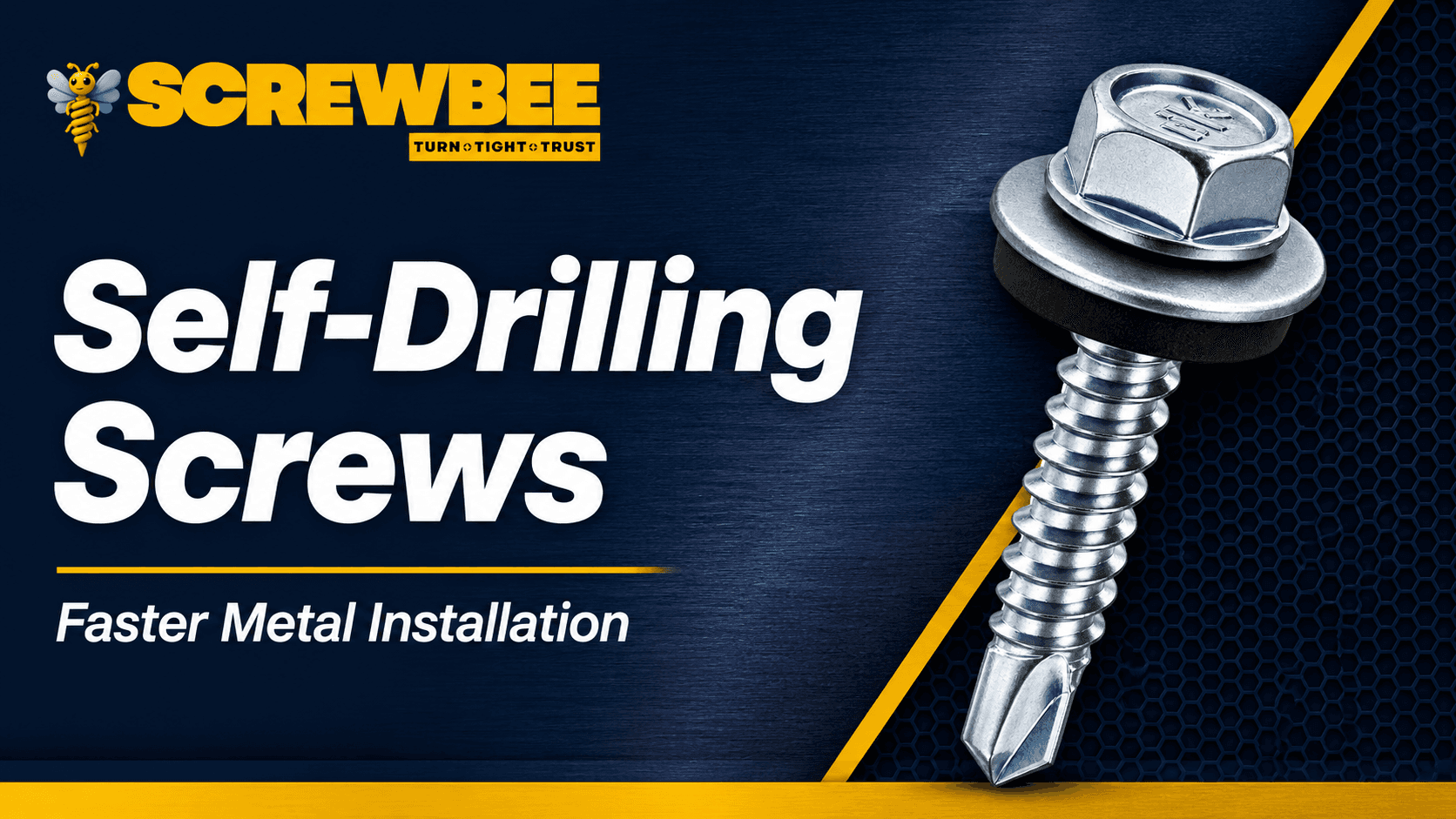
A Metal Fixing Job Was Taking Too Long — How Self-Drilling Screws Changed the Process
Imagine a metal fabrication job where every fixing point needs the same routine:
mark → drill pilot hole → change tool → insert screw → tighten
One fixing is manageable.
But when a project has dozens or hundreds of fastening points, that extra step can slow the work.
This is where Self-Drilling Screws can make metal fastening more efficient.
A self-drilling screw combines a drill point and threaded fastener in one screw, allowing it to penetrate compatible metal and then create thread engagement without a separate pilot-hole operation in suitable applications.
Screwbee’s current Self-Drilling Screw range uses a self-drilling point, Hex Washer Head, zinc-coated mild carbon steel construction, No. 8 (4.2 mm) diameter, and selected lengths from 13 mm to 50 mm.
The Jobsite Problem: Too Many Installation Steps
Consider a light metal framing or sheet-metal project.
The installer is using a conventional fastening method that requires pre-drilling.
For every fixing point:
Position the material
Mark the location
Drill a pilot hole
Remove the drill
Change tool or bit
Insert the screw
Tighten the fixing
The process works.
But across a large project, repeating these steps can increase installation time.
A suitable self drilling screw for metal can reduce the number of separate operations.
What Changes When You Use a Self-Drilling Screw?
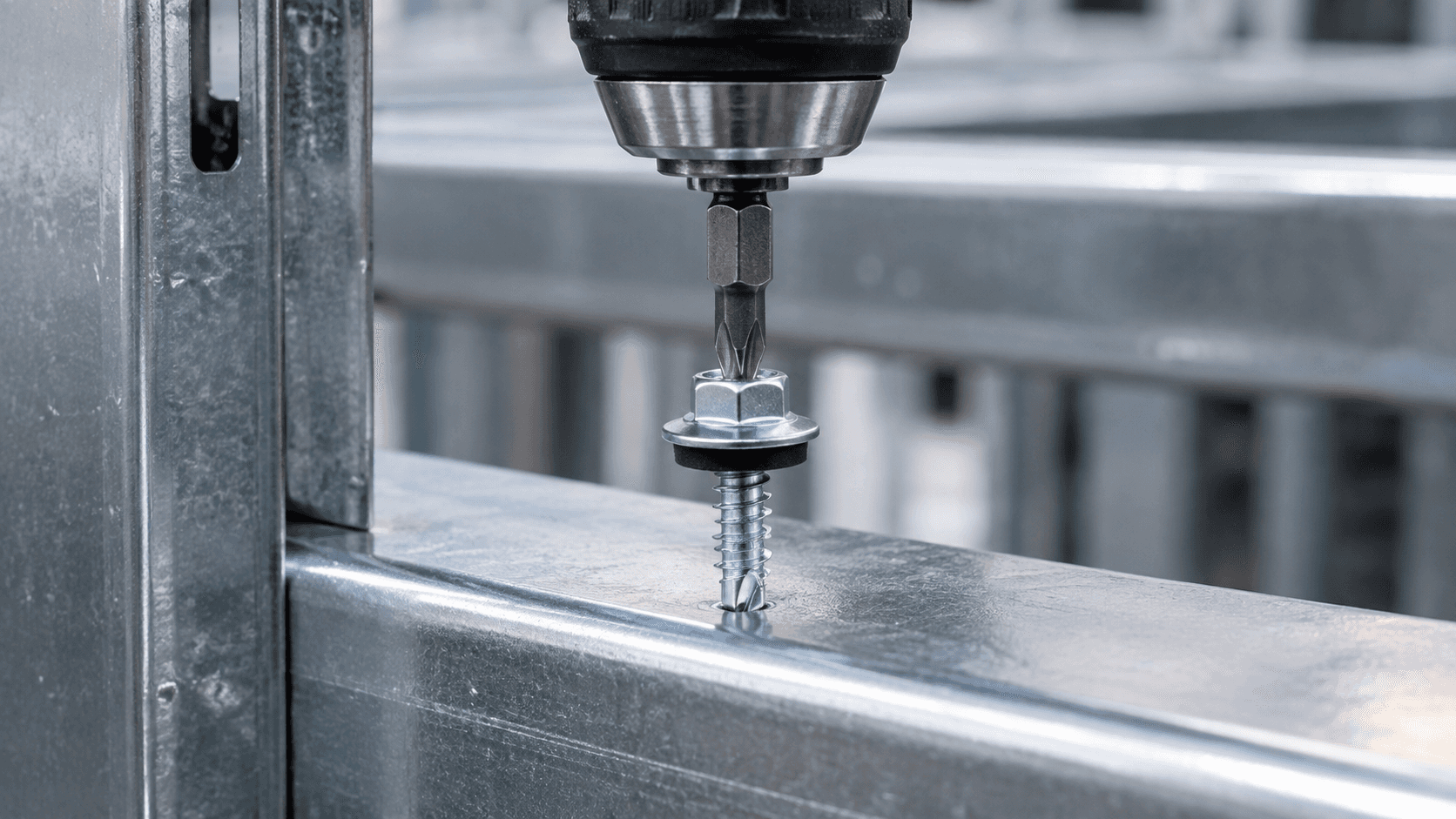
A self-drilling screw has an integrated drill-style point.
When the screw rotates against compatible metal:
drill point cuts → screw penetrates → threads engage → head seats
This means the fastener itself performs both the drilling and fastening functions in one operation.
For compatible applications, this can eliminate the need for a separate pre-drilled pilot hole.
That is the main reason these fasteners are widely considered for fast metal installation.
Why Does the Drill Point Matter?
The drill point is the first part of the screw to contact the metal.
Its job is to create the opening required for the threaded section to follow.
A suitable drill point can help:
Start penetration efficiently
Reduce separate drilling steps
Keep installation workflow simpler
Allow the thread to engage after penetration
But the screw still needs to match the thickness and type of metal being fastened.
Not every self-drilling screw is suitable for every metal thickness.
What Happens After the Drill Point Penetrates?
Once the drill point passes through the compatible metal, the thread starts to engage.
This is where the screw begins creating the actual fastening connection.
Good thread engagement helps:
Pull the materials together
Maintain the fixing
Support clamping
Reduce unwanted movement
The installer should continue driving only until the head is properly seated.
Excessive tightening can damage the fixing or material.
Why Does Screw Length Matter?
The screw must be long enough to:
penetrate the first material → reach the second material → provide suitable thread engagement
Screwbee's current range includes selected lengths of approximately:
13 mm, 19 mm, 25 mm, 32 mm, 38 mm and 50 mm in No. 8 (4.2 mm).
Longer is not automatically better.
The correct length depends on:
Why Is a Hex Washer Head Useful?
The detailed Screwbee product range uses a Hex Washer Head.
This head design provides:
Broad bearing surface
Good clamping area
Easy driving with a suitable socket
Stable torque transfer
For sheet-metal and construction fastening, the larger bearing area can help distribute clamping force over the connected surface.
Screwbee's actual self-drilling product also uses the recognizable hex washer head with bonded washer configuration shown in its current product imagery.
Example Scenario: Light Metal Framing
Imagine an installer connecting light-gauge metal sections.
Method A: Separate drilling
The installer:
drills hole → changes tool → inserts screw → tightens
Method B: Suitable Self-Drilling Screw
The installer:
positions screw → drills through metal → thread engages → screw seats
The second workflow removes a separate drilling step.
Across many fixing points, that can make the installation process simpler and more efficient.
The key word is suitable.
The self-drilling screw still needs to match the material and project specification.
Where Are Self-Drilling Screws Used?
Screwbee currently lists Self-Drilling Screws for compatible metal applications including:
Sheet-metal fixing
Light-gauge metal framing
HVAC and ductwork
General fabrication
Let's look at each one.
1. Sheet-Metal Fixing
Sheet-metal work often involves many fastening points.
A self-drilling screw can reduce the need for separate pilot-hole drilling in compatible sheets.
This can be useful for:
Metal panels
Covers
Light sheet connections
Fabricated components
Correct screw selection is still important because sheet thickness can vary.
2. Light-Gauge Metal Framing
Light-gauge framing is another common application.
Self-Drilling Screws can be useful where compatible metal sections need to be fastened efficiently.
Before installation, check:
Metal thickness
Screw length
Drill-point capability
Head requirement
Project specification
3. HVAC and Ductwork
HVAC and ductwork can involve repeated sheet-metal connections.
A suitable self-drilling fastener can simplify installation where many metal sections need to be joined.
For contractors, reducing repeated tool changes can make the workflow more practical.
4. General Fabrication
In workshops and fabrication environments, self-drilling screws can be used for compatible metal fastening jobs where speed and convenience matter.
Applications may include:
Light metal assemblies
Brackets
Sheet-metal components
Fabricated frames
The screw specification should always match the material being fastened.
Common Mistakes That Can Slow the Job Again
Even with Self-Drilling Screws, installation can become inefficient if the wrong screw or technique is used.
Avoid these mistakes:
Wrong screw length
Too short may not provide enough engagement.
Wrong drill point for the metal
The screw may struggle to penetrate.
Excessive driver speed
This can overheat or damage the drill point.
Poor alignment
The screw may enter at an angle.
Over-tightening
This can damage the thread or connected material.
Using one screw for every metal thickness
Different applications can need different fastener specifications.
How to Choose a Self-Drilling Screw for Metal
Use this quick sequence:
Step 1: Identify the metal
Is it:
Sheet metal?
Light-gauge framing?
HVAC duct?
Fabricated component?
Step 2: Check total material thickness
This affects the length and required penetration.
Step 3: Confirm the drill point
The drill point must suit the metal being penetrated.
Step 4: Choose the correct length
Enough engagement is required after penetration.
Step 5: Check the head
For Screwbee's current range, the detailed product specification uses a Hex Washer Head.
Step 6: Control installation
Use correct alignment, suitable tool speed and controlled tightening.
Why Buyers Should Look Beyond “Self-Drilling”
Two screws may both be called self-drilling screws but still differ in:
Diameter
Length
Head type
Drill point
Material
Coating
Intended metal thickness
Application
So buyers should not order only by the words:
“self drilling screw”
A better purchase request specifies:
diameter + length + head + point + material + application + quantity
Self-Drilling Screws for UAE Metal Projects
Contractors, fabrication workshops, HVAC companies, building-material traders and procurement teams in the UAE may search for:
For UAE projects, the same technical rule applies:
metal type → thickness → drill point → length → head → installation
For bulk procurement, buyers should also confirm quantity, packaging and current technical documentation.
Frequently Asked Questions
Do Self-Drilling Screws need a pilot hole?
In compatible applications, the integrated drill point is designed to penetrate the metal without a separate pre-drilled pilot hole. The screw still needs to suit the material and thickness.
What are Self-Drilling Screws used for?
They are commonly used for sheet-metal fixing, light-gauge framing, HVAC/ductwork and general fabrication.
What size Self-Drilling Screws does Screwbee offer?
The current Screwbee range is No. 8 (4.2 mm) with selected lengths from approximately 13 mm to 50 mm.
What head does the current Screwbee Self-Drilling Screw use?
The detailed listed range uses a Hex Washer Head.
Can Self-Drilling Screws save installation time?
They can reduce installation steps in compatible metal applications because drilling and fastening are combined into one operation.
Are Self-Drilling Screws suitable for every type of metal?
No. The screw's drill point, size and specification need to match the metal thickness and application.
Final Answer
A metal fastening job can become slow when every fixing point requires separate drilling and fastening steps.
A suitable Self-Drilling Screw simplifies that process:
position → drill → thread → tighten
For compatible sheet metal, light-gauge framing, HVAC and fabrication applications, that can make installation more efficient while still providing secure fastening.
The important part is choosing the correct screw for the actual metal and project.