📦 Request Quote
📞 Connect with us
Learn how self-drilling screws work, how the drill point penetrates metal, how the thread engages, and how to choose the right screw for metal fastening.
Learn how a self-drilling screw cuts through metal, engages its threads and completes fastening in one simple driving operation.

How Does a Self-Drilling Screw Work? Drill Point, Thread and Metal Penetration Explained
A self-drilling screw can create its own hole while being driven into compatible metal.
That means a separate pilot hole is often not needed.
The easiest way to understand it is:
Drill point cuts the metal → thread enters the hole → screw tightens the materials together.
This makes self-drilling screws useful for jobs where installers want faster metal fastening with fewer separate drilling steps.
What Is a Self-Drilling Screw?
A self-drilling screw is a fastener with a drill-shaped point built into its tip.
Unlike a normal pointed screw, the tip works like a small drill bit.
As the screw rotates, the point starts cutting into the metal. Once the point passes through, the screw threads engage with the material and secure the connection.
Screwbee Self Drilling Screws are designed for compatible metal-fastening applications and use an integrated self-drilling point.
How Does a Self-Drilling Screw Work?
The process happens in three simple stages.
Stage 1: The Drill Point Starts Cutting
The tip of the screw contacts the metal surface.
As the driver rotates the screw, the self-drilling point begins cutting through the material.
This creates the opening needed for the screw.
Think of it as having:
a drill bit + screw combined into one fastener.
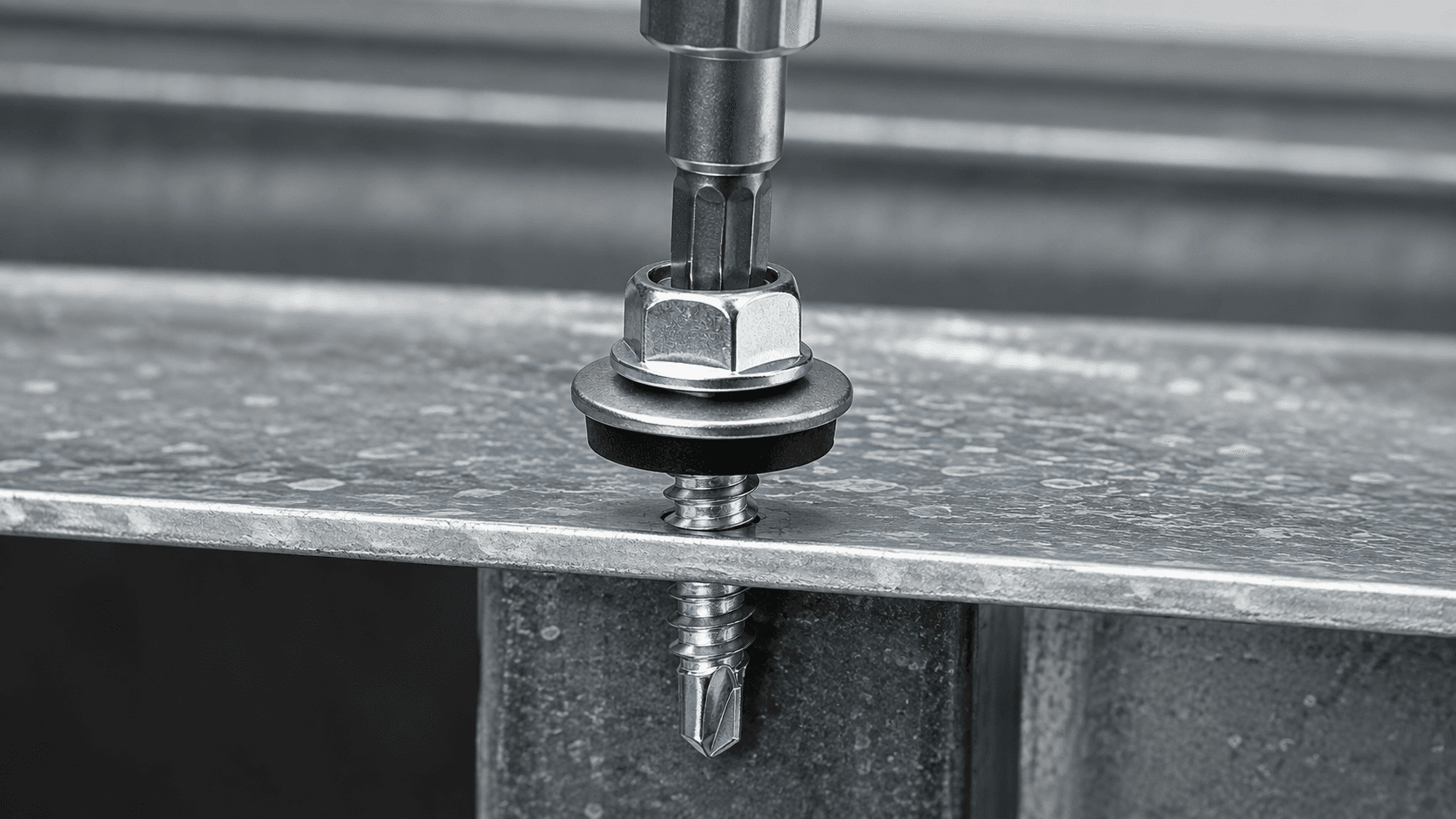
Stage 2: The Threads Enter the Metal
Once the drill point passes through the material, the screw threads begin to engage.
The threads help pull the screw into position and create holding force between the connected materials.
This is why both parts matter:
Drill point → creates the hole
Thread → provides engagement and holding
A good drill point without suitable thread engagement will not give the complete fastening result.
Stage 3: The Screw Seats and Tightens
As driving continues, the screw pulls the connected materials together.
The installer should stop once the screw is securely seated.
Over-tightening can damage:
The screw head
The drive recess
The metal around the hole
The threads
The connected material
Controlled installation is therefore important.
Why Is the Drill Point Important?
The drill point is the key feature that separates a self-drilling screw from many ordinary screws.
Its job is to:
Start accurately on the metal
Cut through the material
Reduce the need for separate pre-drilling
Prepare the opening for thread engagement
Speed up compatible metal-fastening work
The point should be matched to the material being fastened.
Not every self-drilling screw is suitable for every metal thickness.
Do Self-Drilling Screws Need a Pilot Hole?
In compatible applications, self-drilling screws are designed to drill their own hole, so a separate pilot hole is generally unnecessary.
This is one of their main benefits.
However, the screw still needs to match:
Metal thickness
Screw diameter
Drill-point capacity
Material type
Project specification
A self-drilling screw should not be forced through material thicker than the screw is designed to drill.
What Does the Thread Do?
After the point creates the hole, the thread becomes responsible for holding the screw in the material.
The thread helps:
Pull materials together
Maintain engagement
Hold the connection
Resist loosening under normal compatible use
So when choosing a self-drilling screw, do not look only at the tip.
The point, thread, diameter and length all work together.
What Does No. 8 (4.2 mm) Mean?
Screwbee currently lists its Self Drilling Screw range as No. 8, approximately 4.2 mm diameter.
For a beginner:
4.2 mm = approximate screw diameter
Diameter tells you how thick the screw body is.
Screw diameter affects how the screw fits and engages with the application.
How Do You Choose the Right Screw Length?
Screwbee currently lists selected Self Drilling Screw lengths from 13 mm to 50 mm.
The correct length depends on the total thickness of the materials being joined.
Before choosing, check:
Thickness of first metal sheet
Thickness of second material
Required thread engagement
Whether excess screw length is acceptable
Project requirements
The longest available screw is not automatically the best screw.
What Happens During Metal Penetration?
When the screw starts drilling, the point removes a small amount of metal to form the opening.
After penetration:
The drill point passes through.
The thread reaches the opening.
The screw continues forward.
The threads engage.
The materials are pulled together.
The screw reaches its final seated position.
This entire process can happen in one driving operation when the screw is correctly matched to the material.
Where Are Self-Drilling Screws Used?
Screwbee currently lists compatible applications including:
Sheet-metal fixing
Light-gauge metal framing
HVAC and ductwork
General fabrication
These are situations where efficient metal fastening can be important.
Self-Drilling Screws for Sheet Metal
Sheet-metal work is one of the most common applications for self-drilling fasteners.
The built-in drill point can reduce the need to:
mark → drill separate hole → change tool → insert screw
Instead, the installer may be able to:
position → drive → fasten
That can make repetitive metal assembly faster.
Self-Drilling Screws for Light-Gauge Metal Framing
Self-drilling screws can also be used in compatible light-gauge metal framing applications.
The correct screw still depends on:
Metal thickness
Number of layers
Required holding
Screw specification
Do not assume that one screw can penetrate every steel section.
Self-Drilling Screws for HVAC and Ductwork
HVAC installations often involve joining thin metal components.
Self-drilling screws can be useful for compatible:
Duct sections
Sheet-metal connections
Light metal components
Service installation work
The correct fastener should always match the actual material and installation specification.
Self-Drilling Screws for General Fabrication
In workshops and fabrication environments, self-drilling screws can help with repeated fastening of compatible metal components.
Their built-in drilling action can reduce separate operations and make assembly more efficient.
This is particularly useful when many similar connections need to be completed.
Common Self-Drilling Screw Installation Mistakes
Even a good self-drilling screw can perform poorly if used incorrectly.
Avoid these common mistakes:
Using the wrong screw for the metal thickness
Holding the driver at an angle
Applying excessive pressure
Driving too slowly or inconsistently
Over-tightening
Using a damaged driver bit
Selecting the wrong screw length
Assuming every self-drilling screw works with every metal
What If the Screw Does Not Drill Into the Metal?
If a self-drilling screw does not penetrate, stop forcing it.
Possible reasons include:
Metal is too thick
Drill point is unsuitable
Screw is damaged
Driver alignment is poor
Driver speed or pressure is incorrect
Wrong fastener has been selected
Forcing the screw can damage the point or connection.
Why Is Correct Driver Alignment Important?
The screw should meet the metal as straight as practical.
If the screw starts at a severe angle:
The drill point can wander
Drilling becomes harder
The hole may become irregular
The screw may not seat correctly
Driver engagement may be damaged
Start carefully and keep the tool aligned.
Self-Drilling Screws vs Separate Drilling
Traditional metal fastening may require:
Step 1 → Drill the pilot hole
Step 2 → Remove the drill
Step 3 → Position the screw
Step 4 → Drive the screw
With a suitable self-drilling screw:
Drilling + fastening can happen in one operation.
That is the main practical advantage.
Self-Drilling Screws for UAE Metal Projects
Buyers searching for:
should compare more than just price.
Check:
For fabrication, HVAC, metal framing and sheet-metal work, correct screw selection is more important than simply choosing the cheapest available fastener.
Frequently Asked Questions
How does a self-drilling screw drill through metal?
The tip has an integrated drill-point geometry that cuts an opening as the screw rotates. After penetration, the threads engage with the material.
Do self-drilling screws need pre-drilling?
For compatible materials and thicknesses, they are designed to work without a separate pilot hole.
Are self-drilling screws the same as self-tapping screws?
Not exactly. Self-drilling screws include a drill-style point that creates the hole as part of the driving process. “Self-tapping” is a broader term related to forming or cutting mating threads.
What diameter does Screwbee offer?
The current Screwbee product page lists No. 8 (approximately 4.2 mm).
What lengths are available?
The current listed range includes 13, 19, 25, 32, 38 and 50 mm lengths.
Where can Screwbee Self Drilling Screws be used?
The product page lists sheet-metal fixing, light-gauge metal framing, HVAC and ductwork, and general fabrication as application areas.
Final Answer
So, how does a self-drilling screw work?
The process is simple:
Drill point cuts the metal → threads engage → screw pulls the materials together → fastening is completed.
The built-in drilling point is what makes the screw useful for efficient compatible metal fastening.
But remember:
Right drill point + right diameter + right length + correct metal thickness + controlled installation = better fastening result.