📦 Request Quote
📞 Connect with us
Learn about flat head Allen screws, including alternative names, dimensions, materials, standards, applications, installation methods and industrial selection considerations.
A comprehensive guide to flat head Allen screws covering their design, dimensions, materials, industry terminology, technical standards, applications and selection criteria for industrial fastening.

Flat Head Allen Screws:
Types, Dimensions, Materials, Applications and Buying Guide
Introduction
Flat head Allen screws are precision-engineered threaded fasteners used in mechanical assemblies, industrial machinery, metal fabrication, equipment manufacturing and various engineering applications. Their distinctive design combines a flat top, a tapered countersunk head and an internal hexagonal socket that allows installation using an Allen key or hex bit.
The primary purpose of a flat head Allen screw is to provide a secure threaded connection while allowing the screw head to sit flush with the surrounding surface when installed in a correctly prepared countersunk hole. This feature makes flat head Allen screws particularly useful in assemblies where surface clearance, component alignment and a uniform finish are important.
Across the fastener industry, these products are also described by several alternative names, including flat head socket screws, countersunk socket screws, CSK Allen screws and flat head socket cap screws. Although these terms are frequently used in commercial catalogs and online searches, buyers should verify the actual dimensions, drive type and applicable standard before selecting a product.
Understanding the design, specifications and applications of flat head Allen screws helps engineers, manufacturers, procurement professionals and maintenance teams choose suitable fasteners for their requirements.
This guide explains the construction, alternative names, sizes, materials, technical standards, applications and purchasing considerations associated with flat head Allen screws, including the product offering available from Screwbee.
1. What Are Flat Head Allen Screws?
Flat head Allen screws are threaded fasteners featuring a countersunk head with an internal hexagonal recess. The tapered underside of the head fits into a corresponding countersink in the workpiece, allowing the upper surface of the screw to remain approximately level with the surrounding material.
The internal hexagonal socket provides a dedicated driving interface. When the correct Allen key or hex bit is used, rotational force can be applied to tighten or loosen the fastener.
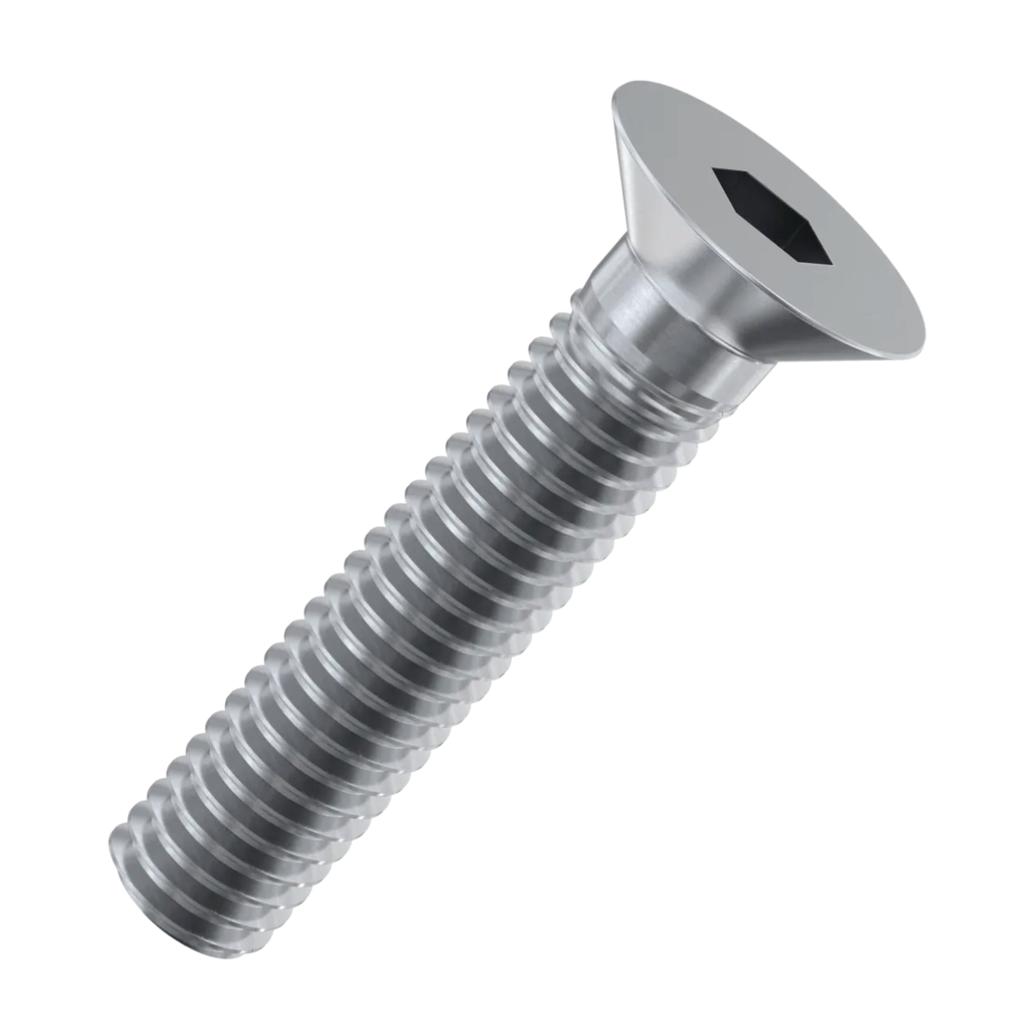
Note: The image above is for illustrative and educational purposes only and represents a general flat head Allen screw design. It does not depict Screwbee’s actual manufactured product. Screwbee specializes in specific platen screw solutions, which are introduced in the product section below.
Typical countersunk head and internal hexagonal drive.
The design consists of several important features:
Flat head: Provides a relatively smooth upper surface when installed correctly.
Countersunk underside: Allows the head to seat within a matching conical recess.
Internal hexagonal socket: Accepts an Allen key or hex bit.
Threaded shank: Engages with a compatible tapped hole or nut to form a joint.
Specified material and finish: Determine the fastener's mechanical properties, corrosion resistance and suitability for the working environment.
The performance of a flat head Allen screw depends not only on the screw itself but also on the quality of the mating thread, the countersink geometry, the parent material and the installation procedure.
2. Alternative Names for Flat Head Allen Screws
One important consideration when sourcing flat head Allen screws is the variation in terminology used by manufacturers, distributors and industrial buyers.
A buyer searching for a flat head Allen screw may encounter a similar product listed under a different name. Recognizing these terms can make product research and supplier comparisons easier.
Alternative name | Meaning and usage |
|---|---|
General commercial description emphasizing the flat head and socket drive. | |
Common catalog term for countersunk screws with an internal socket. | |
Describes the countersunk head geometry and socket drive. | |
Commercial abbreviation using CSK for countersunk. | |
Alternative word order frequently used in product searches. | |
Emphasizes the internal hexagonal drive. | |
Descriptive engineering terminology for the head and drive configuration. | |
Another catalog description for countersunk socket fasteners. | |
A commercial search variation; confirm the exact product type and specification. | |
A standard-related search term for metric hexagon socket countersunk head screws. | |
A legacy German standard designation commonly encountered in catalogs for this fastener type. |
These names help buyers identify relevant products, but they should not be treated as an unconditional guarantee that two listings describe identical fasteners. For example, a generic flat head screw may use a Phillips, slotted or other drive instead of an internal hex socket.
Similarly, the specified standard, dimensional requirements and product revision should be verified when an engineering drawing calls for a particular screw.
For industrial procurement, the complete specification is more reliable than the product name alone.
3. Design and Working Principle of Flat Head Allen Screws
Flat head Allen screws operate through the interaction of the threaded shank, the mating component and the countersunk head.
When the screw is turned using an Allen key, the threads engage with the corresponding internal thread or compatible nut. Continued rotation generates tension in the fastener and clamping force across the joined components.
At the same time, the tapered underside of the head contacts the countersunk surface. When the head geometry and countersink are compatible, this contact allows the screw to seat properly.
The principal design considerations are:
Thread engagement: The threaded portion must engage sufficiently with the mating component to support the intended joint load.
Countersink compatibility: The head angle and countersink angle must match closely enough to achieve the intended seating.
Drive engagement: The Allen key must fit the socket correctly to reduce the risk of rounding or damaging the internal recess.
Installation torque: Tightening requirements must be appropriate for the screw's material, strength class, lubrication condition and joint design.
Flat head Allen screws are not automatically suitable for every high-load or vibration-intensive application. Those requirements need to be evaluated as part of the complete joint design.
4. Flat Head Allen Screws vs Other Types of Screws
Flat head Allen screws belong to a broader family of socket-driven fasteners. Comparing head profiles helps explain why different fasteners are selected for different applications.

Note: The image above is for illustrative and educational purposes only and represents a general flat head Allen screw design. It does not depict Screwbee’s actual manufactured product. Screwbee specializes in specific platen screw solutions, which are introduced in the product section below.
Flat head Allen screw
Countersunk head designed for flush installation in a matching recess.

Note: The image above is for illustrative and educational purposes only and represents a general flat head Allen screw design. It does not depict Screwbee’s actual manufactured product. Screwbee specializes in specific platen screw solutions, which are introduced in the product section below.
Socket head cap screw
Cylindrical head, generally used where a projecting head or a counterbored recess is acceptable.

Note: The image above is for illustrative and educational purposes only and represents a general flat head Allen screw design. It does not depict Screwbee’s actual manufactured product. Screwbee specializes in specific platen screw solutions, which are introduced in the product section below.
Button head socket screw
Rounded, low-profile head used where the joint design accommodates its shape.

Note: The image above is for illustrative and educational purposes only and represents a general flat head Allen screw design. It does not depict Screwbee’s actual manufactured product. Screwbee specializes in specific platen screw solutions, which are introduced in the product section below.
Phillips flat head screw
Countersunk design with a cross-shaped drive rather than an internal hex socket.
Feature | Flat head Allen screw | Socket head cap screw | Button head socket screw |
|---|---|---|---|
Head shape | Tapered countersunk | Cylindrical | Rounded |
Drive | Internal hex | Internal hex | Internal hex |
Flush installation | Designed for it | Requires an appropriate counterbore | Not normally flush |
Main design consideration | Countersink compatibility | Head clearance | Head height and clearance |
The choice between these fasteners depends on the available space, required surface finish, loading conditions and mating-component design.
5. Common Applications of Flat Head Allen Screws
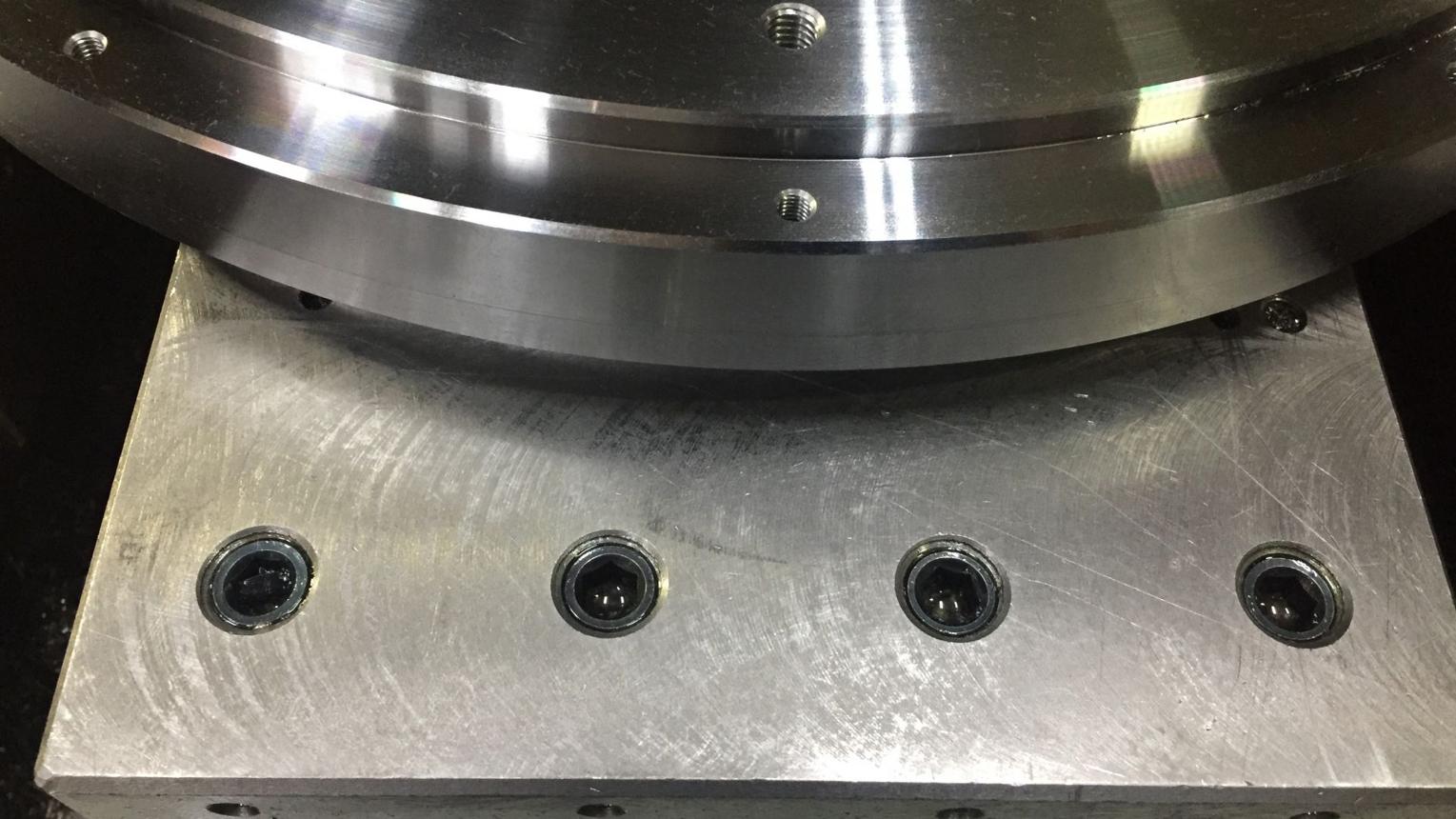
Flat head Allen screws are used across numerous industrial sectors because their countersunk design can accommodate assemblies that require a flush or recessed fastener head.
5.1 Machinery and industrial equipment
Flat head Allen screws can secure machine covers, mounting plates, brackets and fixtures where protruding screw heads could interfere with moving parts or adjacent components.

5.2 CNC machining and engineering fixtures
In jigs, fixtures and precision-machined components, flush-mounted fasteners can help maintain workpiece clearance and avoid interference with locating surfaces.

5.3 Metal fabrication and enclosures
Countersunk socket screws may be used to attach panels, covers and brackets where a relatively smooth exterior surface is desirable.

5.4 Automotive and mechanical assemblies
Suitable specifications may be used for brackets, fixtures and selected mechanical joints. The required strength, fatigue performance and environmental compatibility must be verified for each application.

5.5 Aluminium profiles and fabricated structures
Flat head Allen screws can join compatible profiles and fabricated components when the structure provides sufficient material thickness, suitable countersinks and adequate thread engagement.

5.6 Electrical and electronic equipment
These screws can secure equipment housings, instrument panels and mounting assemblies where clearance, accessibility and surface profile are important.
The presence of a countersunk head does not, by itself, establish that a screw is suitable for a particular application. The complete product specification and joint requirements must be considered.
6. Materials Used in Flat Head Allen Screws
The material selected for a flat head Allen screw influences its strength, corrosion resistance, durability and suitability for the operating environment.
Stainless steel flat head Allen screws
Stainless steel fasteners are used where corrosion resistance is an important consideration. Common stainless steel grades include 304 and 316, although the appropriate choice depends on the specific exposure conditions and required mechanical properties.
Grade 316 may be preferred in some more aggressive environments, but no stainless steel grade is universally resistant to all chemicals, salts or corrosive conditions.
Alloy steel flat head Allen screws
Alloy steel socket screws are used in mechanical and engineering applications where specified mechanical strength is required. The appropriate property class, heat treatment and product standard should be confirmed before use.
Certain alloy steel fasteners have a black oxide finish. This is a surface treatment and should not be confused with stainless steel or assumed to provide equivalent corrosion resistance.
Coated or plated steel fasteners
Coated or plated steel screws may be selected for a required finish or corrosion-protection system. Suitability depends on the coating specification, service environment and compatibility with the joint.
For every material, buyers should verify the grade, mechanical properties, finish and applicable requirements rather than relying on appearance alone.
7. Flat Head Allen Screws: Sizes and Dimensions
Selecting the correct dimensions is essential for ensuring that a flat head Allen screw fits the mating components and performs as intended.
Metric fasteners commonly use an M designation followed by the nominal thread diameter. For example, M6 × 20 identifies a screw with a nominal thread diameter of 6 mm and a nominal length of 20 mm.
For countersunk screws, the length is generally measured from the top of the head to the tip. Always confirm the applicable standard and supplier drawing for the exact measurement convention.
Illustrative metric sizes
Screw size | Nominal thread diameter | Example lengths |
|---|---|---|
M3 | 3 mm | 6, 8, 10, 12 mm |
M4 | 4 mm | 8, 10, 12, 16 mm |
M5 | 5 mm | 10, 12, 16, 20 mm |
M6 | 6 mm | 12, 16, 20, 25 mm |
M8 | 8 mm | 16, 20, 25, 30 mm |
M10 | 10 mm | 20, 25, 30, 40 mm |
M12 | 12 mm | 25, 30, 40, 50 mm |
These are illustrative size and length combinations, not a confirmed Screwbee inventory list or a complete standard dimension table.
Dimensions to check before ordering
Nominal thread diameter.
Thread pitch and thread form.
Overall length and measurement convention.
Head diameter and head height.
Countersunk head angle.
Hex socket dimensions.
Required thread engagement.
Material and mechanical property class.
A screw with the correct thread diameter may still be unsuitable if its head geometry, length or socket dimensions differ from the engineering requirement.
8. ISO 10642 and DIN 7991: Understanding the Standards
ISO 10642 and DIN 7991 are designations frequently encountered when sourcing metric hexagon socket countersunk head screws.
Standards help establish dimensional and product requirements so that engineers and procurement teams can specify fasteners consistently.
When an engineering drawing calls for ISO 10642 or DIN 7991, buyers should confirm the exact specified edition and the required dimensions. The designation should not be used as a substitute for checking all purchase requirements.
Additional information may be required for:
Material and strength class.
Thread dimensions and tolerance.
Surface finish or coating.
Corrosion-resistance requirements.
Inspection and testing.
Traceability and certification.
The correct specification is particularly important when flat head Allen screws are used in production assemblies or when replacement fasteners must match an existing design.
9. How to Install Flat Head Allen Screws Correctly
Correct installation helps ensure proper seating, thread engagement and joint performance.
Step 1: Prepare the hole. Provide a countersink that matches the specified screw head geometry. Verify the dimensions before installation.
Step 2: Check the mating thread. Confirm the thread diameter, pitch and condition of the tapped hole or nut.
Step 3: Select the correct length. Ensure sufficient engagement without the screw bottoming out in a blind hole or interfering with another component.
Step 4: Use the correct Allen key. The tool should fit the internal hex socket fully and securely.
Step 5: Tighten according to the specification. Follow the required torque or assembly procedure for the specific fastener and joint design.
Step 6: Inspect the final seating. Check that the screw head sits as intended and that the joint has no obvious interference or assembly defects.
Common installation errors include incorrect countersink geometry, damaged socket recesses, insufficient thread engagement and excessive tightening torque.
Where the assembly is safety-critical or heavily loaded, installation requirements should be established by the responsible engineering team.
10. Factors to Consider When Buying Flat Head Allen Screws
Choosing a supplier involves more than comparing product names or prices. Buyers should ensure that the fastener supplied matches the technical requirements of the application.
Before requesting a quotation, establish the following:
Product specification: Confirm the head type, drive type and applicable standard.
Dimensions: Specify diameter, length, thread pitch and relevant head dimensions.
Material: Identify the required steel or stainless steel grade.
Mechanical properties: Specify the required property class or strength requirements.
Finish: State the required coating or surface treatment.
Quantity: Provide the required quantity and packaging preferences.
Quality documentation: Identify any inspection reports, material certificates or traceability requirements.
Delivery requirements: Confirm the required delivery schedule and supply arrangements.
A detailed specification makes it easier for suppliers to quote the correct product and helps purchasing teams compare equivalent fasteners.
For recurring requirements, maintaining a standardized product specification can also reduce ordering errors and simplify inventory management.
11. Frequently Asked Questions About Flat Head Allen Screws
What are flat head Allen screws used for?
Flat head Allen screws are used in assemblies where a flush or recessed screw head is required. Applications include machinery, precision fixtures, brackets, metal panels, equipment enclosures and selected mechanical assemblies.
What is another name for flat head Allen screws?
Common alternative names include flat head socket screws, flat head socket cap screws, countersunk socket screws, CSK Allen screws and hex socket countersunk head screws. The exact product specification should always be checked.
Are CSK Allen screws the same as flat head Allen screws?
CSK Allen screw is a common commercial term for a countersunk screw with an internal hex drive. However, the dimensions, head angle and applicable standard must be verified to ensure that a specific product matches the intended requirement.
What is the difference between flat head Allen screws and countersunk socket screws?
These terms often describe the same general fastener configuration. Countersunk socket screw emphasizes the head geometry and internal socket, while flat head Allen screw is a widely used commercial name.
What is the difference between ISO 10642 and DIN 7991 screws?
Both designations are associated with metric countersunk hex-socket screws. The exact requirements and applicable edition should be checked against the engineering drawing and supplier documentation.
Are stainless steel flat head Allen screws available?
Stainless steel versions are available in the fastener market. Confirm the required grade, dimensions, mechanical properties and availability with the supplier.
Do flat head Allen screws require a countersunk hole?
For the intended flush installation, yes. The workpiece needs a matching countersunk recess. Without the recess, the head may project above the surface.
How do I select the correct screw length?
Consider the total thickness of the joined components, the countersunk head geometry, the required thread engagement and the available depth in the mating hole. Follow the engineering drawing where one is provided.
Which tool is used to tighten flat head Allen screws?
A correctly sized Allen key or hex bit engages with the internal hexagonal socket. The tool must fit properly to minimize the risk of socket damage.
What information should I provide when ordering flat head Allen screws?
Provide the nominal diameter, length, thread pitch, material, strength class, finish, applicable standard and quantity. A technical drawing is helpful when exact dimensional conformity is required.
12. Flat Head Allen Screws from Screwbee
Flat head Allen screws are an important part of industrial fastening systems, particularly in applications where a secure threaded connection and a flush surface are required. Selecting the correct screw involves matching the fastener's head geometry, thread dimensions, material and mechanical properties to the requirements of the assembly.
At Screwbee, the focus is on helping industrial buyers identify fasteners that meet their application and specification requirements.
Screwbee offers flat head Allen screws for customers seeking countersunk, hex-socket fastening solutions. These fasteners are relevant to manufacturers, fabricators, machinery builders, engineering teams and industrial procurement professionals who require a suitable fastening option for their assemblies.
When enquiring about flat head Allen screws from Screwbee, customers should specify the required dimensions, material, finish, applicable standard and order quantity. This information helps the team assess the requirement and establish the appropriate product specification.
The required size, grade, finish and availability should be confirmed with Screwbee before placing an order.
Flat Head Allen Screws — Screwbee Product