📦 Request Quote
📞 Connect with us
Learn how to choose drywall screws for large construction projects, from specifications and quality control to bulk quantities, packaging, and supplier reliability.
A practical guide to selecting drywall screws for large projects, covering specifications, quality, bulk procurement, packaging, delivery, and supplier evaluation.

How to Choose Drywall Screws for Large Construction Projects:
A Practical Buyer’s Guide
For a small repair job, buying a box of drywall screws is straightforward. Large construction projects are different.
When a contractor, distributor, fit-out company, or procurement team needs thousands of drywall screws, the decision involves much more than finding the lowest price per box. The fasteners have to match the construction system, remain consistent across batches, arrive when required, and perform reliably throughout installation.
A screw that looks suitable on paper can still create problems if the thread is inconsistent, the coating is unsuitable, the dimensions vary between batches, or the supplier cannot maintain the required volume.
That is why large-volume buyers should approach drywall screw procurement as a specification and supply-chain decision, not simply a product purchase.
📦 Explore Our Product Range
📞 Talk to Our Sales Team
Start With the Construction System
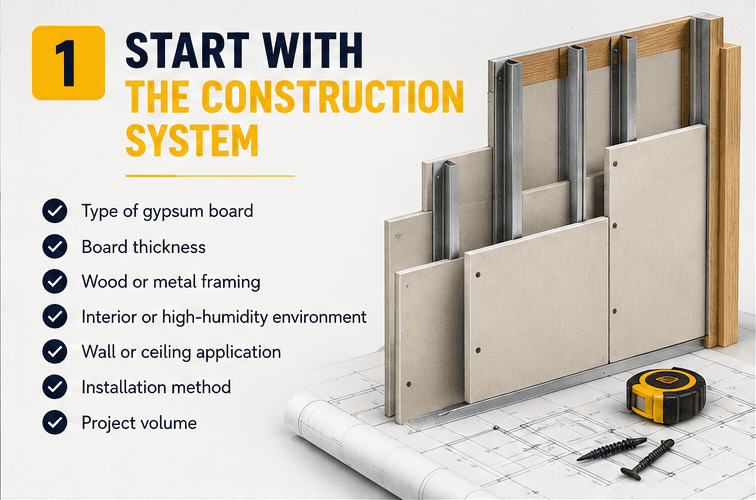
Before comparing suppliers, identify exactly where the drywall screws will be used.
The same fastener should not automatically be specified for every project.
Consider:
Type of gypsum board
Board thickness
Wood or metal framing
Framing thickness
Interior or high-humidity environment
Wall or ceiling application
Expected installation method
Project volume
For example, a screw intended for timber framing may have a different thread configuration from one designed for metal framing.
Getting this decision right at the beginning prevents a common procurement mistake: selecting a fastener first and trying to make it fit the application afterward.
Build a Clear Screw Specification
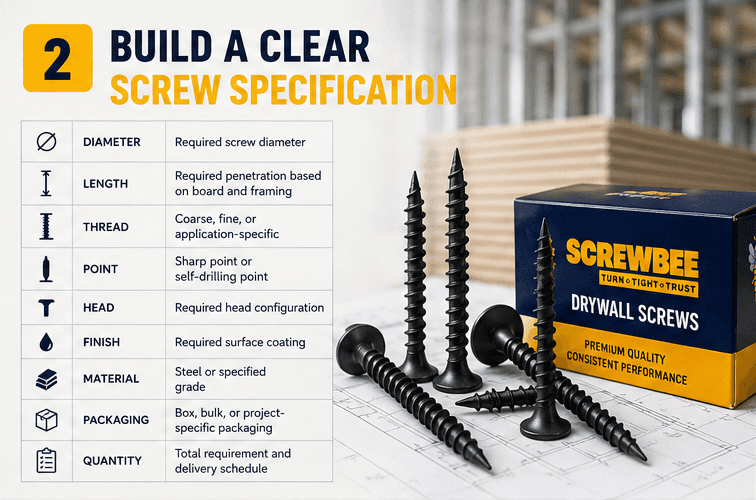
A good purchasing specification gives suppliers a precise target.
Instead of sending a request that simply says “drywall screws required”, specify the characteristics that matter to the project.
A procurement specification can include:
Requirement | What to Define |
|---|---|
Diameter | Required screw diameter |
Length | Required penetration based on board and framing |
Thread | Coarse, fine, or application-specific |
Point | Sharp point or self-drilling point |
Head | Required head configuration |
Finish | Required surface coating |
Material | Steel or specified material grade |
Packaging | Box, bulk, or project-specific packaging |
Quantity | Total requirement and delivery schedule |
The more precise the specification, the easier it becomes to compare suppliers fairly.
Don't Compare Suppliers on Price Alone
Unit price is easy to compare. Total procurement cost is not.
Suppose Supplier A offers screws at a slightly lower price but has inconsistent delivery schedules.
Supplier B costs slightly more but provides consistent dimensions, dependable quality, and predictable delivery.
For a project running on a tight installation schedule, the second option may represent better value.
Procurement teams should therefore consider:
Purchase cost + handling + wastage + installation efficiency + replacement cost + delivery risk
rather than looking only at the invoice price.
Think About Fastener Consistency
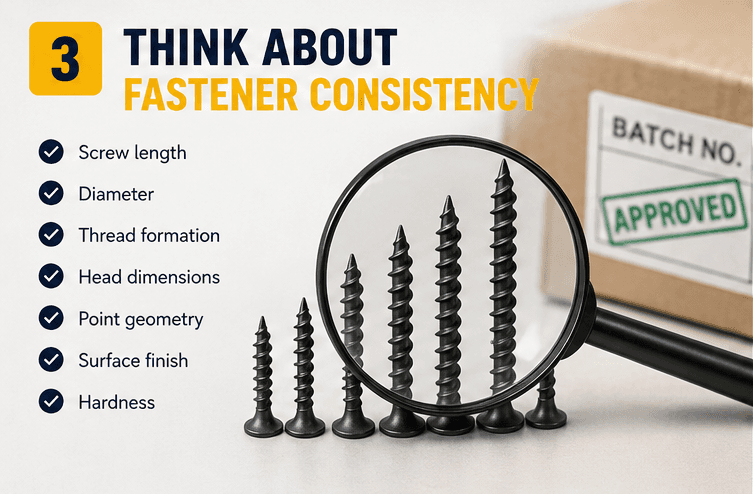
When purchasing a few hundred screws, small dimensional variations may go unnoticed.
When purchasing tens or hundreds of thousands, consistency becomes critical.
Buyers should pay attention to whether the supplier can maintain consistency in:
Screw length
Diameter
Thread formation
Head dimensions
Point geometry
Surface finish
Hardness
A batch should not perform differently from the previous shipment simply because it came from another production run.
For distributors, this is particularly important because inconsistent fasteners can lead to complaints from multiple downstream customers.
Ask About Quality Control
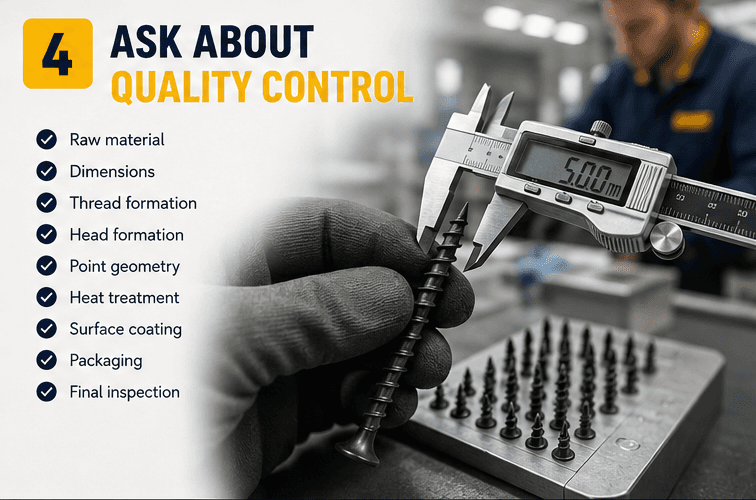
A supplier's quality-control process can tell you more than a product photograph.
Before placing a large order, buyers can ask how the manufacturer controls important production stages.
Depending on the product and manufacturing process, quality checks may cover:
Raw material
Dimensions
Thread formation
Head formation
Point geometry
Heat treatment
Surface coating
Packaging
Final inspection
The exact testing requirements should be aligned with the intended fastener specification and applicable standards.
The goal is straightforward: the screws delivered should match the screws that were approved.
Coating Should Match the Environment
Surface finish is another procurement consideration that should be tied to the project environment.
For ordinary indoor drywall applications, a conventional protective coating may be sufficient.
Projects involving elevated humidity or more demanding environmental conditions may require enhanced corrosion resistance.
Rather than choosing a finish based purely on appearance, buyers should ask:
Where will the screws be installed?
What level of moisture exposure is expected?
Is the fastener protected during storage?
Does the coating specification match the project requirement?
A dark-colored screw is not automatically suitable for every environment, just as a particular coating does not automatically make a fastener appropriate for exterior exposure.
Packaging Matters More Than It Looks
Packaging is often overlooked during fastener procurement.
However, large-volume orders may spend considerable time in warehouses, transit vehicles, or project storage areas before installation.
Poor packaging can expose screws to:
Moisture
Dust
Physical damage
Mixing of different specifications
Incorrect labeling
Good packaging should make the product easy to identify and protect it during handling.
For B2B buyers, labeling can also be important when multiple screw specifications are being purchased for the same project.
Plan Quantities Before Ordering
Large projects should not rely on rough estimates when ordering fasteners.
The required quantity depends on factors such as:
Board dimensions
Framing layout
Screw spacing
Number of layers
Wall and ceiling areas
Project design
Installation requirements
The project team should establish the required fastening pattern and calculate the estimated quantity accordingly.
It is also sensible to account for reasonable installation wastage without unnecessarily over-ordering.
For recurring projects, historical consumption data can make future procurement more accurate.
Consider Delivery as Part of the Product
A supplier can manufacture an excellent drywall screw, but if the shipment arrives after the installation team is scheduled to start, the procurement decision has still failed.
Large buyers should therefore discuss:
Production lead time
Available stock
Shipping schedule
Partial deliveries
Repeat-order capacity
Emergency requirements
Order tracking
For large construction projects, predictable supply can be just as valuable as competitive pricing.
Evaluate the Supplier, Not Just the Screw
A fastener supplier should be evaluated on its ability to support the entire purchasing requirement.
Ask whether the supplier can provide:
Multiple screw specifications
Consistent production
Bulk quantities
Technical information
Suitable packaging
Repeat-order support
Clear communication
Reliable delivery
This is particularly important for wholesalers and distributors that need to maintain their own inventory.
A supplier who can support the same specification over multiple orders is often more valuable than one offering a cheaper first shipment.
Sample Before Scaling the Order
For a new supplier, a sample or small initial order can provide useful information before a major commitment.
The project team can evaluate practical factors such as:
Ease of driving
Head seating
Thread engagement
Point penetration
Surface finish
Packaging condition
Consistency across samples
For high-volume procurement, this step can reduce the risk of discovering a specification problem only after the full shipment has arrived.
Questions to Ask a Drywall Screw Supplier
Before finalizing a large order, procurement teams can ask:
Is the screw designed for our framing material?
What exact dimensions and thread configuration are available?
What coating or finish is used?
How is batch consistency controlled?
What packaging options are available?
Can you support the complete project quantity?
What is the expected production and delivery schedule?
Can the same specification be supplied for repeat orders?
These questions help turn a general purchase request into a controlled procurement process.
A Better Way to Compare Drywall Screws
Instead of creating a supplier shortlist based solely on price, score each option against the factors that matter to your project.
For example:
Evaluation Area | Priority |
Application suitability | Very High |
Dimensional consistency | Very High |
Thread and point quality | High |
Coating suitability | High |
Supply capacity | Very High |
Delivery reliability | High |
Packaging | Medium |
Price | High |
Repeat-order capability | High |
The weighting will vary between projects, but this approach gives procurement teams a more objective basis for decision-making.
Final Takeaway
Buying drywall screws for a large construction project requires more thought than selecting a product from a catalogue.
The right decision starts with the construction system and moves through specification, quality, coating, packaging, quantity, delivery, and supplier capability.
For contractors and project teams, the goal is reliable installation. For wholesalers and distributors, the goal is consistent product quality and dependable supply. For procurement managers, the goal is to balance specification, cost, risk, and availability.
The strongest purchasing decision is therefore not necessarily the cheapest screw.
It is the right drywall screw, supplied consistently, at the right specification and at the right time.