📦 Request Quote
📞 Connect with us
Use this drywall screw sizes guide to compare common lengths and choose the right screw for gypsum-board thickness, layers and framing material.
Compare common drywall screw sizes and learn how board thickness, framing material and thread type affect screw selection.
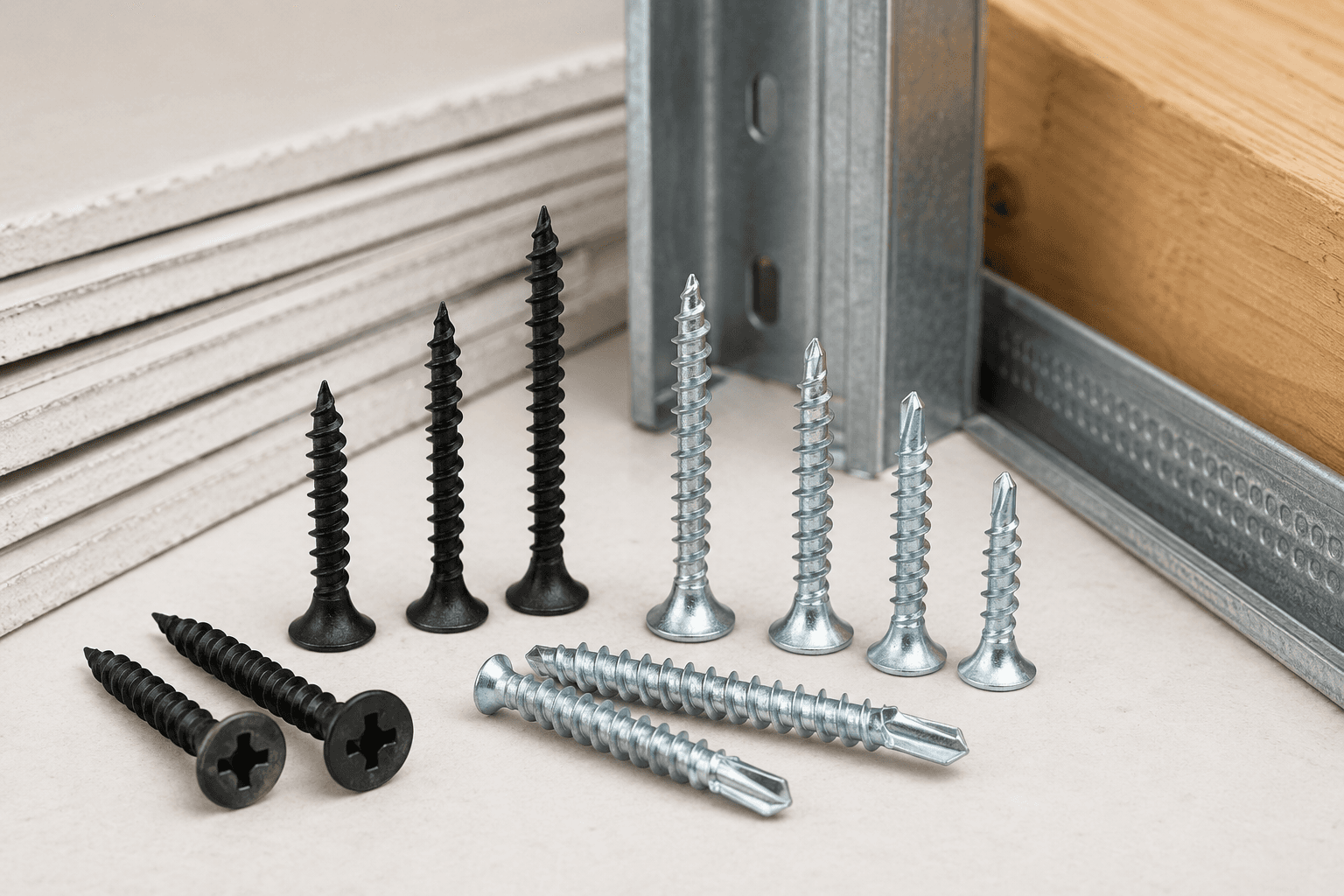
Drywall Screw Sizes Guide: How to Choose the Right Screw Size
Choosing the correct drywall screw size is essential for secure and consistent gypsum-board installation. The screw must be long enough to pass through the board and engage the supporting frame, but additional length does not automatically produce a better connection.
Board thickness, number of layers, framing material, thread type and the requirements of the specified drywall system must all be considered.
This drywall screw sizes guide explains common screw lengths, their potential applications and the information buyers should confirm before ordering drywall screws in bulk.
What Is a Drywall Screw Size?
A drywall screw size normally communicates three important dimensions:
Screw diameter
Screw length
Thread configuration
The stated length is generally measured from the top of the screw head to the tip. However, length alone does not determine whether a drywall screw is suitable.
A correctly selected screw should:
Pass through the gypsum board
Engage the supporting timber or metal frame
Seat its bugle head correctly
Avoid tearing the board’s paper face
Match the framing material and thickness
Meet the requirements of the specified drywall system
Quick Drywall Screw Size Chart
The following table provides a general comparison of commonly available drywall screw lengths.
Nominal screw length | Approximate metric length | General selection consideration |
|---|---|---|
1 inch | 25 mm | Considered for certain single-layer gypsum boards fixed to compatible light-gauge metal framing |
1¼ inches | 32 mm | Commonly considered for standard single-layer drywall applications |
1⅜ inches | 35 mm | May suit outer layers in some multi-layer systems |
1½ inches | 38 mm | Considered for thicker boards or assemblies requiring additional framing engagement |
1⅝ inches | 41 mm | May be selected for thicker single-layer boards or particular framing requirements |
2 inches | 50 mm | May suit certain thick or multi-layer assemblies when approved by the system specification |
This drywall screw size chart is a general reference—not a universal installation specification. Always verify the board manufacturer’s instructions, project requirements and applicable wall or ceiling system before final selection.
How to Select the Correct Drywall Screw Size
1. Check the gypsum-board thickness
The screw must pass through the gypsum board before engaging the supporting frame.
A screw suitable for a thin single-layer board may not provide sufficient engagement when used with a thicker board. Similarly, an unnecessarily long screw may provide no practical benefit and can increase the risk of contacting concealed wiring, pipes or other services.
Begin by confirming the exact board thickness rather than selecting screws only by their familiar trade size.
2. Confirm the number of board layers
Single-layer and multi-layer drywall systems do not necessarily use the same screw length.
In a multi-layer system:
The first layer is fixed directly to the frame.
The outer layer must pass through additional board material.
Different screw lengths may therefore be specified for each layer.
Board joints and fastening patterns may also need to be staggered.
Do not assume that every double-layer drywall system requires one universal screw size. Follow the fastening schedule provided for the specified system.
3. Identify the framing material
Framing material influences both screw length and thread selection.
Screws for timber framing
Coarse-thread drywall screws are generally associated with compatible timber framing. Their wider and deeper threads are designed to engage wood effectively.
Screws for light-gauge metal framing
Fine-thread drywall screws are generally associated with compatible light-gauge metal framing. Their closely spaced threads are designed to engage thin metal more effectively.
The metal thickness must still be checked. A standard sharp-point drywall screw should not automatically be assumed suitable for every steel gauge.
look at our guide: “fine thread vs coarse thread drywall screws”
4. Check the required framing engagement
The selected screw must achieve the framing engagement required by the approved board or wall-system specification.
A longer screw is not automatically stronger. Fastening performance also depends on:
Thread design
Screw diameter
Framing material
Framing thickness
Installation depth
Screw spacing
Edge distance
Condition of the board
Compatibility with the complete assembly
Drywall screws should not automatically be treated as structural fasteners. Use an approved structural fastener wherever the application requires a structural connection.
5. Consider the installation environment
The screw’s surface finish must be compatible with the intended environment.
A zinc or black-zinc finish does not automatically make every drywall screw suitable for exterior, continuously damp or highly corrosive conditions. Confirm the project specification and required corrosion performance before placing an order.
Common Drywall Screw Sizes and Potential Uses
25 mm drywall screws
A 25 mm or approximately 1-inch drywall screw may be considered for certain single-layer boards installed over compatible light-gauge metal framing.
Suitability depends on:
Board thickness
Metal profile thickness
Required frame engagement
Tested system specification
It should not be described as suitable for every light-duty drywall application.
32 mm drywall screws
A 32 mm or approximately 1¼-inch drywall screw is commonly considered for standard single-layer gypsum-board installation.
However, the correct thread type must still be selected according to whether the board is being installed over compatible timber or light-gauge metal framing.
35–38 mm drywall screws
Drywall screws between approximately 35 mm and 38 mm may be considered for:
Thicker gypsum boards
Outer layers in certain multi-layer assemblies
Applications requiring greater framing engagement
System-specific wall or ceiling installations
The total board thickness and specified fastening schedule must be checked before use.
41 mm drywall screws
A 41 mm or approximately 1⅝-inch screw may be considered where additional length is required for a thicker board or a particular framing configuration.
It should not be selected merely because it is longer. Excessive length does not compensate for an incorrect thread, point, diameter or installation method.
50 mm drywall screws
A 50 mm or approximately 2-inch drywall screw may be appropriate for certain thick or multi-layer assemblies.
Before using a screw of this length, confirm:
Total board thickness
Location of concealed services
Required framing penetration
Framing material and thickness
Manufacturer or system instructions
Why Correct Screw Size Improves Installation Reliability
Selecting a suitable drywall screw size can help improve:
Consistent board attachment
Adequate framing engagement helps hold the gypsum board securely against the supporting frame.
Correct screw-head seating
The bugle head should sit slightly below the board surface without tearing the paper face or crushing the gypsum core.
Installation efficiency
Using the correct size and thread type reduces unnecessary driving time and lowers the risk of stripped engagement or installation difficulty.
Reduced material damage
A correctly selected and properly driven screw reduces the likelihood of torn paper, broken board edges and overdriven heads.
More consistent bulk procurement
For contractors, distributors and procurement teams, clearly defined dimensions help maintain consistency between batches, packaging and project deliveries.
Common Drywall Screw Selection Mistakes
Avoid these common errors:
Selecting screws solely by length
Using the same thread for timber and metal framing
Assuming longer screws are always stronger
Ignoring the thickness of metal framing
Using a single screw length for every layer
Overdriving the bugle head
Breaking the board’s paper surface
Using drywall screws as structural fasteners
Assuming a coating makes the screw suitable for all environments
Ordering in bulk without confirming specifications
Information to Provide When Ordering Drywall Screws in Bulk
Before requesting a quotation from a drywall screw manufacturer or supplier, prepare the following information:
Required screw diameter
Required screw length
Fine or coarse thread
Board type and thickness
Number of board layers
Timber or metal framing
Metal-frame thickness, if applicable
Required surface finish
Required quantity
Packaging preference
Delivery destination
Applicable technical or project specification
Providing these details helps the manufacturer understand the requirement and prepare a more accurate quotation.
Why Dimensional Consistency Matters for Bulk Buyers
A bulk order must deliver more than the correct nominal size. Consistency across the complete batch is also important.
Buyers should evaluate:
Length tolerance
Diameter consistency
Thread pitch and depth
Head dimensions
Drive-recess formation
Point sharpness
Surface-finish uniformity
Packaging and batch identification
Variations in these characteristics can affect driving behaviour, frame engagement and installation consistency.
Working with an established drywall screw manufacturer in India can help distributors, contractors and procurement teams obtain clearly specified dimensions and repeatable bulk supply. Buyers should nevertheless verify all technical claims, samples and documentation before confirming an order.
Drywall Screw Size FAQs
What is the most common drywall screw size?
There is no single drywall screw size suitable for every installation. Screws of approximately 25–32 mm are commonly considered for certain single-layer applications, but the correct selection depends on board thickness, framing material and system requirements.
What size drywall screw should be used for a 12.5 mm gypsum board?
A 25 mm or 32 mm screw may be considered in some systems, depending on the framing material and required engagement. The board manufacturer’s system specification should determine the final selection.
Can 25 mm drywall screws be used for every gypsum board?
No. A 25 mm screw may be suitable for some single-layer installations but may be too short for thicker or multi-layer assemblies.
What size screw is required for double-layer drywall?
There is no universal answer. Multi-layer systems may specify one length for the inner layer and a longer screw for the outer layer. Check the tested system’s fastening schedule.
Are fine-thread screws used for metal framing?
Fine-thread drywall screws are generally used with compatible light-gauge metal framing. The metal thickness and approved screw type must be confirmed.
Are coarse-thread screws used for timber framing?
Coarse-thread drywall screws are generally selected for compatible timber framing because their deeper threads engage wood effectively.
Are longer drywall screws stronger?
Not necessarily. Length is only one factor. Thread type, diameter, framing engagement, material compatibility and correct installation also affect fastening reliability.
How deep should a drywall screw be driven?
The bugle head should be seated slightly below the board surface without tearing the paper face or damaging the gypsum core. Installation depth should follow the board-system guidance.
Choose Drywall Screw Sizes According to the Complete System
The correct drywall screw size cannot be selected from a length chart alone. Board thickness, number of layers, framing material, framing thickness, required engagement and installation conditions must all be considered.
A reliable drywall screw sizes guide is a useful starting point, but the final decision should follow the relevant project and gypsum-board system specifications.
Source Zinc and Black-Zinc Drywall Screws from Screwbee
Screwbee manufactures zinc and black-zinc drywall screws for distributors, contractors and bulk procurement requirements.
Share your required dimensions, thread type, framing material, order quantity and packaging preference with our team to discuss available manufacturing and supply options.
🟨 Request Bulk Quote
📘 Download Product Catalogue
📞 Contact Our Sales Team
Related Products
Zinc Drywall Screws — Explore available sizes and thread options.
Black Zinc Drywall Screws — Discover Screwbee’s dark zinc-finished product range.
Drywall/Gypsum Screws — Learn about available specifications for gypsum-board fixing.