📦 Request Quote
📞 Connect with us
A detailed guide on how contractors choose drywall screws based on material, coating, thread type, and project conditions for long-term durability.
A practical guide for contractors and builders on selecting the right drywall screws based on material, coating, and application to ensure long-term durability and installation q
Introduction:
In modern construction, interior wall systems are expected to deliver more than just separation between spaces. They must provide durability, fire resistance compatibility, vibration stability, and long-term structural consistency. While most attention is given to boards, framing, and finishing materials, one small component often determines the actual performance of the entire system — the drywall screw.
A poorly selected screw can lead to surface cracks, board loosening, or premature structural failure. On the other hand, a well-matched fastening solution ensures stability for years without maintenance issues.
This is why professional contractors, procurement teams, and engineers now evaluate fastening systems with the same seriousness as structural materials.
Understanding the Role of Drywall Screws in Construction
Drywall screws are specifically designed to fix gypsum boards on to metal or wooden framing systems. Unlike general-purpose fasteners, they are engineered with controlled thread geometry, high tensile strength, and surface coatings that improve grip and resistance to environmental stress.
A key reason they perform better is because they are optimized for repetitive installation under high-volume construction conditions. In commercial projects like offices, malls, and apartments, thousands of screws are installed daily. Even a small performance issue can multiply into large-scale defects.
This is why sourcing from a reliable drywall screws manufacturer becomes critical for project success.
Choosing Between Metal and Wood Applications
One of the most overlooked decisions in fastening selection is matching screw type to framing material.
Metal framing systems require screws designed with sharper and more precise threading. These are typically fine-thread variants that can penetrate steel studs without damaging structural alignment. If the thread is too coarse, it may strip the metal surface and reduce holding strength.
Wood framing, on the other hand, requires deeper grip penetration. Coarse-thread designs perform better here because wood fibers allow stronger mechanical locking. Using fine-thread screws in wood can result in reduced stability over time.
Contractors who understand this difference significantly reduce installation failures and long-term repair costs.
Surface Coating: The Hidden Factor Behind Durability
Many construction professionals underestimate the importance of surface coating. However, this is one of the most important factors affecting long-term screw performance.
In humid environments, untreated steel fasteners are highly vulnerable to corrosion. Over time, rust spreads from the screw head into surrounding drywall material, weakening the joint.
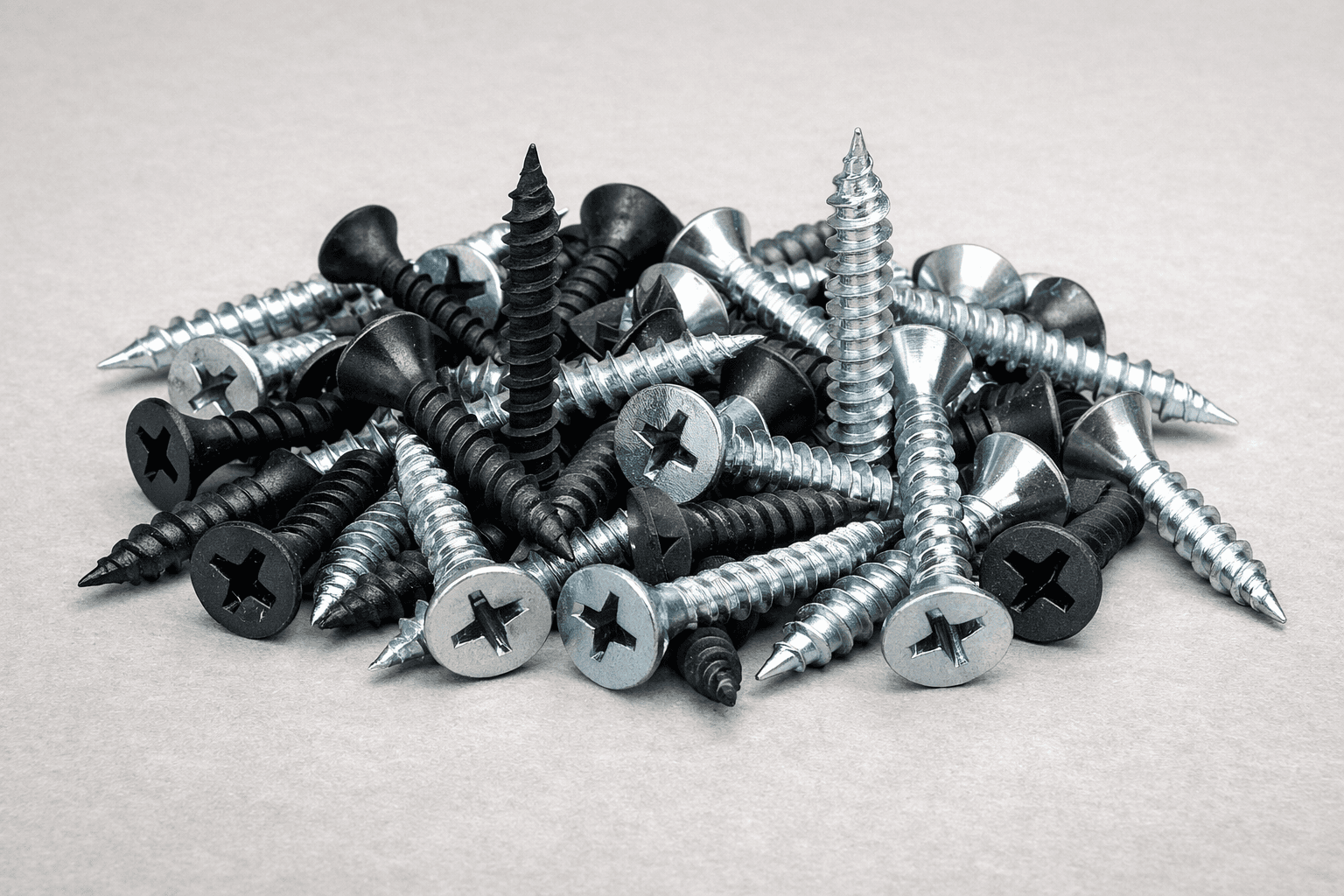
This is why coated variants such as black phosphate and wall screwzinc-based screws are widely used in professional construction.
Coating selection is not just about corrosion resistance — it also influences driving smoothness, friction control, and installation speed.
A technically strong drywall screws supplier ensures that coating consistency is maintained across batches, which is critical for large-scale infrastructure projects.
The Importance of Manufacturing Consistency
One of the biggest challenges in construction procurement is variation between batches of fasteners. Even minor differences in thread depth, hardness, or head design can lead to inconsistent installation results.
High-quality manufacturers control this through automated production systems, heat treatment processes, and strict quality inspection protocols.
Consistency ensures that contractors do not need to adjust installation techniques from one batch to another, which improves productivity and reduces labor fatigue.
This is especially important in bulk construction projects where downtime or rework can significantly increase costs.
Common Problems Caused by Poor-Quality Screws
Construction defects are often blamed on labor or design, but fastening failure is a hidden contributor.
Some common issues include:
Screw head breakage during installation
Thread stripping in metal studs
Surface rust bleeding through paint
Drywall panel loosening over time
Uneven wall finish due to inconsistent screw depth
These problems usually occur when low-grade materials are used or when procurement is focused only on price instead of performance.
Professional builders avoid this by working with established drywall screws wholesale suppliers who prioritize quality control over cost competition.
Global Construction Trends and Fastening Demand
The construction industry has shifted toward faster, lighter, and more modular building systems. Steel framing, prefabricated walls, and dry construction methods are now widely adopted across residential and commercial sectors.
This shift has increased demand for high-performance fastening systems that can support rapid installation without compromising durability.
In international markets, buyers now evaluate fastening suppliers based on:
Technical specifications
Manufacturing transparency
Export capability
Performance consistency
Long-term supply stability
Countries like India have become strong manufacturing hubs due to scalable production systems and competitive engineering capabilities. This has strengthened the role of the drywall screws exporter ecosystem in global supply chains.
How Professionals Evaluate Screw Quality Before Purchase
Experienced procurement teams do not rely only on product descriptions. Instead, they evaluate physical and technical attributes such as:
Torque resistance
Thread sharpness
Head strength under load
Coating uniformity
Packaging quality for bulk transport
Some even conduct field testing before approving large orders for commercial projects.
This evaluation process ensures that only reliable fastening systems are used in structural installations.
The Future of Drywall Fastening Systems
As construction moves toward higher efficiency and sustainability, fastening systems are also evolving. Manufacturers are focusing on:
Improved corrosion resistance
Faster installation designs
Reduced material waste
Higher tensile strength with lighter materials
These improvements are helping contractors complete projects faster while maintaining structural integrity.
The demand for reliable fastening solutions will continue growing as urban infrastructure expands globally.
Conclusion
Drywall screws may appear to be a small component in construction, but their impact on structural performance is significant. From material selection to coating quality and manufacturing consistency, every detail influences the final outcome of a project.
Contractors and procurement teams who prioritize technical evaluation over cost-only decisions consistently achieve better long-term results.
In modern construction, reliability is not optional — it is a requirement.