📦 Request Quote
📞 Connect with us
Can chipboard screws be used in wood? Learn where they work, when to use a pilot hole, and how screw size, edge distance and wood type affect fixing.
A simple guide to using Chipboard Screws in wood, plywood and furniture applications, including pilot holes, screw size and edge distance.
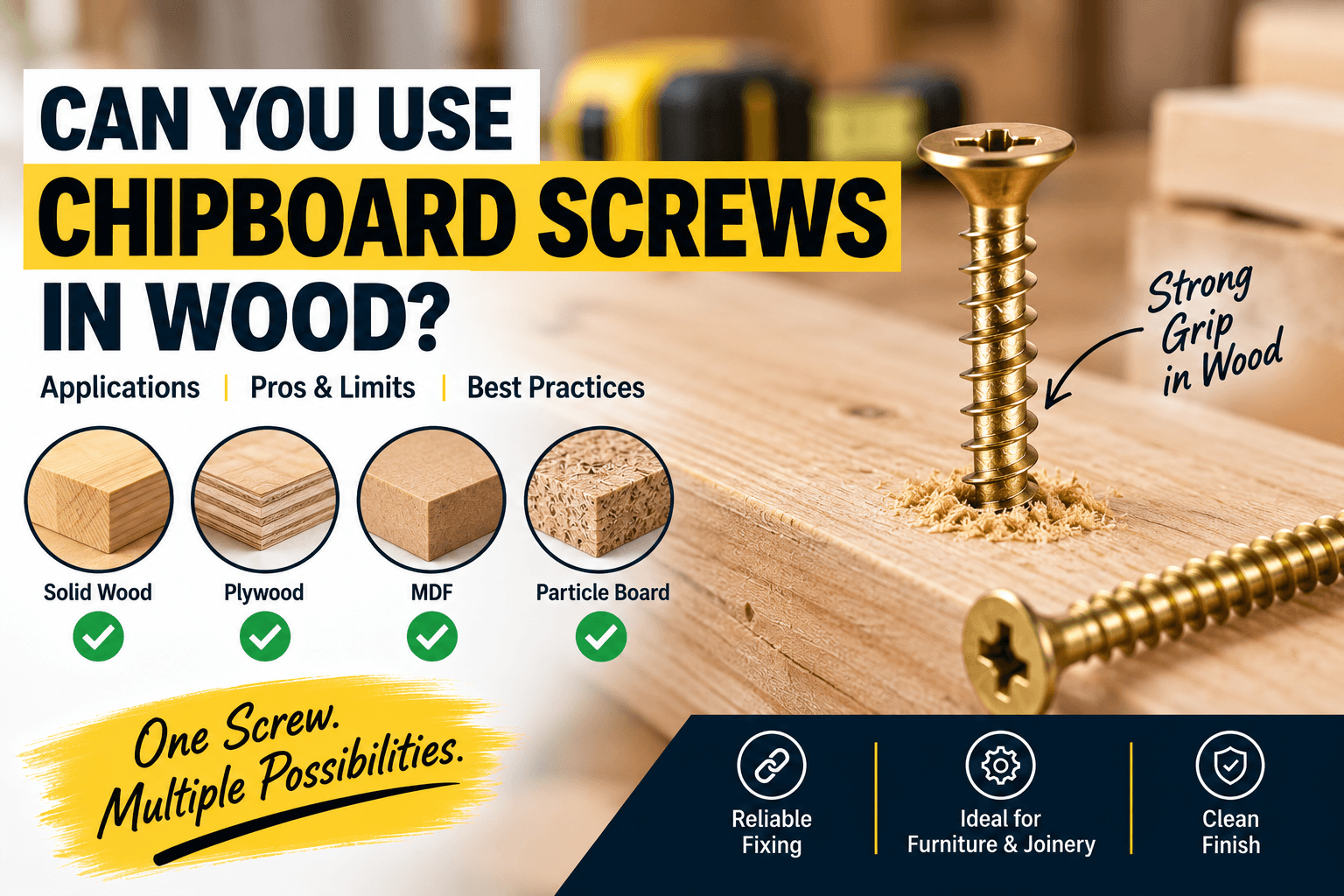
Can You Use Chipboard Screws in Wood?
Yes, Chipboard Screws can be used in many compatible wood applications, but the final choice depends on the wood type, screw size, joint design and installation method.
Chipboard Screws are designed mainly for wood-based materials such as:
They can also work in suitable wood applications because of their sharp point and deep coarse thread.
Why Chipboard Screws Can Work in Wood
Chipboard Screws have a thread profile designed to grip wood-based materials effectively.
Their common features include:
The sharp point helps the screw start, while the coarse thread helps it engage with the material.
Are Chipboard Screws Suitable for Solid Wood?
They can be suitable for compatible solid-wood applications.
Before using them, check:
Wood hardness
Board or timber thickness
Screw diameter
Screw length
Edge distance
Joint design
Harder wood may require more careful installation or a pilot hole.
Can Chipboard Screws Be Used in Plywood?
Yes, they are commonly used in compatible plywood applications.
Plywood has layered construction, so correct screw placement is important.
Use the correct:
Screw length
Diameter
Edge distance
Tightening torque
Avoid placing screws too close to the plywood edge.
Should You Drill a Pilot Hole?
A pilot hole may be useful, especially when:
Using larger screws
Working near an edge
Using harder wood
Reducing splitting risk
Improving alignment
The pilot hole should not be so large that the threads lose grip.
What About the Countersunk Head?
Chipboard Screws use a flat countersunk head.
This allows the head to sit more neatly into the wood surface when installed correctly.
It can be useful for:
Do not over-drive the head, as this can damage the material.
When Should You Use Another Screw Type?
A Chipboard Screw may not be the best option for every wood project.
Choose another fastener if the application requires:
A different head style
Higher structural requirements
Outdoor corrosion performance beyond the screw specification
Frequent disassembly
A project-specific fastener standard
The screw should always match the actual job.
Frequently Asked Questions
Can I use chipboard screws in wood?
Yes. Chipboard Screws can be used in many compatible wood applications when the screw size and installation method are suitable.
Are chipboard screws good for plywood?
Yes. They are commonly used for compatible plywood, furniture and joinery applications.
Do chipboard screws need a pilot hole in wood?
Not always, but a pilot hole may help with harder wood, larger screws or fixing close to an edge.
Can chipboard screws split wood?
Yes, if the screw is too large, too close to an edge, driven at an angle or over-tightened.
Are chipboard screws only for chipboard?
No. They can also be used in compatible MDF, particle board, plywood and selected wood applications.
Final Answer
Yes, you can use Chipboard Screws in wood for many compatible applications.
For better results, check:
Wood type → screw diameter → screw length → edge distance → pilot hole → tightening torque
The correct screw and installation method are more important than the product name alone.